 By Tarang Bansal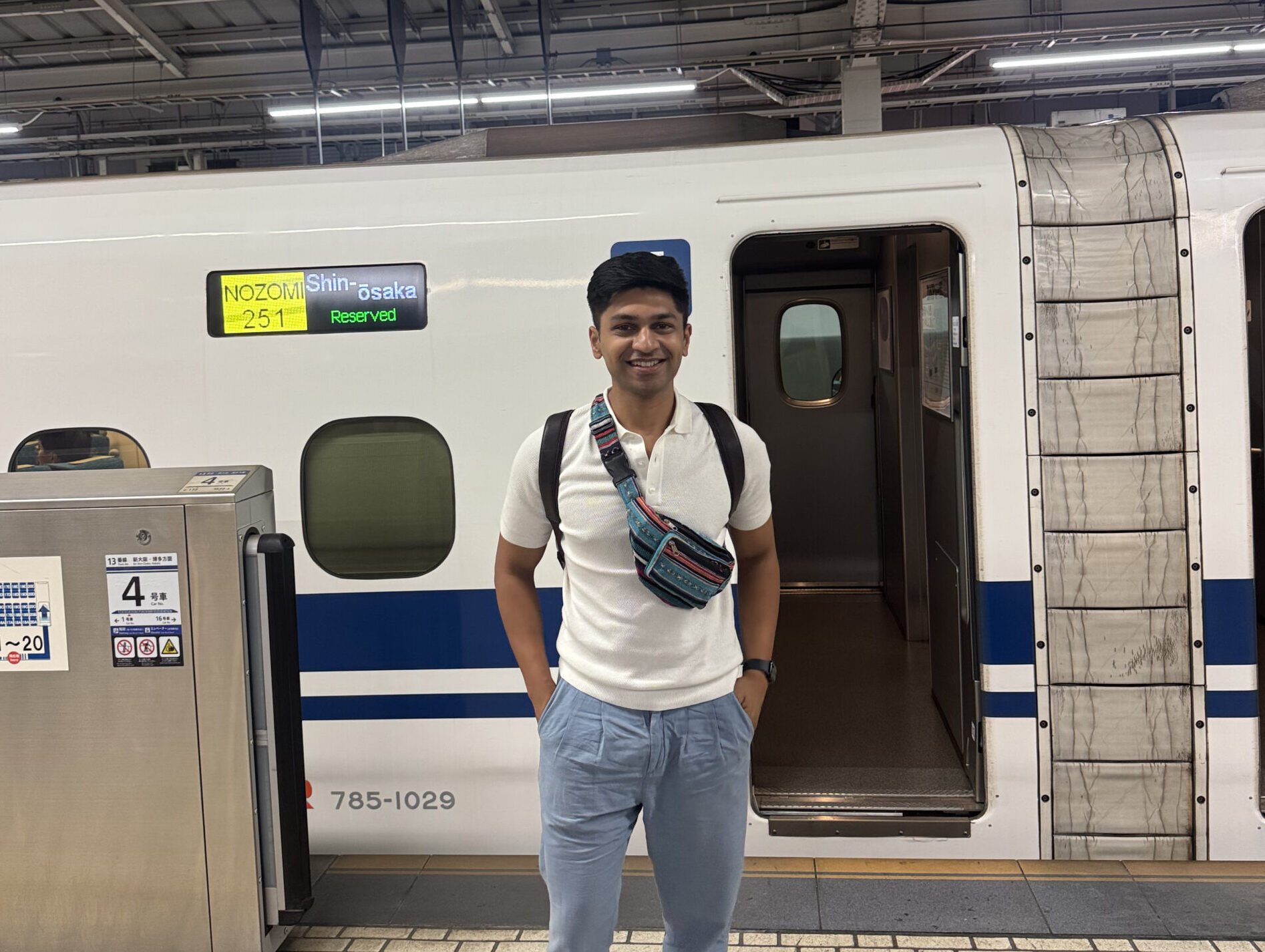

Once you sit down, the Shinkansen feels like any other train, until you stand up and realise you are moving at 285 km/h in your first Japan Bullet Train Experience.
A first-time rider’s full account of the Tokyo to Kyoto Shinkansen experience- boarding precision, seat-rotation magic, separate toilets and urinals, Work business cars, luggage rules, and why it doesn’t feel like 285 km/h until you stand up. Cost, duration, tips, and what to expect.
I want to start with the most counter-intuitive thing about Japan’s bullet train, the one that nobody warns you about:
Once you sit down, the Shinkansen feels like any other train.
It’s smooth. Quiet. Stable. There’s no stomach-dropping acceleration, no rocking, no rattling. You forget you’re moving at over 280 km/h until you stand up to walk to the bathroom, and suddenly you realize the entire cabin is moving at the speed of a small aircraft, and the world outside the window is a horizontal blur of green fields and cities passing in seconds.
That contrast, boring while seated, surreal when you stand, is the most Japanese thing about the Shinkansen. The country’s quiet superpower is making impossibly advanced engineering feel like the default state of the world.
This is the full account of my first Shinkansen ride: Tokyo to Kyoto on Day 5 of my Japan trip. Everything that happened, everything to expect, and why this 2-hour, ₹9,200 train ride is one of the experiences you should not skip in Japan.
If you want the full Japan trip context, read my main 10-day Japan blog here. This post is a focused deep-dive into the Shinkansen experience itself.
The Shinkansen Tokyo to Kyoto: Quick Stats
For anyone who just wants the numbers before the storytelling:
- Route: Tokyo Station to Kyoto Station, on the Tokaido Shinkansen line
- Distance: ~514 km
- Journey time: Around 2 hours 15 minutes (Nozomi service, the fastest)
- Top speed: 285 km/h (Tokaido line); newer N700S train sets cruise comfortably at this speed
- Frequency: Every 5–10 minutes during peak hours
- One-way ticket cost: Around ₹9,200 (¥14,000–¥15,000 unreserved/reserved seat)
- First train: Around 6:00 AM
- Last train: Around 9:30 PM
For comparison: a flight Tokyo to Osaka takes 70 minutes in the air, but with airport-to-airport transit, security, boarding, and luggage, the door-to-door time is essentially identical to the Shinkansen- except the Shinkansen drops you in central Kyoto, not at a far-out airport.
Booking the Ticket: Skip the Middlemen
You can book Shinkansen tickets in three ways:
1. The official Smart EX or EX-IC app– Best for repeat travellers, requires registration. 2. JR ticket counters at any major station– Reliable, English support available, no app needed. 3. Vending machines at Shinkansen stations– English language option, takes 3 minutes.
We pre-booked through option 1, paying around ₹9,200 per person for one-way Tokyo to Kyoto, second class (called “Ordinary” or 普通車).
A common Indian-traveler mistake: assuming the JR Pass is the obvious cheaper option for Shinkansen travel. After the late 2023 price hike, the JR Pass for 7 days now costs around ₹30,000+. For a Tokyo-Kyoto-Osaka loop, individual tickets total ₹15,000-17,000, which works out cheaper. Calculate before buying.
👉 [INSERT AFFILIATE LINK: Shinkansen tickets via Klook / Japan Rail Pass calculator]
The Platform: Where Japanese Precision Becomes Visible
Tokyo Station has 14 Shinkansen platforms. Finding yours is straightforward- large boards in English show train numbers, departure times, and platform numbers, with announcements in clear English alongside Japanese.
Once you’re on the platform, the precision begins.
The platform floor is marked with queuing zones– small numbers and arrows painted on the ground showing exactly where each train car (1, 2, 3…16) will stop, and where the doors of that car will open. You don’t queue randomly. You find the marker for your car number (printed on your ticket), stand inside that small square, and wait.
Within 10 minutes of departure, neat lines form behind every door marker. People stand in single file, polite and silent. There’s no shoving, no edge-cutting, no last-minute scrambling. The Indian railway scene this is not.
When the previous Shinkansen pulls in, this is what happens, and the timing of this is the part that breaks most foreigners’ brains:
- Train arrives, doors open.
- All exiting passengers disembark in under 60 seconds. They’re prepared. They’ve been moving toward the doors as the train slowed down.
- Cleaning crew enters in pink-or-blue uniforms. They have exactly 7 minutes to clean a 1,000-seat train.
- Each cleaner handles one section. Trash bags filled, tray tables wiped, seat covers checked, bathroom cleaned, floor swept.
- Then comes the seat-rotation magic. Every single seat is mechanically (or manually) rotated 180 degrees so all seats now face forward in the direction of travel. This prevents motion sickness for the next group of passengers.
- Cleaning team exits, bows in unison toward the train, and disperses. All within those 7 minutes.
- Doors close. Train moves to a holding area. New train pulls in for boarding.
- Doors open. You board.
You have roughly 2 minutes to board before the doors close again. That’s it. No second whistle, no “please hurry” announcement. The clock runs, and the train leaves on the dot.
By Day 5 of my Japan trip I’d seen many examples of Japanese precision, but the platform sequence still felt like watching a Formula 1 pit crew at work, every move trained, no wasted motion, total predictability.
Stepping Inside: The Cabin
The Shinkansen interior looks like a wide-body airplane minus the cramped feeling.
The layout (Ordinary class): 5-abreast seating (3+2), wider than economy flights. Reclining seats with footrests, individual reading lights, and tray tables. Power outlets at every seat (AC and USB on newer N700S trainsets). Free Wi-Fi (announced via a sticker on the window).
The vibe: Clean. Quiet. Almost antiseptic. People speak in hushed tones if they speak at all. Many close their eyes and nap. Many open laptops and work. Children sit with parents, not running around. There’s a cultural understanding that the Shinkansen is shared space and you don’t impose on it.
The luggage rack above the seats is bigger than what you’d expect- surprisingly, it fits even the biggest-size suitcases comfortably. We had 5 of us with mid-to-large bags, and every bag went up there with room to spare. Behind the last row of seats in each car, there’s an additional space for oversized luggage- useful for the giant 32-inch suitcases that Indians often carry on long international trips.
Important: There’s also a luggage reservation requirement for oversized bags (over 160 cm length+width+height). If your suitcase exceeds this, you need to pre-reserve a special “Oversized Baggage” seat. Skip this and you risk a fine, plus the awkwardness of staff asking about your bag mid-journey. For most Indian travellers, standard suitcases (24″–28″) fit fine without reservation. Only the giant ones need the special booking.
Why is there so much luggage space? Because most Shinkansen passengers travel without luggage. This is a daily commuter route for office workers and family visitors. Most people are on day trips with a small backpack at most. Tourists like us are the exception, not the rule. The system is built for the average rider, which means tourists get more luggage room than expected.
The Toilet Configuration: Yes, Separate Urinals and Toilets
This was the small detail that made me grin.
Each Shinkansen car has multiple bathroom-area cubicles, but they aren’t all the same. There are typically:
- Western-style enclosed toilets with full Washlet functionality- heated seats, jet wash, multiple settings, deodorizer
- Separate urinal cubicles for men- smaller, just-a-urinal stalls for quick visits
- Multi-purpose rooms (large accessible bathrooms with diaper-changing tables, lockable, primarily for wheelchair users and parents with infants)
- Hand-washing stations in the deck area between toilets
The reason for separate urinals: flow management. A man can use a urinal in 30 seconds. The full toilet stall takes 3-5 minutes. By separating these, the Shinkansen handles its 1,000+ passengers’ bathroom traffic without queues building up- a quietly genius public infrastructure decision.
These toilets are spotless. Refilled with paper. Functional Washlets. Air-conditioned. Better than most Indian hotel bathrooms.
The Workstation Cars (S Work)- Yes, This Is Real
You weren’t imagining it- Shinkansen trains do have dedicated workstation cars.
On Tokaido Shinkansen Nozomi services (Tokyo–Kyoto–Osaka), Car 7 is designated as the “S Work” zone on N700S trainsets- a quieter compartment specifically designed for business travellers. Passengers using this car accept that quiet keyboard typing, soft phone calls, and Zoom meetings are normal background sounds. Laptop support cushions, privacy screens, and rental USB chargers are available.
There’s also the new S Wi-Fi for Biz in Car 7 and the Green (first class) car- encrypted, faster Wi-Fi for working professionals who need real bandwidth.
For premium travellers, JR Central is gradually rolling out business booths– semi-private compartments on N700S trains with lockable doors, dedicated Wi-Fi, reclining seats with leg rests, and individual climate controls. Two private rooms per N700S trainset are being introduced from 2026 onward, alongside six semi-private booth seats in Car 10 being added in 2027.
The takeaway: yes, you can absolutely take a video meeting on the Shinkansen, work uninterrupted for 2 hours, and arrive in Kyoto having finished a workday. Japanese trains aren’t just transport- they’re rolling offices for the country’s business class.
The Quiet Magic of the Ride Itself – Japan Bullet Train Experience
The actual journey is the part most descriptions struggle to capture. Let me try.
Departure: The train pulls out of Tokyo Station almost imperceptibly. There’s no jerk, no rumble. You realize you’re moving only when you glance at the platform sliding past the window.
The first 15 minutes: The train works through the Tokyo metropolitan area, which means stops at Shinagawa and Shin-Yokohama. Speed picks up gradually. You watch Tokyo’s high-rises give way to suburbs, then to outer-ring cities.
The middle hour: Past Yokohama, the train hits its full pace. Mt. Fuji appears on the right side around 45-50 minutes in if the weather is clear (sit on the right side facing the direction of travel for the best view). The cabin is silent. Some people watch movies on phones. Some sleep. Some open laptops. Vending carts pass through occasionally with bento boxes, drinks, snacks.
The blur outside: This is when you notice you’re moving fast. Paddy fields don’t roll past- they flicker. A small town appears and disappears in three seconds. A river bridge whooshes underneath in less time than you can fully register it.
The arrival: Around the 2-hour mark, the train slows for Kyoto Station’s approach. There’s no announcement scramble- the clear bilingual displays show stops well in advance. You stand up, gather your bag, and within 60 seconds of stopping, you’re on the Kyoto platform.
The Onboard Vending Cart and Bento Culture
A small detail that delights every first-timer: the food cart.
Every 20-30 minutes, a uniformed staff member pushes a vending cart down the aisle with bento boxes, drinks, snacks, ice cream, beer, sake, and coffee. They bow when they reach your row, ask politely if you’d like anything, take payment in cash or by IC card, and bow again before moving on.
For vegetarians, the bento options are limited but findable- vegetable sushi rolls, some pickle sets, fruit cups, sandwiches. Or, alternatively, buy your bento from any konbini at the station before boarding– much wider variety, fresher, and significantly cheaper.
The legendary Japanese eki-ben (station-bought bento boxes) is a whole subculture. Tokyo Station alone has dozens of bento varieties from regional Japanese cuisines, designed to be eaten on long Shinkansen journeys. Even if you skip the food, walk the bento section before boarding just to see the artistry.
What Doesn’t Work About the Shinkansen
Let me balance the praise with a few honest critiques:
1. The fare is steep. ₹9,200 for a 2-hour journey is genuinely expensive by Indian standards. Compare to a 2-hour AC chair car on Shatabdi: ~₹1,500. The Shinkansen costs 5-6x more. Worth it for the experience and the time saved, but not casual money.
2. Reserved seats only- almost. There are unreserved cars (slightly cheaper, no guaranteed seat), but during peak hours and weekends these fill up immediately. Most travellers reserve, which adds to the cost.
3. Limited luggage space for groups with oversized bags. If you’re 4-5 Indians on a long international trip with all 32-inch suitcases, you need to pre-reserve oversized luggage seats. Otherwise you can hit issues.
4. Food on the train is overpriced. A bento box on the cart is ¥1,200-1,500. The same bento at a Tokyo Station kiosk is ¥800-1,000. Buy before boarding.
5. Wi-Fi quality varies. Improved on N700S trainsets, especially in S Work and Green cars, but the standard Wi-Fi can be spotty in tunnels and remote areas. Don’t plan critical Zoom meetings without a backup plan.
Tips That Will Improve Your First Shinkansen Experience
A few things I learned the hard way:
1. Reserve seats on the right side facing direction of travel for the Mt. Fuji view. Approximately 45 minutes into the Tokyo-Kyoto journey, on a clear day, Mt. Fuji is visible to the right (south-facing) windows.
2. Buy a bento at Tokyo Station before boarding. The selection is incredible, prices are better than onboard, and eating one on the Shinkansen is its own travel experience.
3. Carry yen for the food cart. While many things in Japan accept IC cards, the onboard food cart sometimes prefers cash.
4. If you have oversized luggage, reserve the Oversized Baggage seat in advance. Bags over 160 cm total dimensions need this.
5. Arrive at the platform 10-15 minutes early. Find your car number’s queuing zone, stand in line. Don’t be the foreigner running for the train- it stresses everyone else out, and the train leaves precisely on time anyway.
6. The bathroom on the Shinkansen is worth visiting. Even if you don’t need to go. The Washlet experience at 285 km/h is novel.
7. Keep your ticket until you exit. You’ll need it to tap out at Kyoto Station’s gates. Lose it, and you’ll have a slow conversation with a station officer.
Frequently Asked Questions: The Shinkansen Experience
Q: How fast does the Shinkansen actually go? The Tokaido Shinkansen Nozomi services run at 285 km/h. Newer Tohoku Shinkansen lines (toward Aomori) reach 320 km/h. The trains can technically go faster but are limited for safety and ride quality reasons.
Q: How much is a Shinkansen ticket from Tokyo to Kyoto? Around ¥14,000–¥15,000 one-way (₹8,500–₹9,200) for an Ordinary Class reserved seat. Green Car (first class) is roughly 30-40% more.
Q: Is the JR Pass worth it for the Shinkansen? After the late 2023 price hike, often no. Calculate your route: if you’re doing Tokyo-Kyoto-Osaka and back, individual tickets usually beat the 7-day JR Pass.
Q: Can I bring my regular Indian suitcase on the Shinkansen? Yes, easily. Standard suitcases (up to 28 inches) fit in overhead racks or behind-seat space. Only oversized bags (above 160 cm length+width+height total) require a special reservation.
Q: Does the Shinkansen have toilets? Yes, multiple per car, including Western-style toilets with Washlets, separate urinals for men, and accessible multi-purpose rooms. All spotless and free.
Q: Can I work on the Shinkansen? Yes, very productively. Standard cars have Wi-Fi and power outlets at every seat. Tokaido Shinkansen Nozomi services have dedicated S Work cars (Car 7) for business travelers. Premium business booths are being rolled out from 2026.
Q: Does the Shinkansen accept IC cards? Not for boarding tickets- Shinkansen tickets are separate. But onboard purchases (food cart, drinks) often accept Suica/Pasmo/ICOCA.
Q: How early should I arrive at the Shinkansen platform? 10-15 minutes before departure is sufficient. Find your car’s queuing zone, stand in line. The train leaves precisely on time.
Q: Is the Shinkansen really always on time? Yes. The average annual delay across the entire Shinkansen network is under 1 minute. If your train shows even a 30-second delay, the conductor announces it apologetically.
Final Word
The Shinkansen is one of those experiences that travel writers struggle to do justice to because the magic is in the boring parts.
The boring smoothness of 285 km/h. The boring 2-minute boarding window that just works. The boring efficiency of the cleaning crew in 7 minutes. The boring punctuality of every single train, every single day.
It’s only when you place this against your memory of Indian Railways- Tatkal-booking marathons, station chaos, 4-hour delays as standard, broken AC, food poisoning roulette- that you realize how thoroughly the Japanese have solved a problem India is still actively suffering through.
If you’re going to Japan, the Shinkansen is non-negotiable. Don’t skip it for budget reasons. Don’t take a budget bus to Kyoto. Pay the ₹9,200, ride the bullet train, and notice when you stand up that you’ve been moving at small-aircraft speed without realizing it.
That’s the moment you understand Japan.
For the full Japan trip experience, read my main blog here.
Drop a comment if you’ve ridden the Shinkansen, or if you’re planning to. And tag the friend you’d take on a Tokyo-Kyoto Shinkansen run for the Mt. Fuji window seat.