 By Tarang Bansal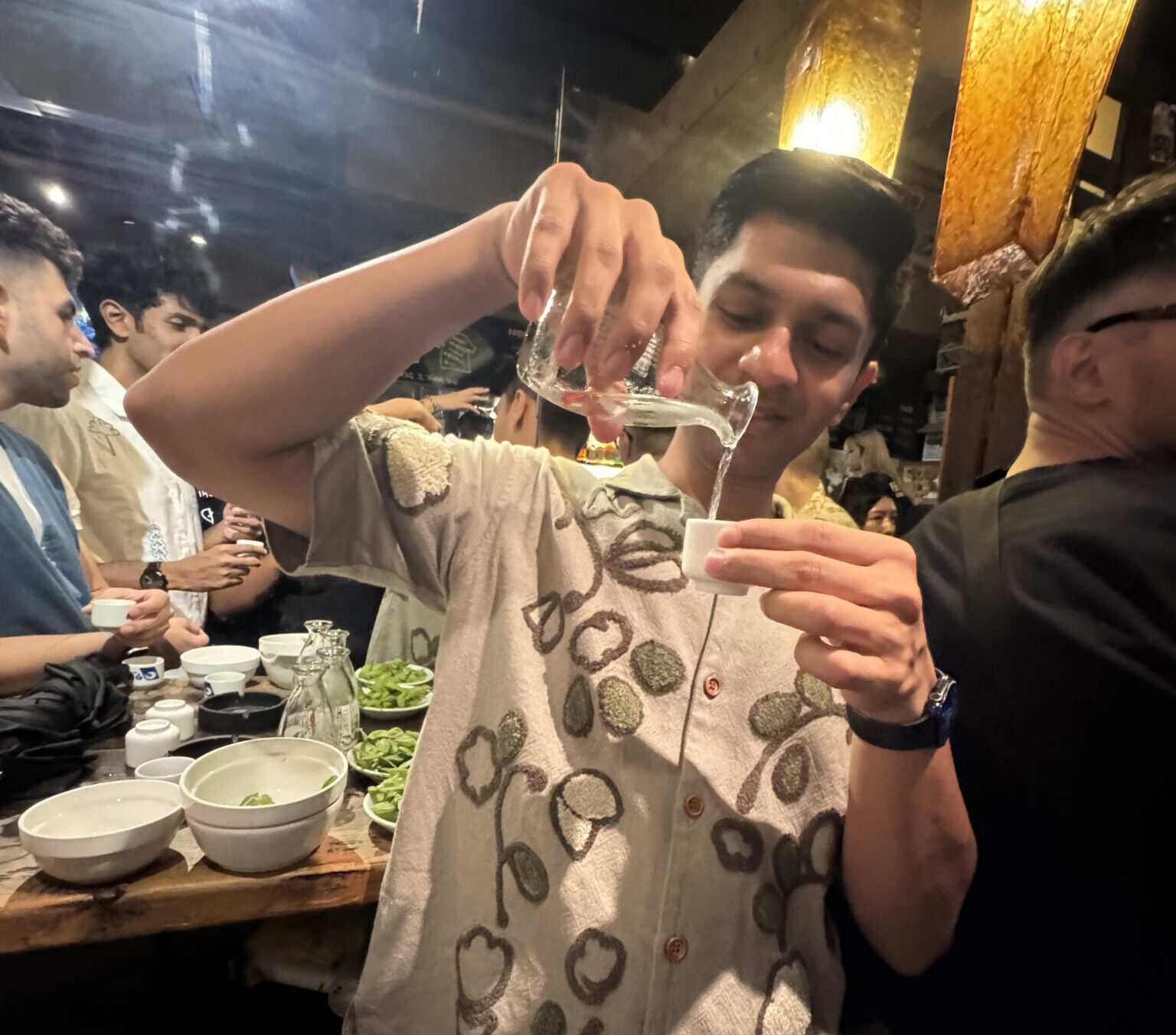
This sake guide for tourists starts where I did, walking into a Shibuya bar assuming sake would burn like vodka. It doesn’t.
I walked into a small sake bar in Shibuya on Day 2 of our Tokyo trip with a very specific assumption: sake is strong, like vodka, and I should be careful.
The bartender poured me a small ceramic cup- a ochoko– of clear liquid. It looked exactly like vodka. I sniffed it cautiously. It smelled it but I guess I was already somewhat drunk to smell anything. I took a sip prepared for the throat-burn.
Nothing.
It tasted like a slightly dry, lightly fragrant white wine. Smoother than wine, actually. Cleaner. With a subtle sweetness in the aftertaste. By the time I’d put the cup down, I’d already realized something important: everything I had imagined Sake would be, was wrong.
This post is two things in one. First, a beginner’s guide to sake, written from the perspective of someone who walked into the experience expecting one thing and got something completely different. Second, a quick tour of the rest of Japan’s alcohol landscape- shochu, awamori, Japanese whisky, umeshu, beer, chuhai, yuzushu- most of which Indians have never heard of, and many of which are objectively superior to what we drink at home.
If you want the full Japan trip context, read my main 10-day Japan blog here.
The Misconception That Needs to Die
Most Indians (and most non-Asians generally) assume sake is a hard liquor. Clear color + Japanese origin + comes in tiny cups = obviously a spirit, like vodka or shochu, sitting at 40% ABV.
This is wrong on the most basic level.
Sake is brewed, not distilled. It’s made from rice, water, koji mold, and yeast- fermented like beer or wine, not distilled like vodka or whisky. Its alcohol content is typically 13-16%, with premium varieties reaching 18-20% maximum. It is structurally far closer to wine than to any spirit.
The reason it’s served in tiny cups isn’t because it’s strong. It’s because the cups are part of the ceremony- small portions to encourage slow drinking, savouring, and conversation. A standard sake serving (called ichi-go, ~180 ml) at 15% ABV contains roughly the same alcohol as a glass of red wine.
Once that misconception is out of the way, the entire experience opens up.
What Sake Actually Is
Sake (also called nihonshu in Japanese) has a 2,000-year history in Japan. It’s deeply woven into Shinto rituals, weddings, business ceremonies, and seasonal celebrations. Beyond ritual use, it’s the country’s traditional everyday drink- pre-dating beer, modern wine, and whisky in Japanese culture by centuries.
The four ingredients:
- Rice (specially polished sake rice, not the rice you eat with curry)
- Water (mineral content of the local water defines regional sake styles)
- Koji mold (the same fungus used in miso, soy sauce, and amazake- converts rice starch into sugar)
- Yeast (converts the sugar into alcohol)
The brewing process produces what’s technically a high-ABV brewed beverage- naturally fermenting up to ~20% alcohol, which is unusually high for a brewed (non-distilled) drink. This is why, paradoxically, sake feels strong (because tasting suggests “spirit-like”) while actually being closer to wine.
The Polishing Ratio: Why Sake Bottles Have a Number
Walk into any Japanese liquor shop and you’ll see numbers like 70%, 60%, 50%, 40% on sake labels. This is the polishing ratio (seimai-buai)- the percentage of the rice grain that REMAINS after polishing. The rest has been milled away.
The lower the number, the more rice has been polished away, the cleaner and more refined the resulting sake.
The four main grades:
- Junmai (純米)– “pure rice” sake, made with only rice, water, koji, and yeast. Polished to 70% or less. Fuller body, more umami, slightly tangy.
- Honjozo (本醸造)– like junmai but with a small amount of distilled brewer’s alcohol added for flavour. Polished to 70% or less. Lighter, smoother.
- Ginjo (吟醸)– more refined. Polished to 60% or less. Light, fragrant, fruity. Often floral aroma.
- Daiginjo (大吟醸)– the top tier. Polished to 50% or less (sometimes as low as 23%). Exceptionally clean, aromatic, often described as floral or fruity.
You can also have Junmai Ginjo or Junmai Daiginjo– the “junmai” prefix means no added alcohol, just rice and water purity at premium polishing levels.
Beginner’s recommendation: start with a Junmai Ginjo– it’s the balanced sweet spot between body and elegance.
How to Order Sake at a Bar or Restaurant
This is what tripped us up in Shibuya, before the bartender just took over and decided for us.
The traditional measurement is go (合)– one go = ~180 ml.
- Ichi-go = one serving (180 ml)
- Ni-go = two servings
- A standard sake bottle (called issho-bin) is 1.8 L
The traditional service:
- Tokkuri– small ceramic carafe used for serving sake
- Ochoko– tiny ceramic cups (~30-40 ml) that you sip from
- Masu– wooden box, sometimes used as a glass or to hold an overflowing glass
Many bars have an English menu. If they don’t, useful phrases:
- “Junmai onegaishimasu”– “Junmai please”
- “Hiyazake”– “cold sake”
- “Atsukan”– “hot sake”
- “Reishu”– “chilled sake (cooler than hiyazake)”
If completely lost: tell the bartender your flavour preference (light/dry/sweet/fragrant/full-bodied) and let them choose. This is what we did. Sake bartenders, especially at specialty sake bars in Tokyo and Kyoto, are some of the most knowledgeable bartenders on Earth.
Hot, Cold, or Room Temperature?
Sake’s flavour changes dramatically with temperature. There’s no “right” way- but here’s the rough guide:
- Premium sake (Ginjo, Daiginjo, Junmai Ginjo): Serve chilled (5-15°C). Cold preserves their delicate aromas. Often served in wine glasses to concentrate the fragrance.
- Junmai and Honjozo: Versatile. Can be served at room temperature (15-20°C) or warm (40-45°C). Warming brings out richer, mellower flavours.
- Heavier styles (Kimoto, Yamahai): Best served warm.
- Sparkling sake and Nigori (cloudy unfiltered sake): Always cold.
In summer, chilled. In winter, warm. The Japanese have a saying: “Hana-bie in spring, Nuru-kan in fall”– slightly chilled in spring, slightly warm in autumn.
The 5 Sake Styles to Try as a Beginner
If you’re new to sake and want a structured tasting plan, work through these in order:
- Junmai Ginjo– your baseline. Try Dassai 50, Hakkaisan, or any local equivalent.
- Junmai Daiginjo– the upgrade. More floral, more refined.
- Junmai (warm)– the rustic, mellow, umami-rich style.
- Nigori (cloudy)– sweeter, creamy, slightly milky. Pairs beautifully with spicy food.
- Sparkling sake– fun, light, low ABV (~5%), like champagne. Perfect for non-drinkers who want to try sake.
This 5-step progression gives you the full range of what sake can be. Doing this in one sitting is too much (you’d be drunk by step 3). Spread over your trip, ideally one per night.
👉 [INSERT AFFILIATE LINK: Tokyo and Kyoto sake-tasting tours via Magical Trip / Klook]
Beyond Sake: The Rest of Japanese Alcohol
Sake is just the most famous traditional Japanese drink. The country produces a remarkable range of alcohols, each with its own history, region, and culture. Here’s what you should know about each.
Shochu- Japan’s Distilled Spirit
What it is: Japan’s traditional distilled spirit. Distilled (not brewed like sake), making it stronger.
ABV: Typically 25-30%, can reach 45%
Color: Clear
Made from: Sweet potato (imo), barley (mugi), rice (kome), buckwheat (soba), or brown sugar- depends on region
Region of origin: Kyushu (southern Japan), where the warm climate suits distillation
How to drink: On the rocks (rokku), with cold water (mizuwari), or with hot water (oyuwari)
Cultural connotations: A “working man’s drink” historically- earthy, less ceremonial than sake. In 2003, sales of shochu actually overtook sake in Japan, marking a major cultural shift.
Try: Kuro Kirishima (sweet potato, smooth, easy entry) or Maou from Kagoshima (premium, sought after)
Awamori- The Okinawan Original
What it is: Japan’s oldest distilled spirit, indigenous to Okinawa.
Older than shochu– distillation technology came to Okinawa from Thailand in the 15th century.
ABV: Typically 25-30%, but can reach 60% (notably the hanazake style)
Color: Clear; aged versions (kusu) develop golden hues
Made from: Long-grain Thai indica rice + Okinawan black koji mold (uniquely combined)
How to drink: Most popularly in Okinawa with water and ice. Also straight or with soda. Adventurous: with milk or coffee (Okinawan local style).
Cultural connotations: Deeply tied to Okinawan identity. The aged version (kusu) is aged in clay pots underground- kusu must be aged 3+ years to qualify. UNESCO Intangible Cultural Heritage (added December 2024 for sake, awamori, and shochu collectively).
Try: Zuisen or Zanpa brands, available at Naha Airport and souvenir shops
Japanese Whisky- Now World-Class
What it is: Japanese-style whisky, born in 1923 with the Yamazaki Distillery.
ABV: 40-43% (typical whisky range)
Color: Amber to deep gold
Made from: Malted barley + corn, distilled, aged in oak barrels (often Japanese mizunara oak, which gives unique flavor notes)
Cultural connotations: Japanese whisky is now globally celebrated- winning more international awards than Scotch in some recent years. The defining Japanese whisky experience is the Highball (whisky + carbonated soda over crystal-clear ice), designed perfectly to pair with food.
Try: Hibiki Harmony (entry-level premium, blended), Yamazaki 12 or Hakushu 12 (single malts, both extraordinary), Suntory Toki (mid-tier, perfect for highballs), Nikka From the Barrel (cask-strength, highly rated)
Where to buy: Department store basements, specialty liquor shops, or duty-free at Narita/Haneda
Beer- The Default First Drink
What it is: Japanese beer (called biiru ビール) is the social glue of Japanese drinking culture. The first drink most groups order anywhere.
ABV: 4.5-5.5% standard
Color: Pale gold (most common)
Made from: Standard barley + hops + water + yeast
Big four brands:
- Asahi Super Dry– crisp, dry, the most exported globally
- Kirin Ichiban– slightly sweeter, smoother
- Sapporo– Hokkaido’s pride, balanced and rich
- Suntory Premium Malt’s– fuller body, slight sweetness
Cultural connotations: First drink of the meal, especially in group settings. Order with: “Nama biiru o kudasai” (one draft beer please).
Craft beer scene: Growing rapidly. Hitachino Nest Beer (owl logo), Yo-Ho Brewing, Kyoto Brewing Co.
Umeshu- Japanese Plum Wine
What it is: A sweet liqueur made by steeping unripe ume (Japanese plum) fruits in sugar and shochu (or sake/brandy/gin). Steeped for 6 months to several years.
ABV: 10-15%, sometimes up to 20-25%
Color: Amber to deep amber
Cultural connotations: Loved by all ages (including older Japanese women, who often make it at home each spring). Considered approachable and beginner-friendly. Excellent introduction for travellers who don’t usually drink alcohol– sweet enough that it doesn’t taste “boozy.”
How to drink: On the rocks, with sparkling water (ume soda), in cocktails, or chilled neat.
Cultural moment: When ume plums come into season in early June, supermarkets across Japan sell green plums alongside rock sugar and shochu- for people to make their own at home.
Try: Choya (most famous brand, available at every konbini), Suntory Yamazaki Whisky Barrel Aged Plum Liqueur (premium, matured in whisky casks)
Yuzushu- Japan’s “Limoncello”
What it is: A fruit liqueur made by steeping yuzu citrus peel in sugar and shochu/sake. ABV: ~8-15% Colour: Pale yellow Cultural connotations: Yuzu is one of Japan’s most beloved citrus fruits- somewhere between lime, grapefruit, and orange with a herbal edge. Yuzushu came after umeshu in the popular alcohol pantheon. How to drink: On the rocks, mixed with sparkling water, or in cocktails.
Chuhai- The Konbini Favorite
What it is: Shochu Highball– shochu mixed with carbonated soda and flavouring. Now usually canned and sold cheaply in convenience stores.
ABV: 3-9% (huge range)
Cultural connotations: Mass-market casual drinking. The Japanese equivalent of pre-mixed cocktails like Smirnoff Ice- except taken much more seriously.
Major brands:
- Strong Zero– vodka-based, 9% ABV, fruit-flavoured, hits fast (locally famous as the cheap drunk)
- Horoyoi– sweet, light, 3% ABV, beginner-friendly
- Kodawari Lemon Sour– premium chuhai with real lemon juice
- -196°C– fruit chuhai using freeze-dried fruit
- Highballs (canned whisky + soda)- dry alternative Cultural moment: A Japanese “drinking on the cheap” tradition. A 350ml can costs ¥150-250 at any 7-Eleven. Pop one open after a long day, on a park bench, on the bullet train. Genuinely a Japan cultural experience for ¥200.
Sparkling Sake & Modern Sake Innovations
Modern Japanese brewers are experimenting with sparkling sake, low-ABV sake (5-8%), natural sake, and rice-wine-meets-cocktail hybrids. Try: Suzune by Ichinokura- sparkling, smooth, only 5% ABV, beautifully packaged
👉 [INSERT AFFILIATE LINK: Japanese alcohol via JapanCrate / Japan Centre delivery to India]
The Bigger Picture: Why Japan’s Alcohol Culture Is Different
Three observations after watching Japanese drinking culture for ten days:
1. Drinking is social, not solo. You almost never see a Japanese person drinking alone in public. Drinking is something you do with colleagues after work, with friends at an izakaya, or with family at celebrations. This shapes what’s drunk and how.
2. Drinking is paired with food. Japan has no concept of “going for drinks” without food. Every drink tradition (sake, beer, shochu, chuhai) is built around accompanying meals. This is why portions are small and pace is slow.
3. Drinking is regional. Sake is associated with Niigata and Akita, shochu with Kyushu, awamori with Okinawa, whisky with Yamazaki near Kyoto. Each region has alcoholic identity. Asking a sake-loving Niigata person to drink Kyushu shochu is like asking a Punjabi to swear loyalty to South India’s filter coffee- possible, but slightly heretical.
Beginner’s Tasting Strategy for Your Trip
If you have 7-10 days in Japan and want to taste broadly without getting overwhelmed:
- Day 1: Have a beer (Asahi or Kirin) at dinner. Standard.
- Day 2: Try sake- Junmai Ginjo, chilled. Either at a sake bar or with sushi dinner.
- Day 3: Try a Japanese whisky highball. With dinner.
- Day 4: Try umeshu or yuzushu. After dinner.
- Day 5: Try chuhai from a konbini. On a park bench. The full local experience.
- Day 6: Try shochu (with cold water). Pair with grilled food.
- Day 7: Return to your favorite of the above for a deeper second tasting.
If you’re going to Okinawa: add awamori. If you’re staying in Tokyo: include the sparkling sake or premium daiginjo from a department store basement.
Frequently Asked Questions
Q: Is sake stronger than wine? Sake is 15-20% ABV, slightly stronger than wine (12-14%) but not by much. It’s brewed, not distilled- closer to wine in production than to vodka or whisky.
Q: How should I drink sake as a beginner? Start with a chilled Junmai Ginjo. Sip slowly from a small ochoko cup. Experiment with food pairings. Try the same sake at different temperatures to learn how heat changes the flavor.
Q: What’s the difference between sake and shochu? Sake is brewed (15-20% ABV); shochu is distilled (25-30% ABV). Different production, different rice, different cultural origin. Sake is closer to wine; shochu is closer to vodka or whisky.
Q: Is umeshu strong? Generally 10-15% ABV– similar to wine. Sweet, fruit-forward, easy-drinking. A great introduction to Japanese alcohol for those who don’t like beer or wine.
Q: What’s the most famous Japanese whisky? Yamazaki 12, Hakushu 12, and Hibiki Harmony are the three most internationally celebrated. All three are produced by Suntory, Japan’s pioneer distillery (founded 1923).
Q: What’s the cheapest way to drink in Japan? Chuhai (canned cocktails) from konbini– ¥150-250 (~₹100-150) per can. Strong Zero at 9% ABV is the budget-friendly punch. Sit in a park, open a can, and you’ve had the local working-class experience for under ₹150.
Q: Can I bring Japanese alcohol back to India? Yes, within Indian customs limits- typically 2 liters of alcoholic beverages per adult. Japanese whisky and premium sake are popular gifts. Buy at duty-free at Narita or Haneda for the best prices.
Q: What’s the legal drinking age in Japan? 20 years old, strictly enforced at konbini and supermarkets. ID may be requested.
Q: Does Japan have a tipping culture for bartenders? No. Tipping in Japan is not customary anywhere- this includes bartenders. The price you see is the final price.
Final Word
Indians arrive in Japan thinking sake is a hard liquor and leave realizing it’s actually a thoughtful, food-friendly, surprisingly accessible drink. They arrive thinking Japanese alcohol means sake and leave knowing the country produces some of the world’s best whisky, fascinating distilled spirits, fruit liqueurs, and cheap cans-on-park-benches.
If you remember one thing from this post: sake is wine, not vodka. Drink it slowly, paired with food, at the right temperature, and let it surprise you.
The rest of Japan’s alcohol landscape- shochu, awamori, whisky, umeshu, yuzushu, chuhai, beer- rewards exploration the same way. Don’t stick to your usual order. Ask the bartender what they’d recommend. Try the regional specialty. You’ll come home with new favorites.
For the full Japan trip experience, read my main blog here.
Drop a comment if you’ve had a Japanese drink that surprised you- and which one you’d fly back for.