 By Tarang Bansal
Let’s start with the uncomfortable truth that most Japan travel content refuses to say:
The sakura bloom lasts approximately 5-10 days. The peak — when you see the pink tunnel photos — lasts 3-4 days. Rain or strong wind ends it overnight. You cannot predict the exact dates more than 2 weeks in advance. And if your flights are booked 4 months ahead based on an “average” forecast, there’s a meaningful chance you’ll arrive one week too early or one week too late.
This is why so many Indians return from “sakura trips” saying some version of: “We didn’t really see much of the cherry blossom… but Japan was amazing anyway.” The country delivers. The bloom doesn’t always.
That said — when you do hit it right, the sakura bloom is genuinely very beautiful.
So the honest answer to “is it worth it?” is: conditionally, yes. Unconditionally, no. This guide tells you exactly what those conditions are.
If you want the full Japan trip context, read my main 10-day Japan blog here.
The Biology First: Why Sakura Is Harder to Chase Than It Looks
Japan has roughly 600 varieties of cherry trees, but 80% of what you see in gardens and parks is one specific variety: Somei Yoshino. This is the pale pink-to-white tree in every photo. It was selectively cultivated in the Edo period and mass-planted across Japan in the Meiji era — which is why the whole country looks the same shade of pink at roughly the same time.
The Somei Yoshino has a brutal bloom cycle:
- Kaika (first bloom): A few flowers open on the tree. Technically “started.”
- 5-day window: Trees go from first bloom to full bloom (mankai) in roughly 5 days if weather cooperates.
- Mankai (full bloom): Peak. This is what you want. Typically lasts 5-7 days under good weather.
- Wind or rain: A single storm can knock 70% of petals off overnight.
- Konoha (green leaves appearing): Bloom is effectively over. The pink is gone; green returns.
Total window from first bloom to over: 2-3 weeks. The “Instagram window” where it looks extraordinary: 5-7 days. The truly optimal window: 3-4 days at mankai, no rain, no wind.
This is not a “cherry blossom season” in the way that, say, autumn has a colour season (which lasts 3-4 weeks). It’s a narrow, weather-dependent event.
The forecast problem: Japan’s Meteorological Corporation issues sakura forecasts that are updated weekly. Early forecasts (December-January) can be off by 7-10 days. Even the forecast issued 2 weeks before bloom day can be off by 3-5 days. If you’ve booked your Japan trip 6 months in advance based on the “average April 1st peak in Kyoto,” you are gambling.
The Social Media Distortion
Here’s what the Instagram photos don’t tell you:
1. Those photos were taken at 6 AM. Every viral sakura image was shot before the crowds arrived. The “empty tunnel of pink blossoms” at Philosopher’s Path in Kyoto — that shot was taken before 7 AM. By 10 AM it looks like a platform at Shinjuku Station during rush hour.
2. Telephoto lenses compress reality. A 200mm lens on a camera makes the trees look denser and the pink more overwhelming than your naked eye perceives standing underneath them.
3. The famous spots are famous. Every person chasing sakura in Japan has the same 6 spots bookmarked from the same 20 travel blogs. Ueno Park, Maruyama Park (Kyoto), Philosopher’s Path, Meguro River — all genuinely beautiful, all genuinely packed beyond comfortable viewing during peak week.
4. The bloom is beautiful. The experience is complicated. Hotel prices in Tokyo and Kyoto triple or more during peak bloom. Restaurants add sakura surcharges. The Shinkansen between Tokyo and Kyoto during the first week of April is sold out weeks ahead. Ueno Park during the peak hanami weekend is closer to a music festival crowd than a garden visit.
The Bloom Calendar: When and Where Across Japan
Japan’s sakura season runs like a relay race from south to north. Understanding this is the key to smart planning.
National Bloom Timeline (2026 actuals / typical averages)
| Region | City | First Bloom | Peak Bloom |
|---|---|---|---|
| Kyushu (south) | Fukuoka | ~March 18-22 | ~March 28-31 |
| Kanto | Tokyo | ~March 19-20 | ~March 27-31 |
| Kansai | Osaka | ~March 24 | ~March 28-31 |
| Kansai | Kyoto | ~March 23 | ~April 1-5 |
| Chubu | Nagoya | ~March 17-20 | ~March 28-April 1 |
| Tohoku | Sendai | ~April 5-10 | ~April 12-17 |
| Tohoku | Aomori | ~April 18-22 | ~April 22-26 |
| Hokkaido | Hakodate | ~April 25-28 | ~May 1-3 |
| Hokkaido | Sapporo | ~Late April | ~May 1-5 |
2026 was earlier than average (warm February) — Tokyo peaked around March 27-31 and Kyoto around April 1-5. Every year varies.
The intelligence move: Use the south-to-north progression to extend your sakura window across a 2-week trip. Tokyo first (late March), then Kyoto (early April), then either Tohoku or Hokkaido if you have time. If you can only pick one week, Tokyo late March to Kyoto early April gives the best odds of hitting at least one city at peak.
Best Spots in Tokyo: Free vs Paid
Free (and best value)
Meguro River (Nakameguro) — Free, Open Access Both riverbanks are public paths. ~800 cherry trees lining the river form a dreamy pink tunnel. Evening lantern illuminations make this arguably the most photogenic evening sakura spot in Tokyo. Crowd tip: manageable early morning (6-8 AM) or late evening (8-10 PM); intense 11 AM-7 PM during peak week.
Chidorigafuchi Moat — Free walking path; rowboats extra The moat around the Imperial Palace has 260 cherry trees creating a tunnel effect; the water reflects the blossoms, doubling the visual impact. You can rent rowboats and paddle under the cherry trees — romantic, though expect 30-45 minute waits during peak bloom. Rowboat rental ~¥800 for 30 minutes.
Sumida Park (Asakusa) — Free 1,000+ cherry trees along the Sumida River with Tokyo Skytree as backdrop. Not as dense as Meguro, but the Skytree framing makes for a uniquely Tokyo photo. Less crowded than Ueno. See [Asakusa neighbourhood guide].
Shinjuku Gyoen Outer Perimeter — Free Walk along the outside perimeter walls for views of trees overhanging from inside. (Entry to the garden itself costs ¥500; see paid section below.)
Paid (worth it)
Shinjuku Gyoen National Garden — ¥500 (~₹300), no alcohol 1,100 trees across 58 hectares; deliberately calmer than public parks because alcohol is prohibited (which filters out the louder hanami crowd). Multiple varieties including weeping cherry and late-blooming yaezakura that extend the viewing period. Go on a weekday morning. Opens 9 AM; arrive by 8:30 for the queue.
Ueno Park — Free entry; food stalls ¥300-800 each Technically free, but Ueno Park during peak hanami is the most festive (and most crowded) experience in Tokyo. This is louder and more social than other spots. People bring elaborate picnic setups, plenty of sake, and stay all day. If you want to experience how Tokyo celebrates cherry blossoms, this is it. 1,000+ trees. Food stalls and street vendors line every path. The party starts at 10 AM and ends at dark.
Koishikawa Korakuen Garden — ¥300 Tokyo’s oldest surviving traditional Japanese garden, founded 1629. Small but extraordinary quality. Much smaller crowds than Shinjuku Gyoen. The combination of traditional architecture and blossoms is unmatched. Underrated.
👉 [INSERT AFFILIATE LINK: Tokyo cherry blossom walking tours via Magical Trip / Klook]
Best Spots in Kyoto: Free vs Paid
Kyoto is most people’s top choice for sakura, and rightfully so — the combination of ancient temples, lantern-lit stone paths, geisha districts, and cherry trees is incomparable. The problem: everyone knows this. See the crowd intelligence section below.
Free (and genuinely excellent)
Philosopher’s Path — Free, Open Access A 2km stone path along a canal, lined with ~500 cherry trees forming a dense arch. The classic Kyoto sakura image. Genuinely one of the most beautiful walks in the world at peak bloom. The trick is timing: walk it before 7:30 AM or after 8 PM (path is lit at night). During the day (10 AM-5 PM) it’s so dense with tourists that enjoyment is difficult. I covered this path by e-bike in [Blog 7 — Kyoto e-bike ride].
Maruyama Park — Free Kyoto features its traditional charm, Tokyo buzzes with modern energy. Maruyama Park is the centre of Kyoto’s hanami culture — a large weeping cherry tree (shidarezakura) at its heart, illuminated at night. Free to enter. Beer and food stalls surround the tree. Busy, but the central tree itself is spectacular enough to justify it.
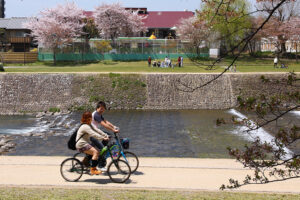
Kamo River banks — Free Walk the riverside paths between Sanjo and Shijo bridges for understated, non-tourist-destination cherry blossoms with local families having quiet hanami picnics. Completely free; none of the Instagram-crowd energy.
Nijo Castle outer moat — Free Over 400 trees around the moat perimeter. The combination of fortress walls and cherry blossoms is very different from temple settings.
Paid (worth it)
Daigo-ji Temple — ¥1,500 A UNESCO World Heritage site, the temple grounds feature around 700 cherry trees, with a highlight being a massive weeping cherry tree whose blossoms cascade like a waterfall. One of the most theatrical sakura experiences in Japan. Toyotomi Hideyoshi himself held a famous hanami party here in 1598 with 1,300 guests. Slightly further from central Kyoto (30 min by subway/bus) — crowd pressure lower than Philosopher’s Path.
Maruyama Park (Chion-in lantern zone) — Free entry, some illumination events ~¥1,000 The paid evening illumination events around Chion-in temple adjacent to Maruyama Park are legitimately spectacular — golden lanterns, stone pathways, pink canopy above.
Arashiyama / Nakanoshima Park — Free The Oi River banks in Arashiyama are lined with cherry trees. Free, beautiful, best combined with your bamboo grove visit. See [Kyoto e-bike blog] for context on the route.
The Best Sakura in All of Japan (Beyond Tokyo and Kyoto)
Some argue the most spectacular sakura experiences aren’t in the major cities at all:
Hirosaki Castle Park, Aomori — Late April The town of Miharu boasts 10,000 cherry trees, but Hirosaki is the undisputed king of castle-and-sakura combinations. 2,600 trees around the castle moat; petals fall into the water forming a “sakura raft” (hanaikada) — a pink carpet on the surface. Peak late April. Far fewer international tourists than Tokyo or Kyoto, which makes the experience calmer and more intimate.
Yoshino Mountain, Nara Prefecture — Early to mid-April 30,000 cherry trees covering an entire mountain. One of Japan’s three most famous sakura sites. The trees are planted at different altitudes, meaning the bloom travels visibly up the mountain over 2-3 weeks — you can see the different elevations turning pink sequentially. Deeply spiritual (Shinto pilgrimage site for 1,300 years). From Nara, 1.5 hours by train; or day-trip from Osaka.
Nara Park — Early April Cherry blossoms + deer = the best combination in Japan. 1,500 trees across Nara Park, the deer wander peacefully underneath, and no crowds at 7 AM. See [Nara deer blog].
Kawazu, Izu Peninsula — Late February If you want to see sakura WITHOUT the peak-season crowd, the Kawazu-zakura variety blooms a full month before Somei Yoshino. Deep pink (not pale pink), 850 trees along a 4km river walk, 2.5 hours from Tokyo. The Kawazu Sakura Festival runs February 10-March 10. Hotel prices are 40-60% lower than peak season. Significantly smaller crowds. Easier bookings. You still see spectacular cherry blossoms.
Hokkaido — Late April to May Sapporo and Hakodate bloom weeks after Tokyo, meaning you can see sakura well into May with lower prices and calmer crowds. See [Hokkaido guide] for the Goryokaku fort’s star-shaped cherry blossom view.
Crowd Intelligence: How to Actually Enjoy It
The crowd problem is solvable with three rules:
1. Go early. Really early. Before 8 AM at any famous sakura spot, the crowds are manageable to minimal. By 10 AM at Philosopher’s Path or Meguro River, it’s shoulder-to-shoulder. This is non-negotiable: your best photos and your best experience will happen between 6 AM and 8:30 AM.
2. Go on a weekday. The peak weekend during sakura season at Ueno Park or Maruyama Park has crowd levels comparable to a cricket match at Wankhede. The same spots on a Tuesday morning are completely different. If you have any flexibility, weekday visits are transformative.
3. Skip the most famous spots if the timing is wrong. If you arrive 4 days before peak bloom, the most famous spots look normal — green trees, no drama. Instead of being disappointed, redirect: find the spots with late-blooming yaezakura trees (which peak 1-2 weeks after Somei Yoshino), or visit a lesser-known garden.
Free vs Paid Summary
| Spot | City | Entry | Best Time |
|---|---|---|---|
| Meguro River | Tokyo | Free | 6-8 AM or post-8 PM |
| Chidorigafuchi Moat | Tokyo | Free (rowboats ¥800) | Weekday morning |
| Sumida Park | Tokyo | Free | Sunset (Skytree lit) |
| Ueno Park | Tokyo | Free | 7-9 AM or evening festival |
| Shinjuku Gyoen | Tokyo | ¥500 | Weekday 9-11 AM |
| Koishikawa Korakuen | Tokyo | ¥300 | Any time; less crowded |
| Philosopher’s Path | Kyoto | Free | Before 7:30 AM or 8+ PM |
| Maruyama Park | Kyoto | Free | Morning or evening |
| Kamo River banks | Kyoto | Free | Afternoon picnic |
| Nijo Castle moat | Kyoto | Free perimeter | Morning walk |
| Daigo-ji Temple | Kyoto | ¥1,500 | Mid-morning weekday |
| Hirosaki Castle Park | Aomori | ¥310 | Late April, anytime |
| Yoshino Mountain | Nara | Free | Morning, early April |
| Kawazu | Izu | Free | Late February |
Practical Booking Advice
Hotels: Book 4-6 months ahead for Tokyo and Kyoto during sakura season. Even then, prices will be 2-3x normal rates. If budget is a concern, stay in Ueno or Ikebukuro (cheaper, still excellent access) and day-trip to the famous spots. See [Tokyo neighbourhoods guide].
Shinkansen: Tokyo-Kyoto Shinkansen during the first week of April books out fast. Reserve as soon as seat reservation opens (1 month in advance on the JR system). Non-reserved carriages are an option but you risk standing.
Flexibility is the single biggest asset. If your trip can flex by 3-4 days based on a forecast update 2 weeks before departure, your odds of hitting peak bloom increase dramatically. This is how Japanese domestic travellers plan it — they wait for the forecast, then book the weekend hotel.
Track the forecast with these tools:
- Japan Meteorological Corporation (n-kishou.com) — the official source
- Sakura Navi app — real-time updates on 1,000 spots
- Weathernews Cherry Blossom Map — nationwide visual overview
The Verdict: Is Sakura Actually Worth It?
Here’s the honest breakdown:
Worth it if:
- You can flex your dates 3-4 days based on a late forecast update
- You’re visiting Japan anyway and can time arrival for late March-early April
- You understand peak bloom is 5-7 days and plan your trip’s “Japan days” accordingly
- You’re willing to be at the best spots before 8 AM
Not worth it if:
- You’re flying to Japan specifically and only for sakura with rigid fixed dates
- You expect the Instagram experience by showing up at 2 PM to a famous spot
- You haven’t factored in the 2-3x hotel premium and the crowd density
The honest rating:
- The bloom itself, at peak, at the right spot, at 6 AM: 10/10
- The bloom at a famous spot during peak hour on a weekend: 4/10
- Arriving a week early or late: 2/10
The alternative frame: Rather than visiting Japan for the sakura, visit Japan during the sakura. The country is magnificent regardless. The bloom is a bonus when it cooperates, not the centrepiece of the experience. This mental shift prevents disappointment and elevates the trip.
Japan’s 30 million other things to do don’t care whether the cherry trees are blooming or not. The ones that bloom are extraordinary. The rest of it was always the point.
Frequently Asked Questions
Q: When exactly is sakura season in Japan? Peak bloom varies yearly. Generally: Tokyo late March-early April, Kyoto early April, Osaka late March-early April, Tohoku mid-April, Hokkaido late April-early May. Forecasts can be off by as much as a week — check the Japan Meteorological Corporation website for weekly updates.
Q: How long does the sakura bloom last? Full bloom (mankai) typically lasts 5-7 days under good weather. A single rainy or windy day can shorten this to 3-4 days. The broader season (from first bloom to petals fully fallen) runs about 2 weeks.
Q: Is sakura viewing free in Japan? Most sakura viewing is free — public parks, riverbanks, castle moats. Some temple and garden entries cost ¥300-1,500 and are worth paying for the lower crowds.
Q: Which is better for sakura — Tokyo or Kyoto? Both are exceptional for different reasons. Tokyo’s Meguro River and Chidorigafuchi offer modern-city contrast; Kyoto’s Philosopher’s Path and temple settings offer historical depth. Kyoto peaks 5-7 days after Tokyo, so a combined trip catching both is the ideal strategy.
Q: Why do people say they missed the sakura despite going in spring? Because peak bloom is only 5-10 days and weather-dependent. Travelling with fixed dates 6 months ahead, arriving a week before or after peak, or visiting during rain are the three most common reasons.
Q: What’s the best sakura spot outside Tokyo and Kyoto? Hirosaki Castle Park (Aomori, late April) for the most spectacular castle-and-moat combination. Yoshino Mountain (Nara Prefecture) for 30,000 mountain trees. Kawazu (Izu Peninsula, late February) for early deep-pink blooms without the crowds.
Q: Is cherry blossom season too crowded? Famously crowded, yes. The solution: visit before 8 AM and choose weekdays. Hotel prices 2-3x normal and Shinkansen seats sell out — book 4-6 months ahead.
Q: Can I still enjoy Japan if I miss the sakura? Absolutely. Japan is extraordinary in every season. Autumn (October-November) foliage is arguably more spectacular and cheaper. See my [Japan in August warning] for the worst season, and [Japan festivals calendar] for the best non-sakura events.
Final Word
The sakura bloom is real and it is magnificent. It is also genuinely, materially shorter and more weather-dependent than social media suggests. The gap between the Instagram version and the walk-up-at-noon version is one of Japan travel’s biggest disappointments.
Plan for it properly and it will reward you completely. Plan casually and it will elude you.
Track the forecast. Book the hotels early. Wake up before the city does. Find the river you haven’t seen on Instagram. Buy a convenience store coffee and a konbini onigiri and sit under a canopy of pink at 6:45 AM while the petals fall around you in silence.
That is the sakura experience. That is why people keep chasing it.
For the full Japan trip experience, read my main blog here.
Drop a comment if you’ve chased sakura in Japan — did you hit it perfectly, barely miss it, or find your own quiet spot nobody else had bookmarked?