 By Tarang Bansal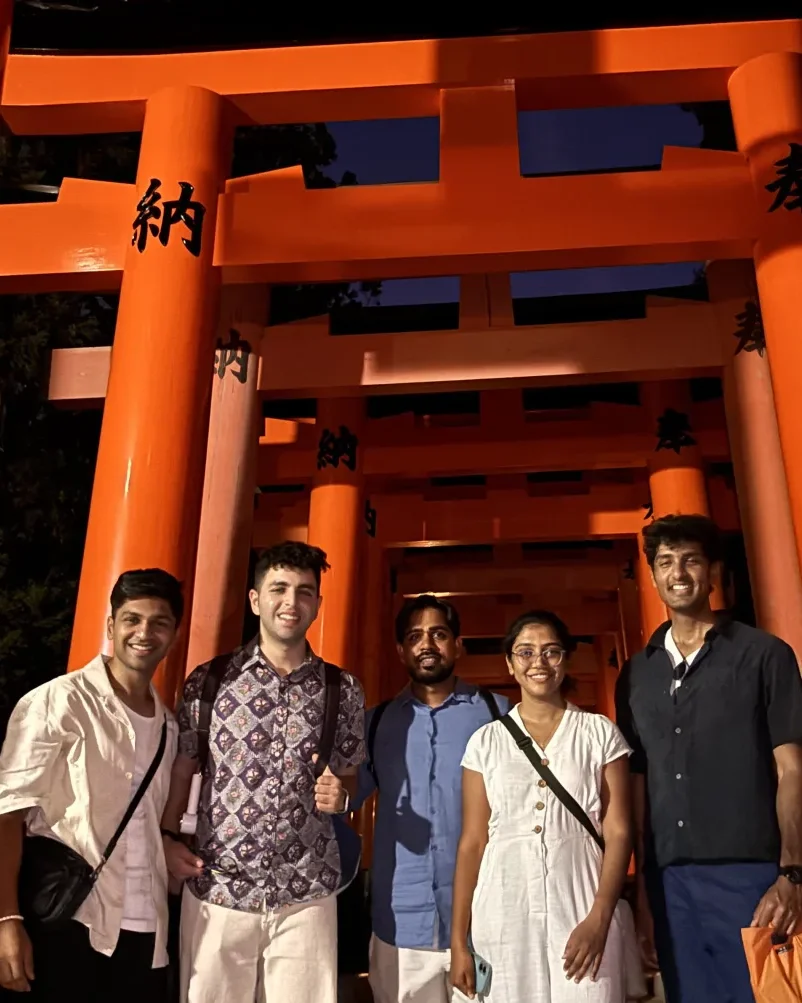

Every torii gate at Fushimi Inari was paid for by an individual or company- with prices starting at ₹2.5 lakh per gate. The full story of who donates, how much it costs, the inscriptions on the back, and the temple-tile donation system at many Japanese temples that few tourists notice.
I learned something at Fushimi Inari Shrine in Kyoto that nobody had told me before, and it changed how I looked at the next two hours of the trail.
I was walking through the famous tunnel of orange torii gates- the iconic ones from every Japan travel video- when I noticed a friend turn around and start photographing the back of the gates instead of the front. I asked why.
“Look at the carvings,” she said.
The back of every single torii gate is densely inscribed in black Japanese characters. Names. Dates. Some shorter, some longer.
“These are the donors,” she explained. “Each gate is paid for by an individual or a company. Their name, their business, the year they donated- it’s all carved on the back. Big donors get bigger gates. Small donors get small ones.”
I stopped walking. I’d been at Fushimi Inari for an hour and had assumed the gates were placed there by the shrine, the city, or some government tourism budget. The truth was much more interesting: every torii at Fushimi Inari is a private gift, paid for by someone hoping for business prosperity or thanking Inari for prayers already answered.
Once you know this, the whole shrine reads differently.
If you want the full Japan trip context, read my main 10-day Japan blog here.
The Torii Gate Donation System, Explained in this Fushimi Inari Guide
Fushimi Inari Taisha is Japan’s most important Inari shrine– the head of a network of 30,000+ Inari shrines across the country. Founded in 711 AD (over 1,300 years ago), it’s dedicated to Inari, the Shinto god of rice, sake, harvests, and the most relevant here- business prosperity.
This is why companies and individual entrepreneurs donate gates: they’re asking Inari for business success, or thanking the deity for it.
The tradition started in the Edo Period (1603-1868), around 400 years ago. Today the trail up Mount Inari has roughly 10,000 torii gates total, with about 800-1,000 forming the iconic dense tunnel called Senbon Torii (“Thousand Gates”). Most gates are donated by small-to-mid-sized Japanese businesses; the most prominent ones are sponsored by major corporations.
How Much Does a Gate Actually Cost?
Here are the actual numbers, current as of recent shrine guidance:
- Smallest size torii gate: Around ¥400,000 (~₹2,40,000)
- Mid-size torii: ¥600,000-800,000 (~₹3,60,000-4,80,000)
- Large torii on the main path: ¥1,000,000+ (~₹6,00,000+)
- The very large entrance-style gates: Several million yen, sometimes more
- Mini-torii (palm-sized) for casual visitors: Around ¥800 (~₹500), usable as wish-offerings at smaller shrines
The “your name on a giant gate at the entrance” experience is reserved for major corporate donors- typically Japanese banks, large manufacturers, sake breweries, and family business empires that have been at it for generations. You’ll spot these along the most-photographed sections.
A small gate placed off the main path, off in a quieter sub-shrine area? Around ₹2.4 lakh gets your family name carved into the wood for the next several decades.
There’s also a renewal cost– torii are wooden, painted with vermilion lacquer, and exposed to weather year-round. Most gates need full replacement or restoration every 10-30 years depending on their location and the local climate. The donor (or their successor business) is expected to renew the donation when the gate is restored. Many do. Some don’t, and the gate eventually gets reassigned to a new donor.
So the full deal: a gate is not a one-time donation. It’s a long-term commitment between a family, a company, and a 1,300-year-old shrine.
What’s Actually Carved on the Back
Walk slowly through Senbon Torii and look at the back of each gate. You’ll see (in vertical Japanese characters):
- Donor name– individual or company
- Date of donation– year and month, often written using both the Gregorian calendar and the Japanese imperial era
- Sometimes the location of the donor’s home or business
Some gates have multiple inscriptions because they’ve been restored and re-donated by descendants. The oldest visible inscriptions go back over a century. The most recent are from the past few months.
It’s an open public record of devotion- every gate a small tax-receipt of faith, going back generations.
The Tile Donations at Todai-ji: A Quieter Version of the Same Idea
Once I noticed the donor system at Fushimi Inari, I started seeing similar patterns at every major Japanese temple I visited. The most charming version was at Todai-ji Temple in Nara.
Inside the Daibutsuden (Great Buddha Hall)- the world’s third-largest wooden building, housing a 15-meter bronze Buddha- there’s a small booth set up to one side. A monk or temple staff member sits there with a stack of plain ceramic roof tiles and a writing brush.
The pitch: for around ¥1,000 (~₹600), you can write your name, your wish, or a short message on a tile, which will then be used in the temple’s ongoing roof restoration. Your tile literally becomes part of Todai-ji.
Roof tiles need replacement every several decades. Todai-ji has been doing this for centuries. The combination of temple maintenance funding + the chance for visitors to leave their literal mark on a sacred building is one of the most elegant fundraising systems I’ve seen anywhere.
This pattern- donor inscriptions on functional structures- is everywhere in Japan once you know to look. Lantern donations at Kasuga Taisha. Stone tile donations at Kiyomizu-dera. Pillar inscriptions at countless smaller shrines. Japanese religious institutions have been crowdfunding through devotee inscriptions for over a thousand years, long before the word “crowdfunding” existed.
How to Visit Fushimi Inari (Practical Guide)
Now the practical stuff:
Getting There
- From Kyoto Station: JR Nara Line, 5 minutes to Inari Station (¥150). Shrine is right outside.
- From Gion / Higashiyama: Keihan Main Line to Fushimi-Inari Station, about 4 minutes’ walk to the shrine.
- By taxi: Avoid- the central Kyoto fare to Fushimi Inari can hit ₹2,500+ unnecessarily.
Cost
- Entry: Free. No ticket, no admission fee. Open 24/7, all year round.
The Two Routes: Long vs Short
The shrine’s torii trail goes up Mount Inari (233m), with the full hike taking 2-3 hours round trip. Most visitors don’t do the whole thing- they do the short version. Here’s the difference:
The Short Version (Recommended):
- Walk through the Romon Gate, past the main shrine, into Senbon Torii
- Continue up to the Yotsutsuji intersection at roughly the halfway point
- This takes about 30-45 minutes one-way, or 1-1.5 hours round trip with photos
- Yotsutsuji has a viewpoint over Kyoto, several food stalls, and the trail splits here for the longer hike
- What you see: The most densely packed and photogenic torii sections, including the iconic Senbon Torii tunnel
- What you skip: Diminishing-density gates on the upper trail, more of the same scenery
The Long Version:
- Continue from Yotsutsiji up to the actual summit (Kami-no-Yashiro)
- Adds another 1-1.5 hours each way
- Passes smaller sub-shrines, additional torii sections, and stone deity statues
- What you see: A genuinely different mountain shrine experience
- What’s the trade-off: The torii gate density drops significantly past Yotsutsuji. The dense, magazine-worthy gate sections are mostly in the lower half. The upper trail is more about the spiritual hike than the visual spectacle.
Honest take: do the short version. Unless you’re specifically a hiking enthusiast or a deeply spiritual traveler, the upper trail is more of the same scenery with fewer crowds- but you’ve already seen the best parts in the lower section.
Day vs Night Visit: Why We Picked Night (And You Should Too)
We went to Fushimi Inari at night, after dinner, around 8 PM in August.
Day visit (10 AM-5 PM):
- Maximum crowds- particularly hard during the 11 AM-3 PM tour-bus window
- Brutal heat in summer (we were there in August at 36°C)
- Difficult to get clean photos without other tourists in frame
- More vendors and food stalls open
- Better natural lighting for photography overall
Night visit (after 6 PM, especially 7-10 PM):
- Significantly fewer people. By 8 PM, you may have entire stretches of Senbon Torii to yourself
- Cooler temperatures (especially critical in summer)
- The trail is illuminated by traditional lanterns placed at intervals
- A quieter, more spiritual atmosphere
- Better for atmospheric photography
- Most food stalls closed; bring water
The shrine is open 24/7 with no entry fee, so a night visit costs you nothing extra. As long as you stay on the main trail (and bring a small flashlight if you go past Yotsutsuji), it’s perfectly safe.
👉 [INSERT AFFILIATE LINK: Fushimi Inari guided night tours via Klook / Viator]
Practical Tips
- Best time to visit: 6:30-8:30 AM (sunrise crowd) or 7:00-10:00 PM (night crowd). Avoid 10 AM-4 PM if possible.
- Wear comfortable walking shoes– even the short version involves uphill stone steps.
- Carry water– vendors are mostly at the base; it’s a longer walk than you think.
- Cash for the small offerings at sub-shrines along the way (¥100-500 amounts).
- Keep your phone charged– you’ll take more photos than expected.
- Don’t touch or lean on the torii gates. They’re sacred structures.
- The best photo spots are inside Senbon Torii, with the trail receding into orange. For inscription shots, photograph the back of the gates as you walk down.
Frequently Asked Questions
Q: Who pays for the torii gates at Fushimi Inari? Each gate is donated by an individual or business. The smallest cost around ¥400,000 (~₹2,40,000); the largest cost over ¥1,000,000 (~₹6,00,000+). The donor’s name, business, and date are inscribed on the back of each gate.
Q: Why do companies donate torii gates? Inari is the Shinto god of business prosperity. Companies donate gates either to ask for future business success or to thank the deity for prosperity already received. The practice dates back to the Edo Period (~400 years).
Q: Is entry to Fushimi Inari free? Yes. Fushimi Inari Taisha has no entry fee and is open 24/7, year-round.
Q: How long does it take to walk Fushimi Inari? The short version (up to Yotsutsuji intersection) takes 1-1.5 hours round trip. The full summit hike takes 2-3 hours round trip.
Q: Should I visit Fushimi Inari at night? Yes, it’s significantly less crowded, cooler, and illuminated by lanterns. Bring a small flashlight if going past Yotsutsuji.
Q: How do I get to Fushimi Inari from Kyoto Station? JR Nara Line to Inari Station, about 5 minutes (¥150). The shrine is right outside the station.
Q: Can I donate a torii gate myself? Yes, anyone can. Smallest gate starts at ¥400,000. Mini-torii wish-offerings (¥800) are available at the shrine for casual visitors.
Q: How many torii gates are there at Fushimi Inari? Approximately 10,000 torii in total across the mountain trail. The famous Senbon Torii tunnel near the main shrine has about 800-1,000 gates.
Final Word
Most travel content presents Fushimi Inari as a photo opportunity- the orange tunnel, the Memoirs of a Geisha aesthetic, the must-do Kyoto stop. That’s all true.
But the deeper layer is the donor system. You’re walking through 400 years of accumulated business prayers, each gate a small contract between a Japanese family or company and a god of prosperity. Some of the prayers worked out. Some didn’t. The gates stand regardless, in their thousands, fading and being restored on a slow generational cycle.
Once you notice it, you can’t un-notice it. And it makes the walk itself richer than any photo can show.
For the full Japan trip experience, read my main blog here.
Drop a comment if you’ve been to Fushimi Inari, and which inscription stopped you. Mine was a small gate in a quiet sub-shrine area inscribed by a family business in 1947, just two years after the war ended. Hard to walk past that.