 By Tarang Bansal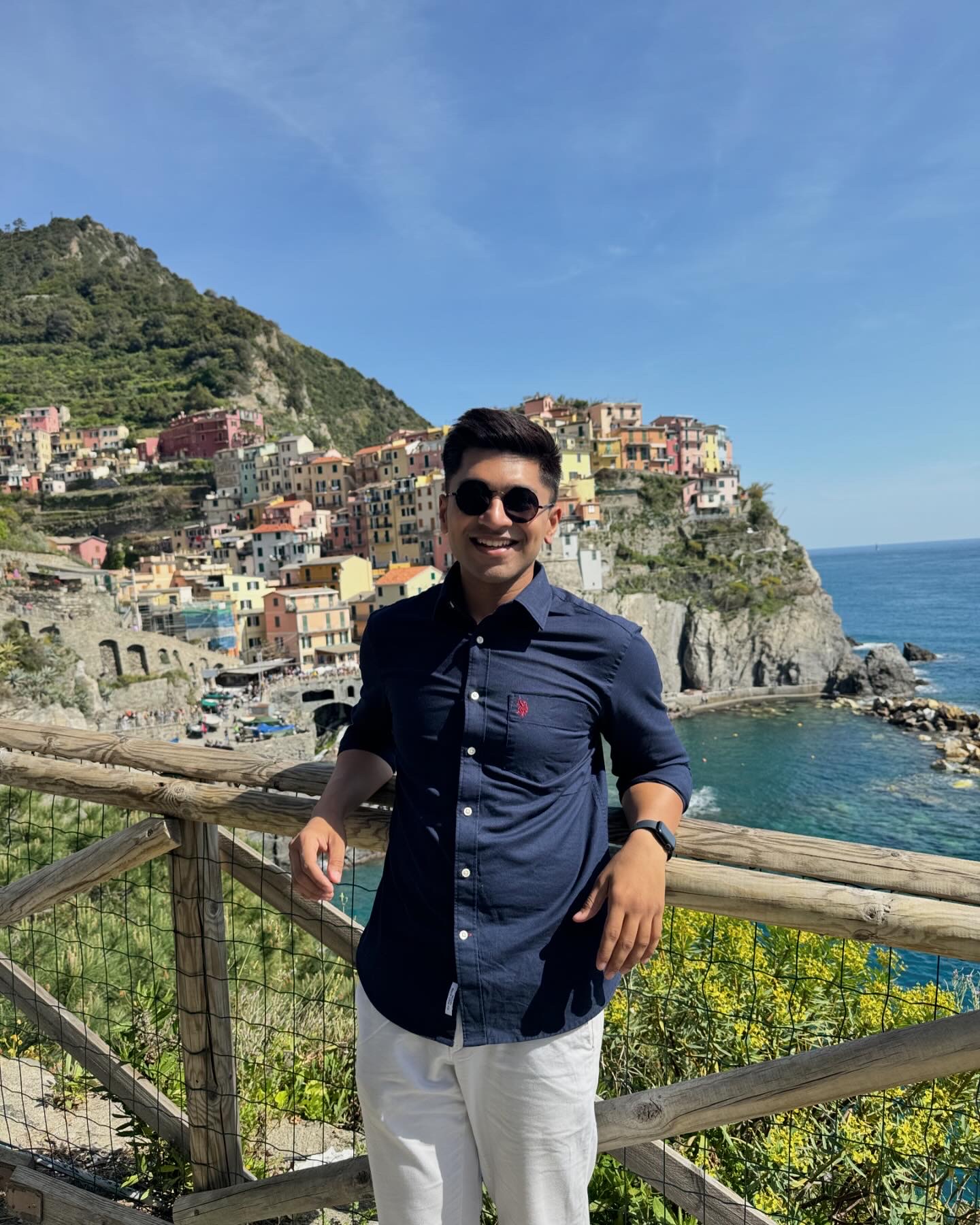
Italy is one of those romantic destinations many Indians dream of going to. It is one of the first countries that comes to mind when one thinks of a trip to Europe. But Italy is not just about romance for us Indians, it is so much more.
From Pizza and Pasta being the most popular foreign food in India to Italian Marble and Venetian blinds being a hallmark of home luxury interiors, from reading Julius Caesar in school to Indian songs filled with words like Gucci, Armani, Prada, Ferrari, or Lamborghini, Italy shows up everywhere in Indian life without us even noticing.
So many words we use in English are borrowed from Italian too, espresso, cappuccino, mafia, gelato, tiramisu, lasagne, risotto, opera, piano, panini. No wonder so many Indians have an Italian dream.
I have been to Italy twice, once with my parents and sister in October 2019, and again with friends in April 2024. This Italy itinerary for Indians covers my 2024 trip in detail, with a separate note on what we covered back in 2019 at the very end.
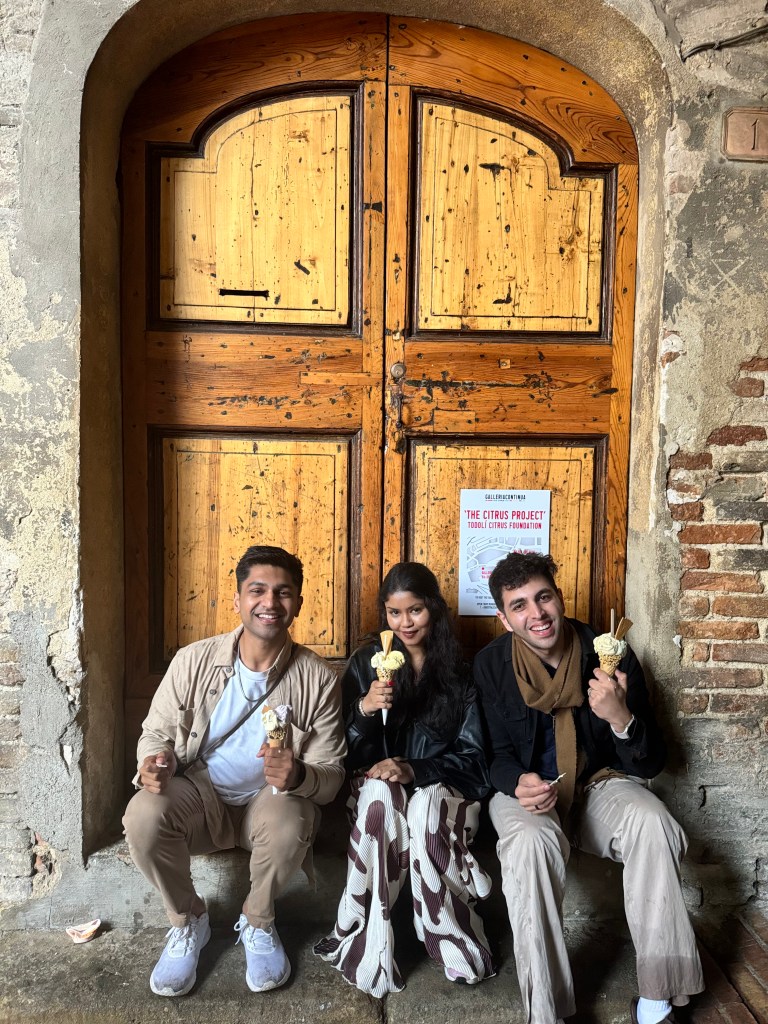
We Indians usually think of visiting a bunch of countries when we go to Europe, with the trip lasting anywhere from 2 to 3 weeks. So it is very unlikely that any one country gets more than 10 days in this kind of cascading itinerary.
We spent exactly 10 days in Italy. Here is our full itinerary:
| Date & Day | When Awake | Night in |
| 25th April, Thu | Milan to Lake Como (Self-Drive) | Menaggio (Como) |
| 26th April, Fri | Varenna & Bellagio | Menaggio (Como) |
| 27th April, Sat | Milan City | La Spezia (Cinque Terre) |
| 28th April, Sun | Riomaggiore & Manarola | La Spezia (Cinque Terre) |
| 29th April, Mon | Vernazza & Monterosso | La Spezia (Cinque Terre) |
| 30th April, Tue | Self-Drive to Florence upcountry | Near San Gimignano |
| 1st May, Wed | Siena & San Gimignano | Near San Gimignano |
| 2nd May, Thu | Florence City & Travel to Rome | Rome |
| 3rd May, Fri | Colosseum & Roman Forum | Rome |
| 4th May, Sat | Vatican & Rome City Tour | Rome |
| 5th May, Sun | Return to India |
The Visa
Italy is a party to the Schengen Agreement, which lets its holder move freely within Schengen states like a domestic traveller. A Schengen Visa obtained from any country is equally powerful, but the process of getting one differs from country to country. Here are the broad-stroke rules to know before you plan your own Italy itinerary as an Indian traveller.
How the Application Process Works
Indians must apply for the visa either directly through a consulate or embassy, or through the VFS agency. VFS is a private body that acts as an intermediary between the consulate and the applicant, making the process more accessible and streamlined.
VFS staff are trained to behave like approving officers of an embassy. You can’t expect to say “please accept the document my way” and leave it to the embassy to decide later. They will not accept your application until they’re satisfied, and documents need to be submitted exactly the way they want them. This means they can often appear nitpicky or fussy about signs, stamps, or extra documents, which can get frustrating.
The upside: if your application clears VFS, there’s a very high chance the embassy will clear it too.
Which Country to Apply Through
If you’re visiting more than one Schengen country, you must apply for the visa of the country where you’ll spend the most nights.
In my case:
- Italy: 10 nights
- Slovenia: 3 nights
- France: 3 nights
- Malta: 2 nights
Since Italy had the most nights, I was ineligible to apply through Slovenia, France, or Malta, and had to apply through Italy.
Regional Jurisdiction Rules
Certain Schengen countries, Italy included, also have regional jurisdiction rules for their embassies in India. This means you cannot apply for an Italian visa appointment from just any VFS center in the country, only the one tied to your current residence.
A few examples to make this concrete:
- Passport issued in Assam, working in Bangalore: You cannot apply through VFS Kolkata, since you’re a resident of Bangalore, not Guwahati.
- Working from home in Guwahati for a Bangalore-based company: You’d have to apply through Kolkata, not Bangalore.
- Guwahati domicile passport, Bangalore-based company, working from home in Delhi: You’d have to apply through VFS Delhi. Neither Kolkata nor Bangalore will accept your application.
In short, jurisdiction is decided by your current residence, not your passport’s home state or your employer’s city. You may need a notarized rental agreement or a letter on company letterhead to prove where you actually live or work from.
Document Requirements Vary by Center
Document requirements also differ from center to center:
- Some ask for flights to and from your base city within India, if you’re not flying in or out of India from your home city itself.
- Some ask for proof of city-to-city travel within Italy.
In my case, since my flights to Italy were from Bangalore but I’d applied through the Kolkata VFS, they asked me to show my Guwahati-to-Bangalore and Bangalore-to-Guwahati tickets. It’s a tedious process either way, so budget extra time for document collection.
Cost and Processing Time
The Italian visa costs around ₹10,000 including VFS fees. Processing time varies significantly by center:
Bangalore: Can keep you waiting right up to 3 days before departure
Kolkata: Often grants the visa within a week
The Cost
| Amount (INR) | Comment | |
| Flights | 65,000 | Lufthansa BLR-FRA-MXP Lufthansa FCO-MUC-BLR |
| Inter City Travel | 10,000 | Milan to Cinque Terre (Train) Cinque Terre to Florence (Train) Florence to Rome (Bus) |
| Visa, Insurance, SIM | 10,000 | |
| Food & Drinks | 60,000 | ~15 Euros per meal + Drinks |
| Stay | 35,000 | ~10k/ night for 3 pax |
| Experiences | 20,000 | Vineyard tour & wine tasting Vatican & Colosseum Como Villa Entry |
| Intra City Travel | 10,000 | Bus + Cinque Terre Train pass Uber + Como Ferry |
| Self Drive | 15,000 | Lake Como (2 days) Florence Countryside (2 days) |
| Total | 2,25,000 |
Self-Driving in Europe
One can self-drive across Europe using the driver’s license of one’s home country, as long as it’s written in a language that follows the Latin script. This includes English, Spanish, French, German, and Italian, among others.
Since Indian driver’s licenses are issued in English, we don’t need an International Driver’s Permit to drive in Europe. I have self-driven in Iceland, Croatia, Italy, and Turkey so far. This becomes an issue only for licenses in Arabic, Chinese, Japanese, and a few other non-Latin scripts.
If self-driving is part of your own Italy itinerary, here’s what to actually plan for.
Registering Drivers and the Security Deposit
You need to register and pay for every driver who plans to drive the car, and each one must show their physical license.
As a security token, one of the registered drivers has to block an amount on their credit card, this is not a transaction, just a hold on your credit limit. A few things to keep in mind:
- Card type: Mastercard or Visa have universal acceptability. Amex and Diners have patchy acceptability.
- Amount: Usually around ₹1 lakh for a non-premium car for 2-4 days.
- Whose card: It must be in the name of one of the registered drivers, not a spouse, parent, or child.
- Cash or debit cards are not accepted. It has to be a credit card.
Turn on international currency transactions on your card before leaving India, since this hold may require an OTP.
Understanding Car Insurance Top-Ups
A basic insurance plan is mandatory with all bookings, but it only covers claims beyond a certain value. For example, if your plan’s cover kicks in beyond ₹1,50,000, then for any damage or claim under that amount, you pay the actual cost yourself, and only claims above ₹1,50,000 are covered by the insurance company.
Always get a Full Top-up instead of a Basic Top-up. Here’s the difference:
- Basic Top-up: No liability on paper (cover starts from ₹0), but it does not cover tyres or glass, side mirrors, windshields, etc. A single tyre puncture can cost you around 350 euros (roughly ₹35,000). A broken window or mirror, even while parked, could cost several thousand euros more.
- Full Top-up: Covers everything, including major damage, for a flat rate. Ours cost 25 euros per day, far cheaper than a single puncture under Basic. I broke a side window while driving and paid nothing, no questions asked.
The peace of mind alone makes the Full Top-up worth it.
Tolls and Fines
You’re still responsible for all tolls and fines along the way.
- Many European tolls are unmanned, and the machines only accept NFC (wireless-tap) Visa or Mastercard cards enabled for international transactions.
- Fines for violations like speeding, jumping a light, or not wearing a seatbelt can be issued on the spot by police, or recorded by cameras and mailed to your India address later.
- The rental company can also charge your card months later, both for courier costs and the fine itself, plus a penalty.
Try to avoid any violation altogether; recovering from one after you’re back in India is far more hassle than it’s worth.
Popular Italian Destinations
There are countless places worth listing, but here are the most popular ones to help shape your own Italy itinerary.
Milan
Milan is the fashion capital of Italy and its largest urban center. It has three airports:
- Malpensa (MXP): The largest, with the most international connections
- Bergamo (BGY): Serves low-cost airlines like Wizz, Ryanair, and EasyJet
- Linate (LIN): A smaller airport with limited connections within Europe
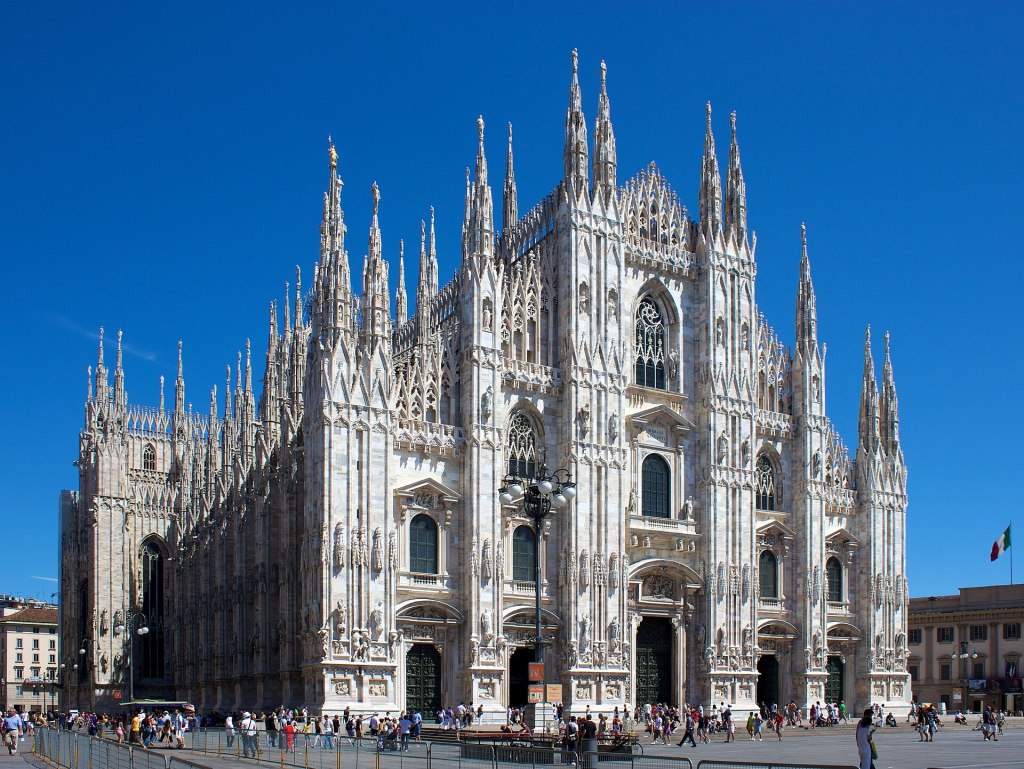
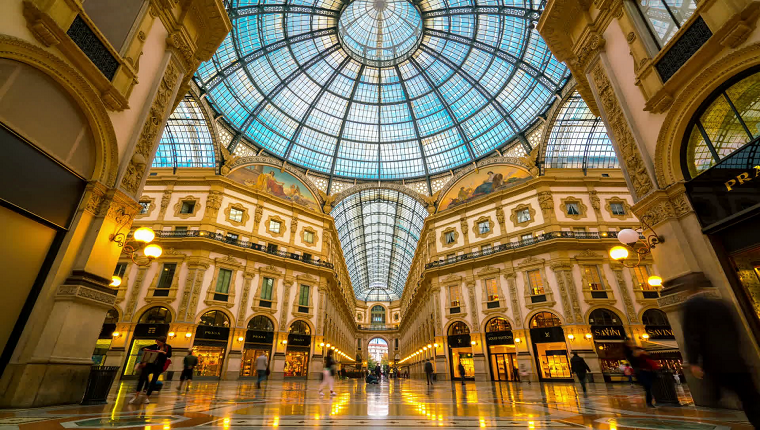
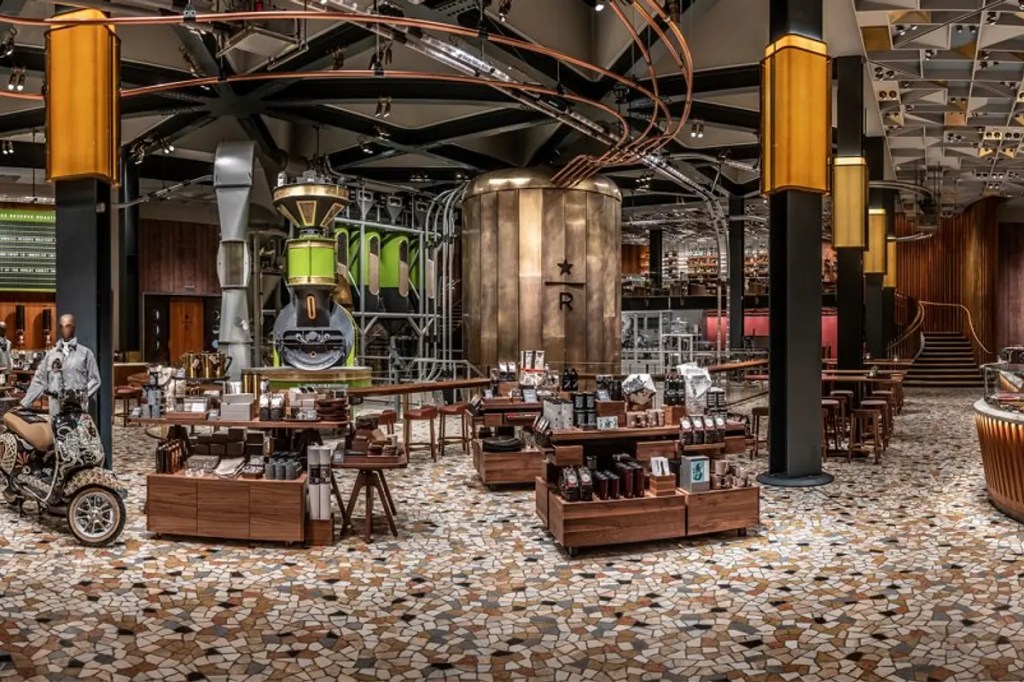
The Milan Cathedral (Duomo) is grand and famous, and the 19th-century luxury shopping arcade Galleria Vittorio Emanuele sits right next to it. Milan is also home to one of only 6 Starbucks Reserve Roasteries in the world, the only one in Europe, located close to the Duomo.
Lake Como
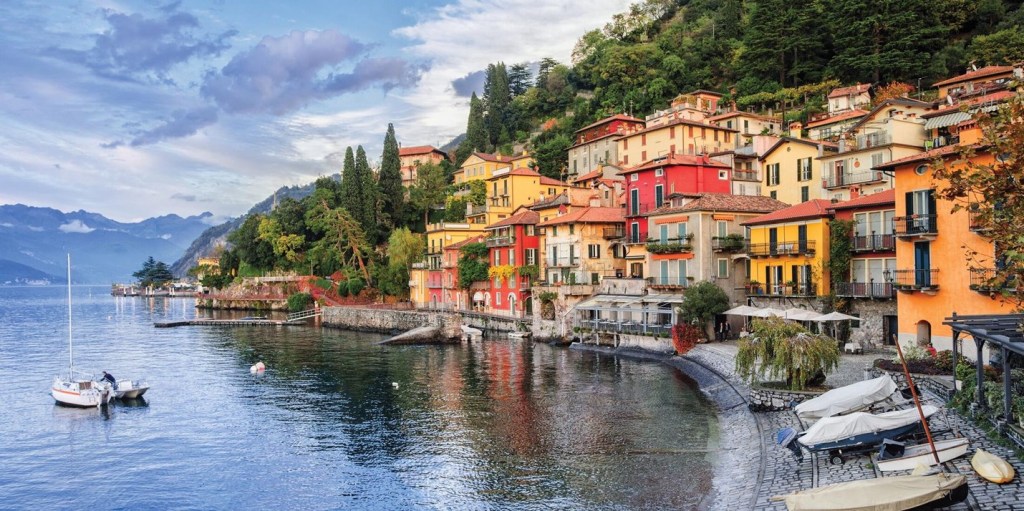
Lake Como is a huge lake in Northern Italy, close to Milan. Several towns sit around the lake, with Como, Bellagio, Menaggio, and Varenna being the most popular.
These towns have maintained villas and gardens from the era of monarchy, where tourists today pay to enter and take beautiful pictures. Ferries run between the lake towns daily throughout the day. E-cycling is a popular pastime in the area too, do try it.
Venice
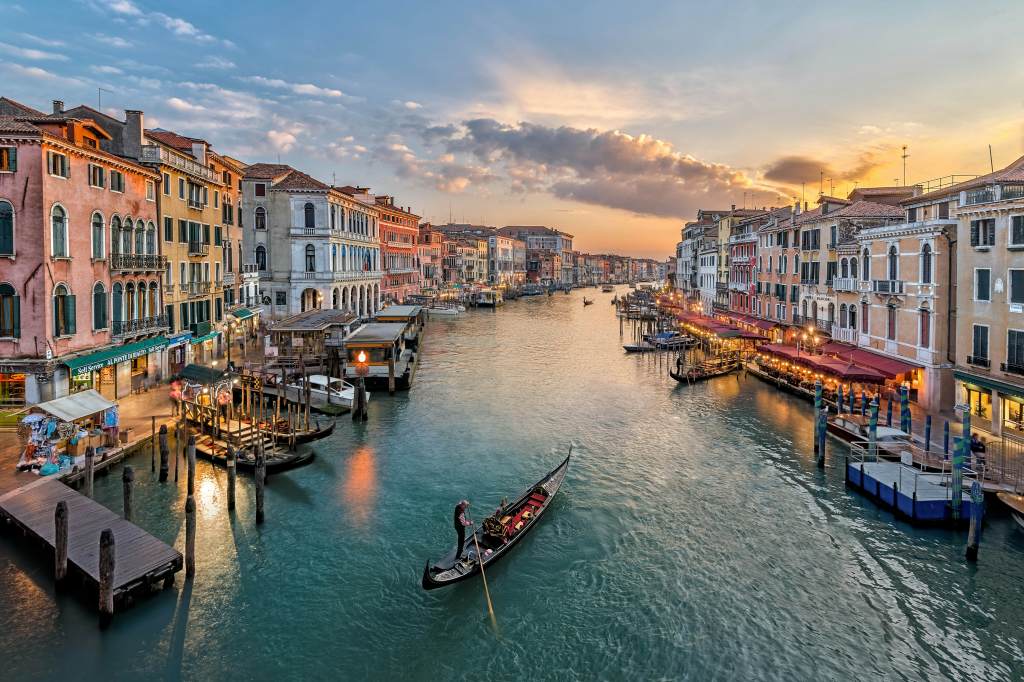
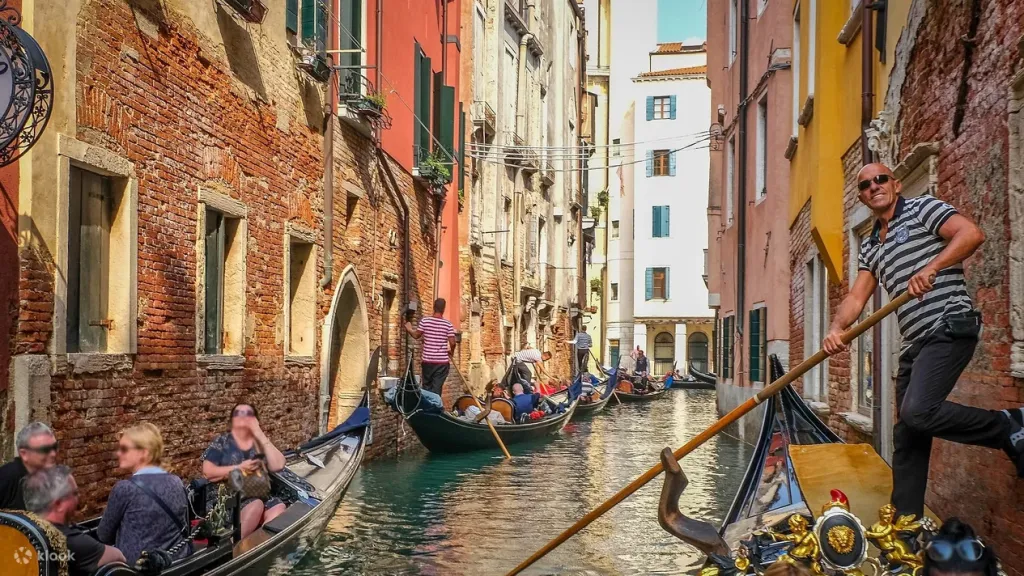
The city of canals, as most people know it, is actually just a small part of the larger Venice city. Most residents live in the part attached to mainland Italy, the part tourists rarely see.
The touristy part of Venice has no roads, only narrow footpaths connecting one place to another, along with numerous canals you can travel by boat. There are cafes, shops, and hotels throughout the area. The famous, and expensive, gondola ride also happens here.
San Marino
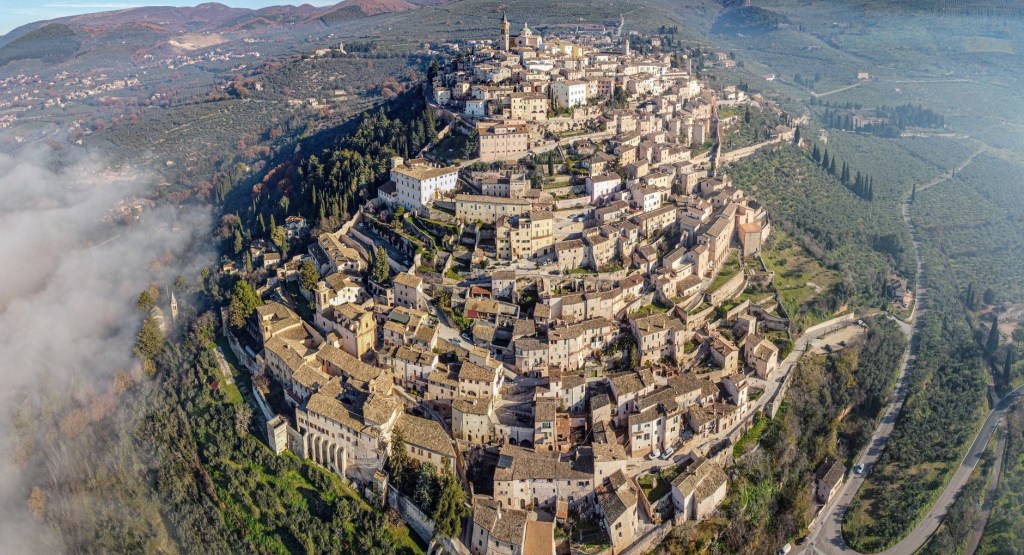
San Marino is a tiny hill town that happens to be its own country, completely landlocked by Italy. It’s really just a hill with houses and a fortress at the top.
There isn’t much to see or do, but it’s an easy country to check off your list if you’re passing through the region.
Cinque Terre
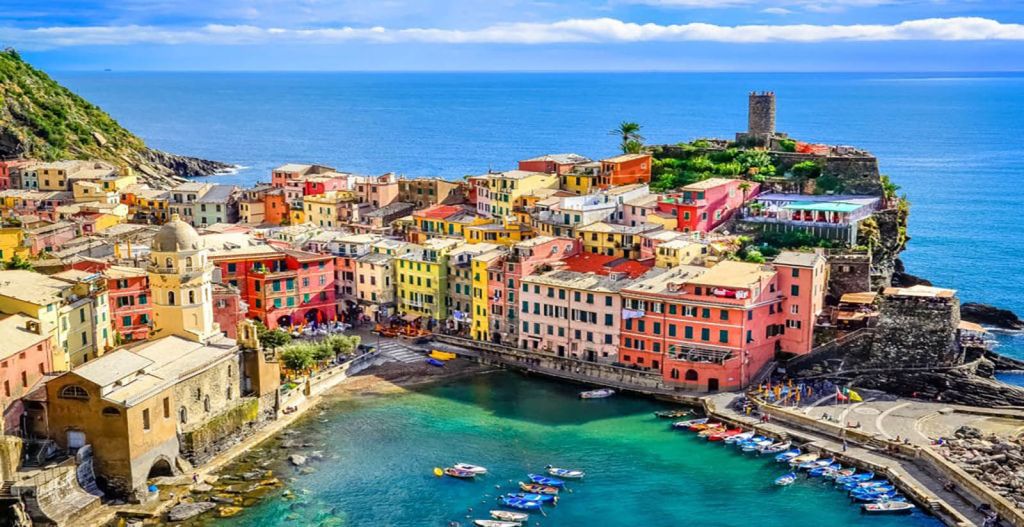
Cinque Terre is a group of 5 fishing villages, Monterosso, Vernazza, Corniglia, Manarola, and Riomaggiore, located right next to each other. They’re small, colourful, and have become one of the most popular stops on any Italy itinerary, with cute cafes, shops, and developed hiking trails connecting all 5 villages.
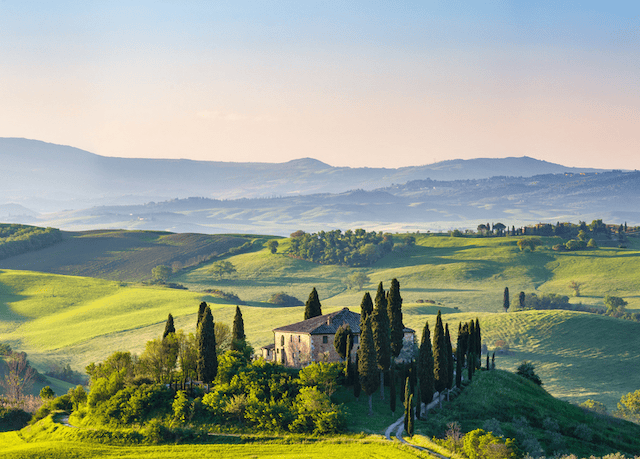
Florence & Countryside
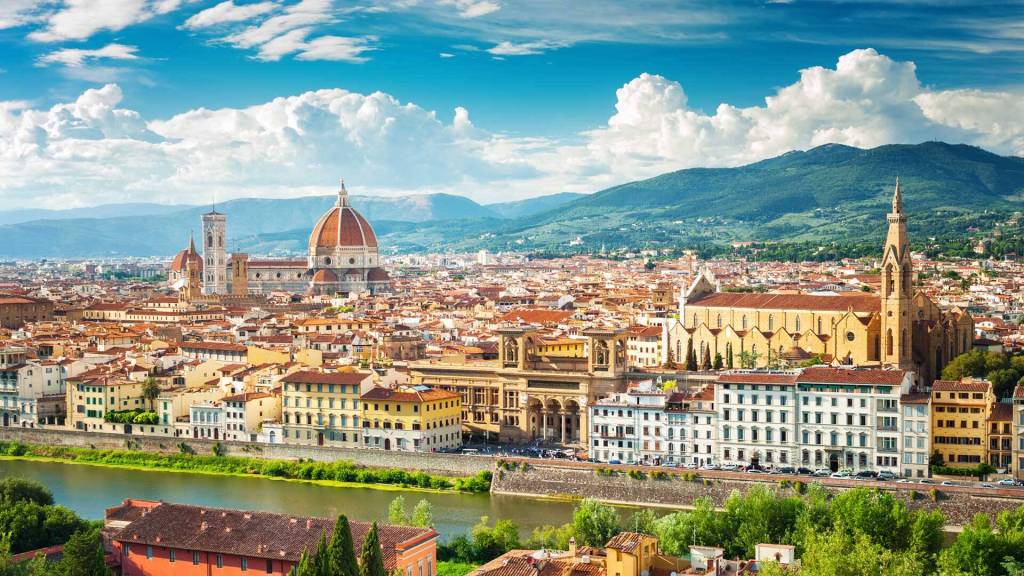
Florence anchors Italy’s most popular wine region. The city itself is known for its art galleries, churches, food, and as the HQ of Gucci.
The surrounding countryside includes the wine-growing region of Chianti, along with towns like San Gimignano, Volterra, and Siena.
Rome
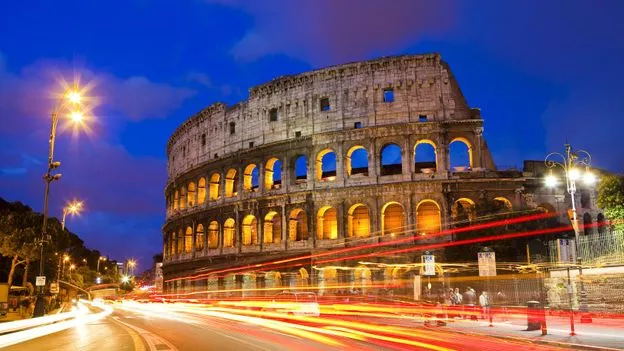
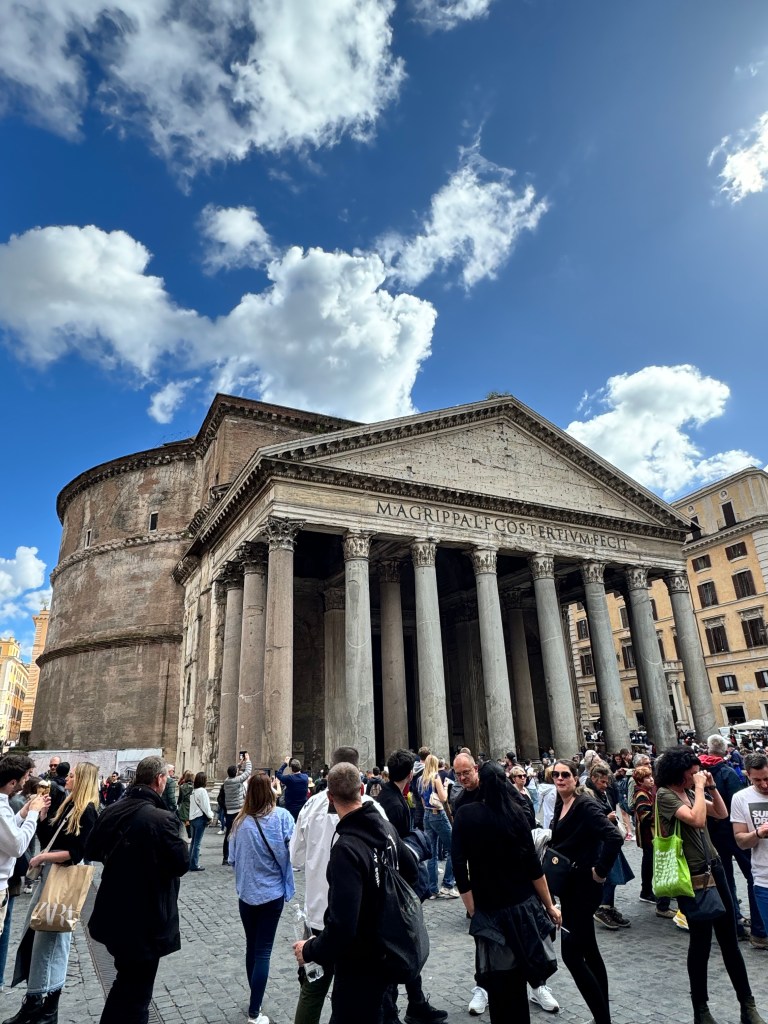
Rome is the capital city and home to the Colosseum, the Roman Forum, the Pantheon, the Trevi Fountain, and the country of Vatican City. It has more sites to see and places to eat than you can fit into a few days.
Beyond These Six
These were the places I covered across my two visits. A few other well-known spots worth knowing about while planning your own Italy itinerary:
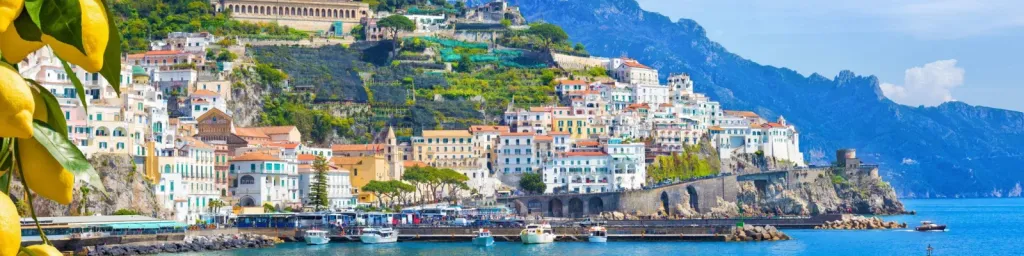
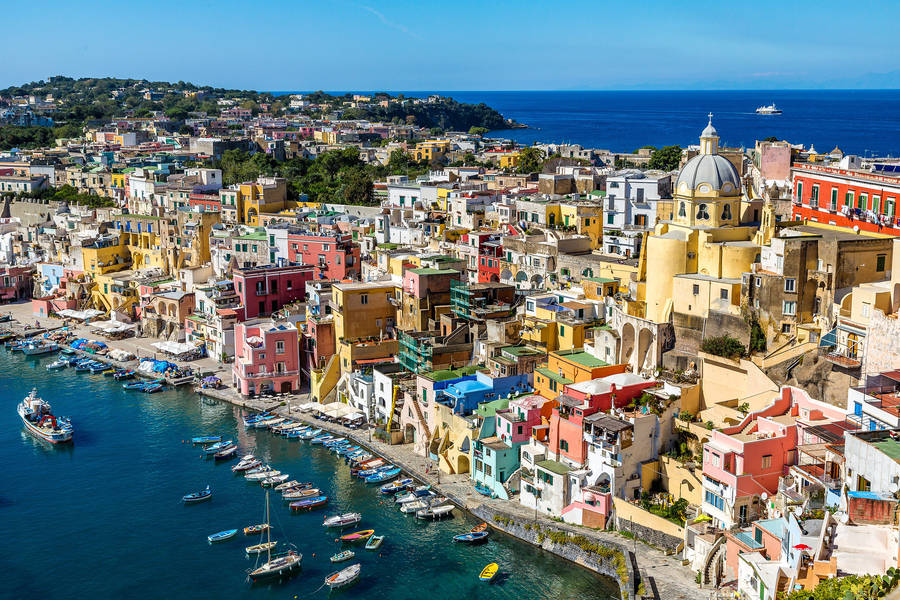
- The Amalfi Coast and the Island of Capri
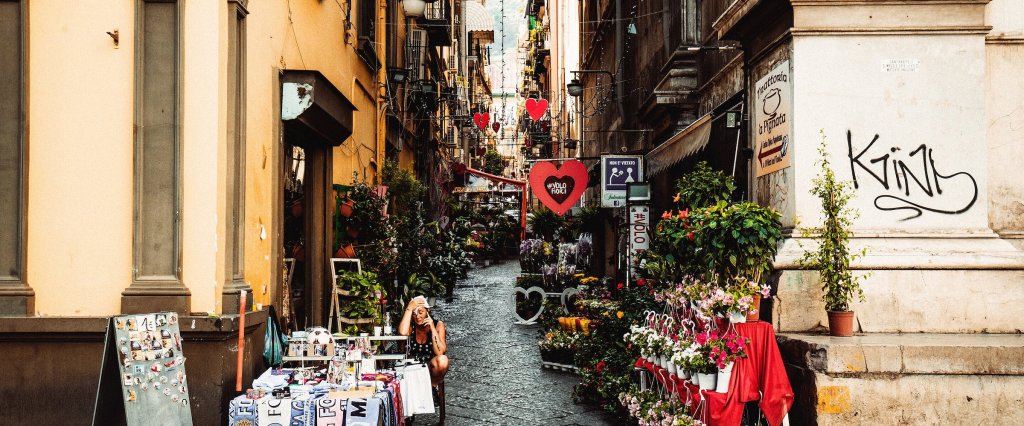
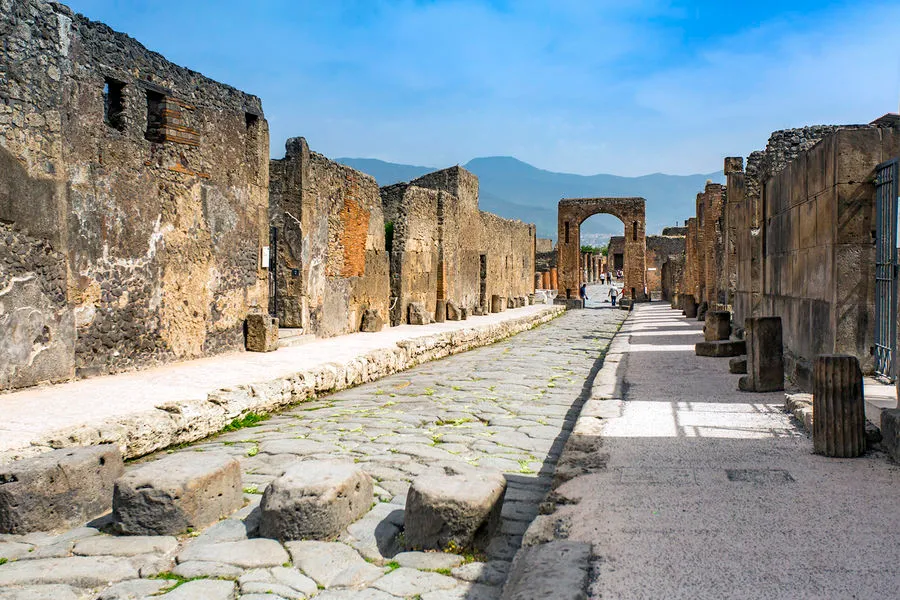
- Naples and Pompeii
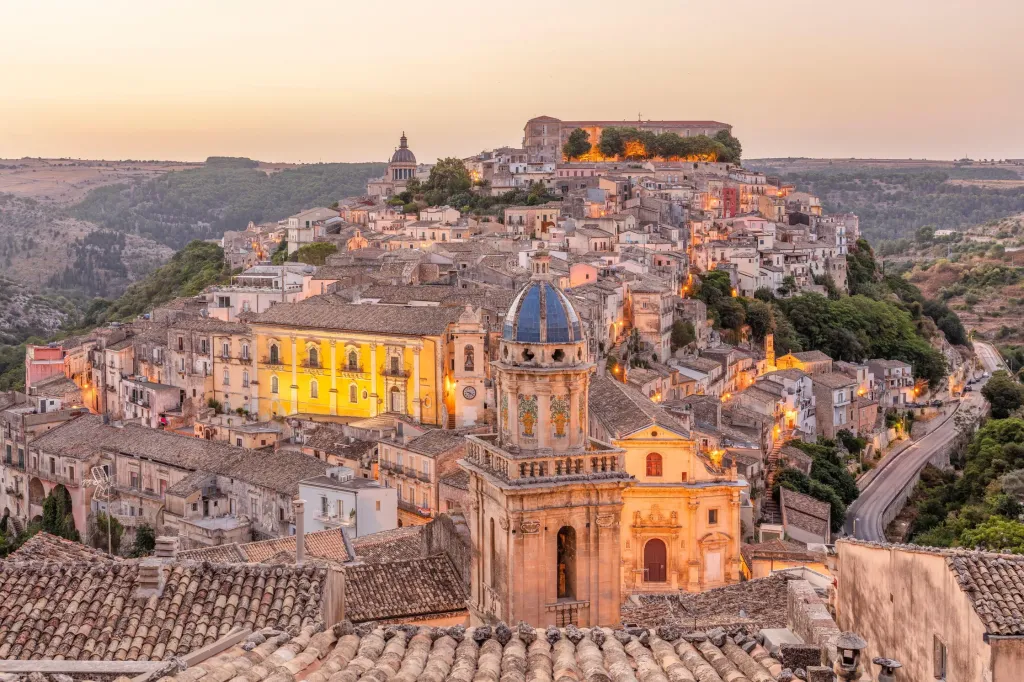
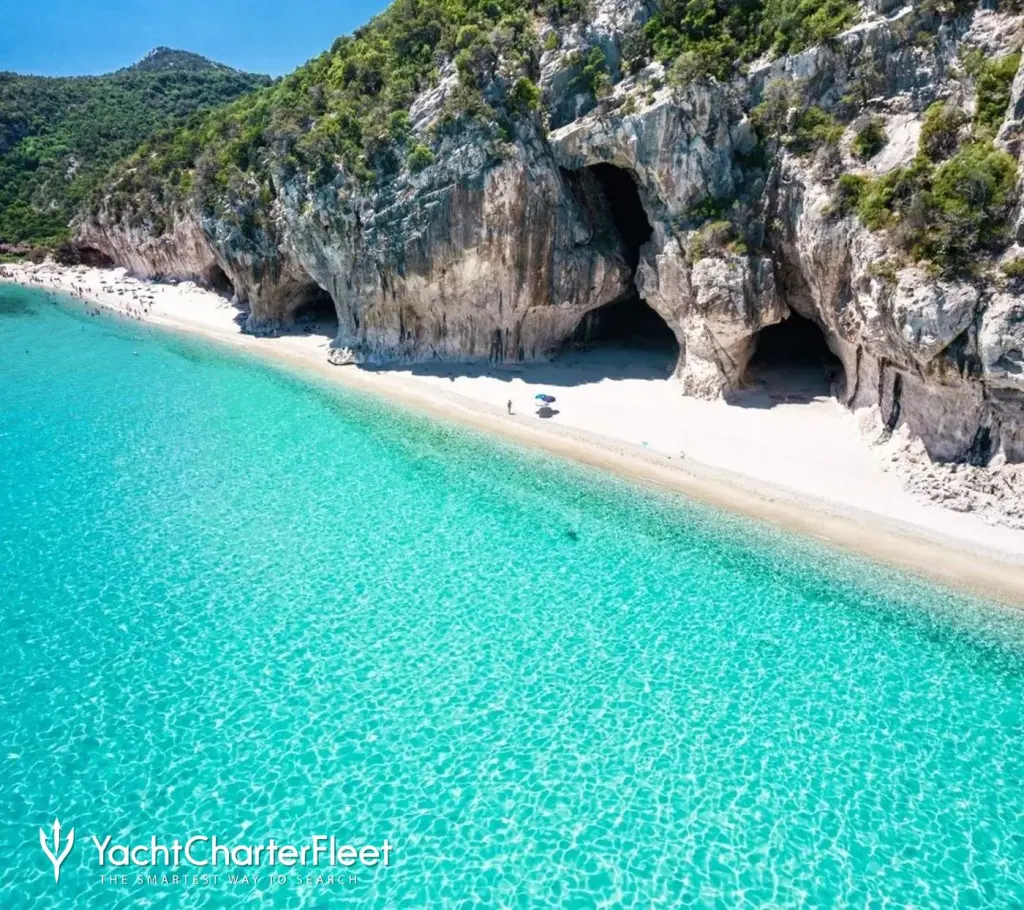
- The island states of Sicily and Sardinia
- The Italian Alps at the Dolomites
- The HQ towns of Ferrari and Lamborghini, near Bologna
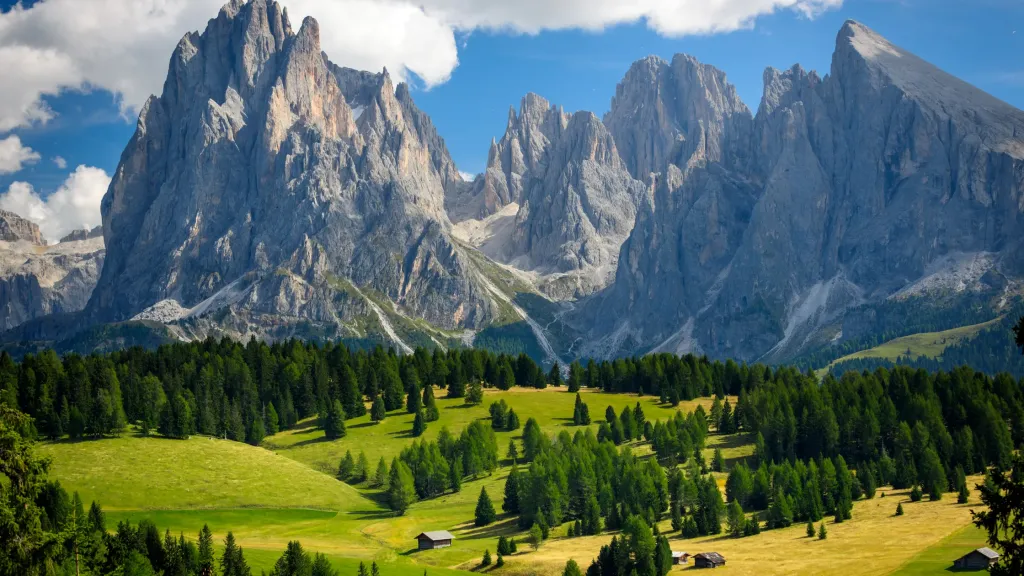
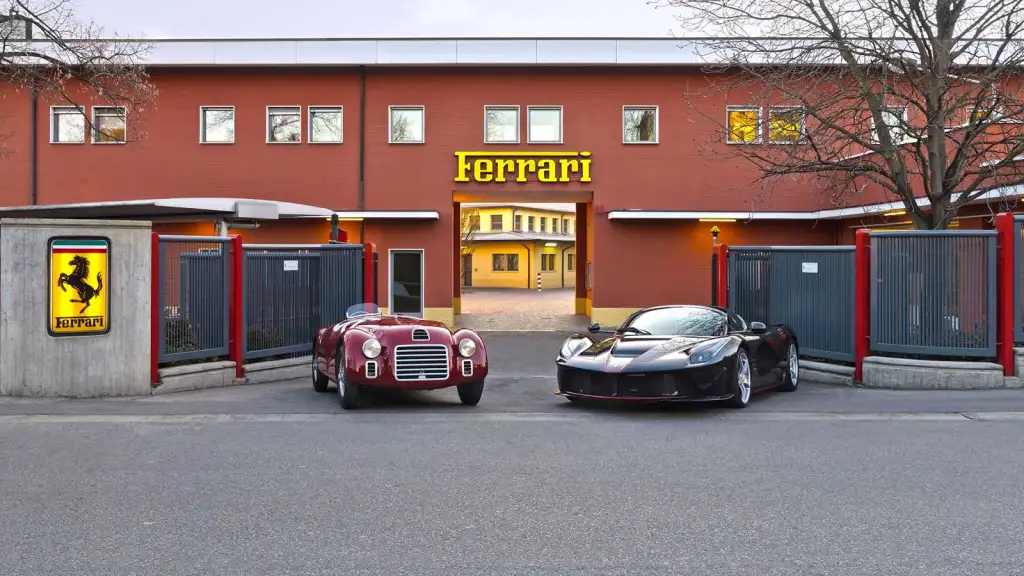
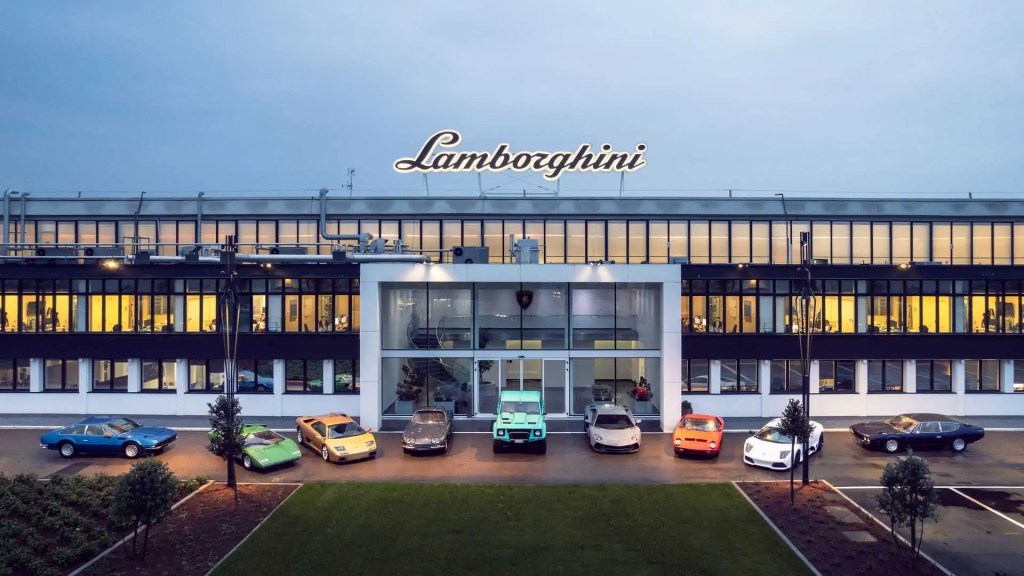
Our 10D10N Itinerary
25th April, Thursday- Drive to Como
We landed at Milan Airport (MXP) via Germany from Bangalore, with immigration completed in Germany itself. From there, we headed to our self-drive car operator, Sicily by Car, located inside the MXP airport itself. We had pre-booked the car under my name through Skyscanner.com.
After picking up the car, we drove straight to Menaggio, a little under 2 hours away.
On reaching the town, we ran into our first practical lesson: car parking isn’t free at most places, and typically costs around 20 euros per night. Menaggio also has two types of parking zones:
- Blue zones: Paid during the day, free at night
- White zones: Free throughout
We eventually found a free parking lot with hundreds of open spots close to our hotel and parked there instead.
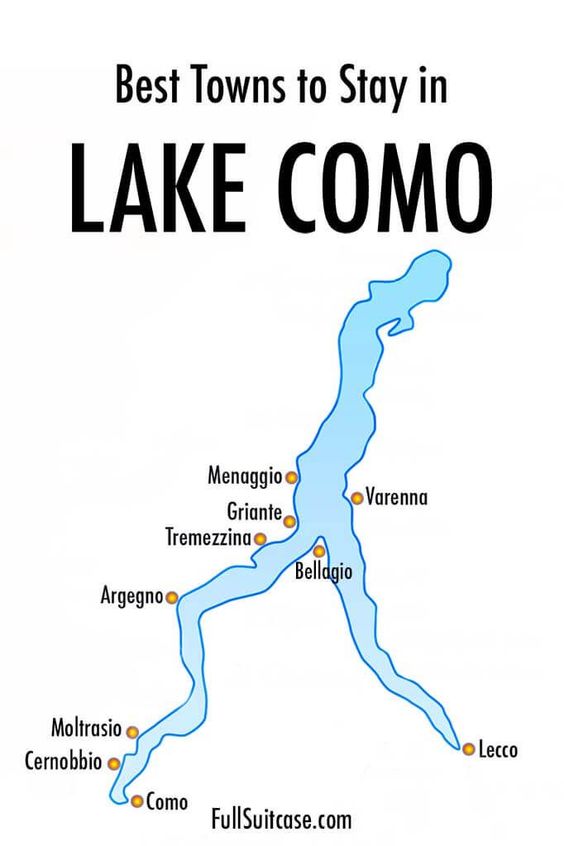
If you look at the map above: driving from MXP, you emerge from the bottom-left corner and drive along Lake Como on your right to reach Menaggio. Menaggio, Bellagio, and Varenna are three of the most famous Como towns, all located at the heart of the lake. Como town itself, in the bottom-left, has direct trains to and from Milan Central Station and is the biggest town around the lake.
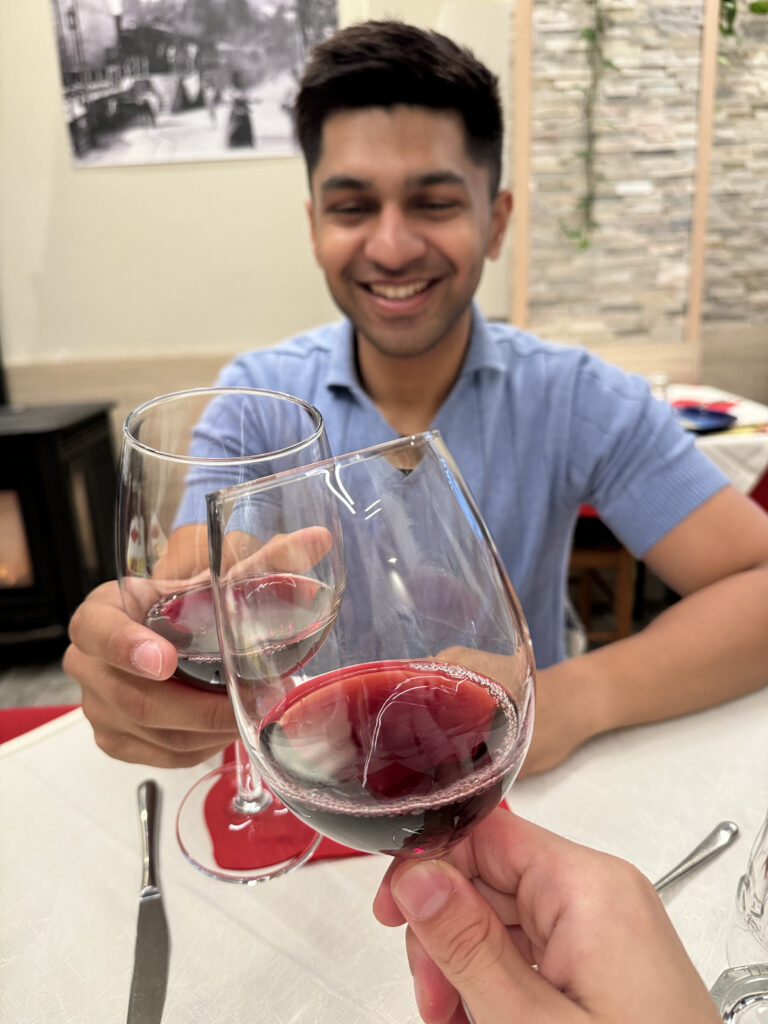
We checked in at Hotel Bellavista in Menaggio, a nice small hotel. Hungry from the drive, we got ready quickly for the evening and found Pizzeria Lugano, where we had one of the best pizzas of the entire trip, the Bufala Cheese Pizza. We strolled around, took plenty of pictures, had some good gelato, and called it a night.
We’d also been looking for a SIM card, but the only supermarket selling Iliad network SIMs was closed by the time we got there, so that got sorted later in the trip.
A quick driving note: the route from MXP to Como has wide highways for about half the journey. The other half, once you reach the lake itself, has narrow roads where it’s genuinely easy to clip your side mirror on something.
Day 1 ratings (out of -5 to +5): Self-drive experience to Lake Como: -2 | Hotel Bellavista: +1 | Menaggio town: -1 | Pizzeria Lugano: +4
26th April, Friday – Ferry Around Como Towns
We started at 8 am and headed to a pastry shop for coffee and pain au chocolat. We picked up a ferry chart from our hotel reception, ferries leave Menaggio once or twice an hour, and made it in time for the 9 am one.
Ferry basics:
- A day’s unlimited pass costs 15 euros per person (doesn’t cover some extended routes)
- Ferries can carry cars, bikes, and bicycles
- Cars are charged 20 euros per trip
- Travel time between Varenna, Bellagio, and Menaggio is about 15 minutes port to port
Varenna
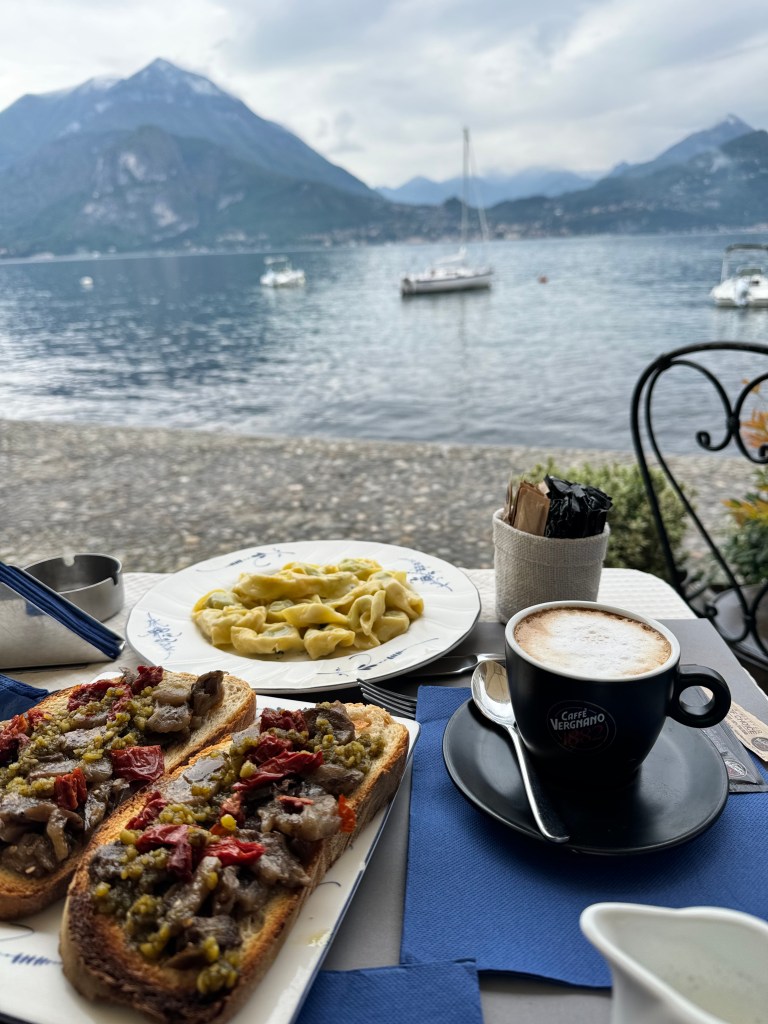
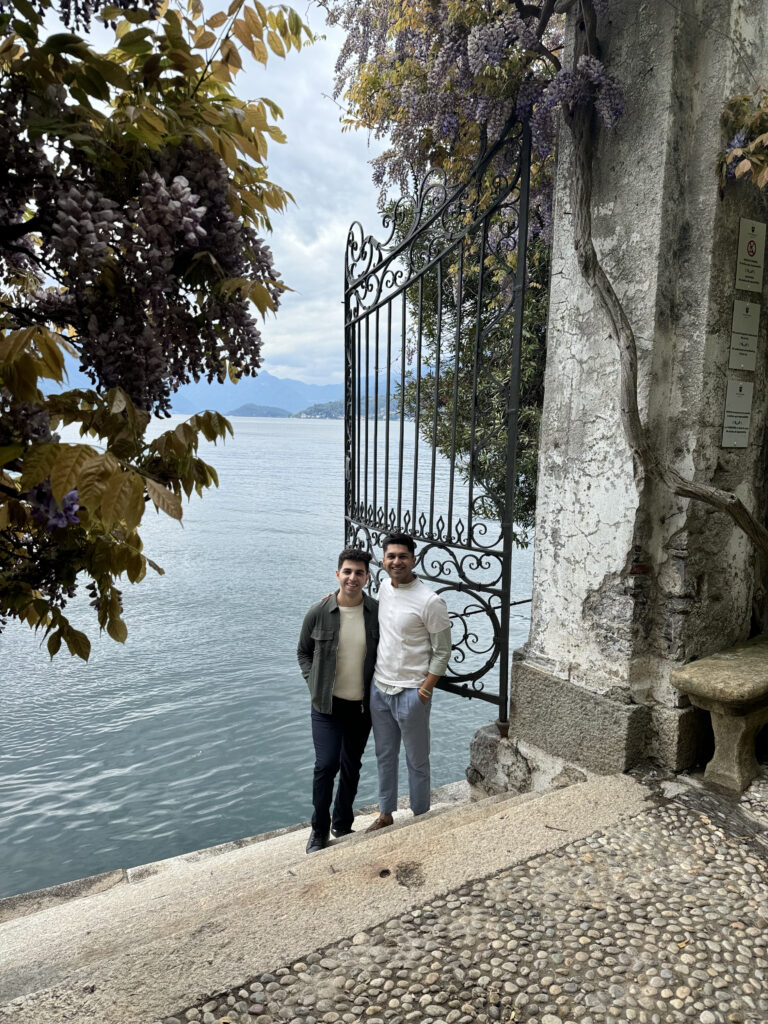
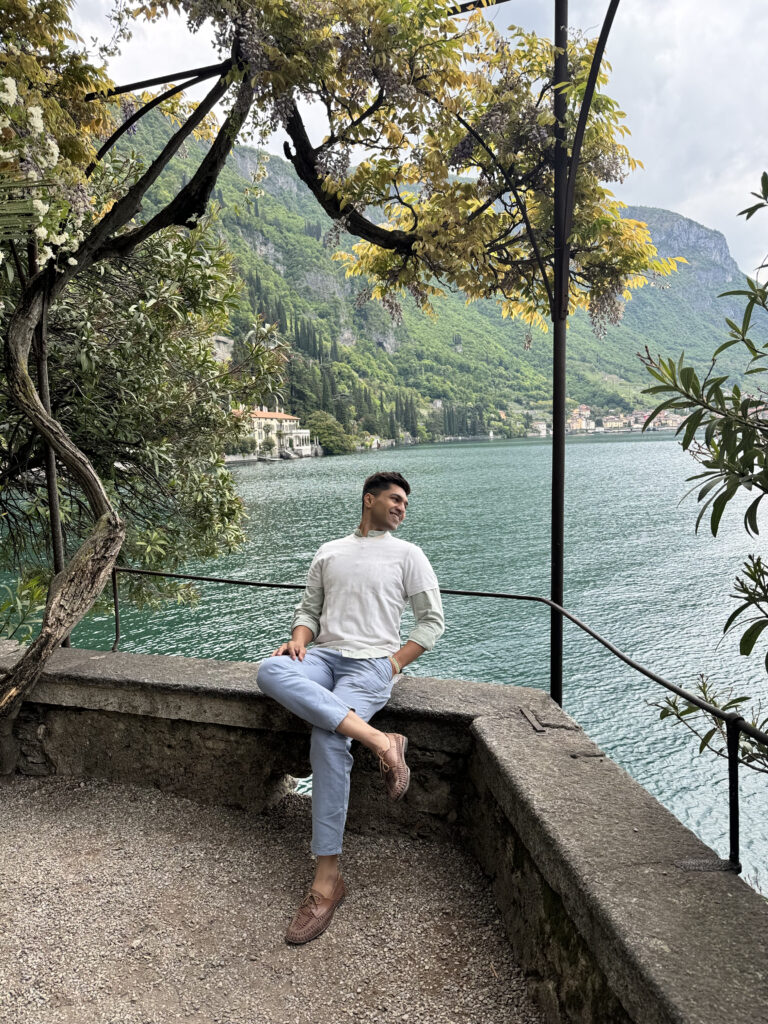
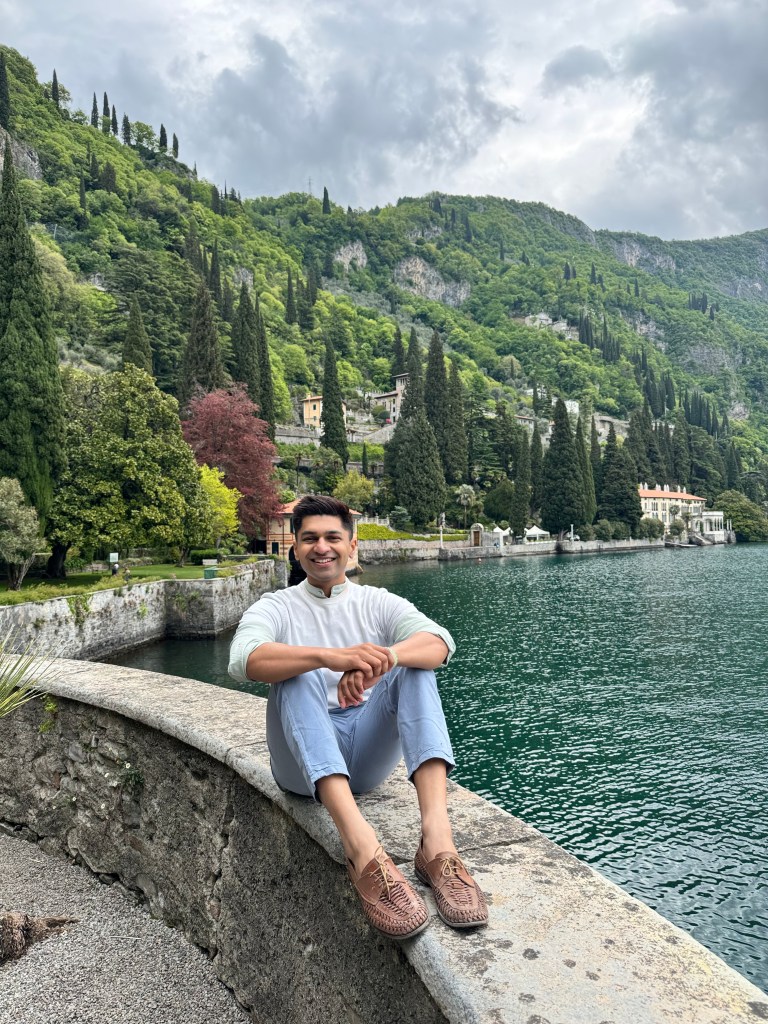
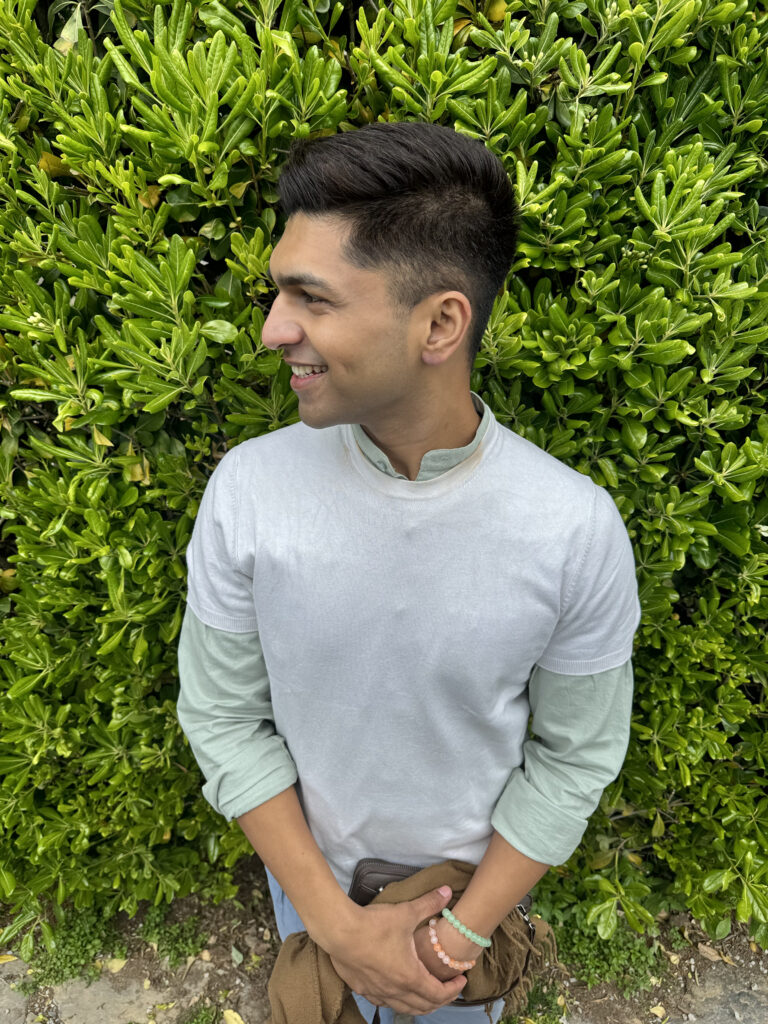
We landed here first, strolled around, and had breakfast at Cafe Varenna (the bruschetta was good). From there, we visited the two most beautiful villas in Como, Villa Cipressi and Villa Monastero, located right next to each other. A joint discounted ticket for both costs around 20 euros, with a student discount for under-25s (no student ID needed).
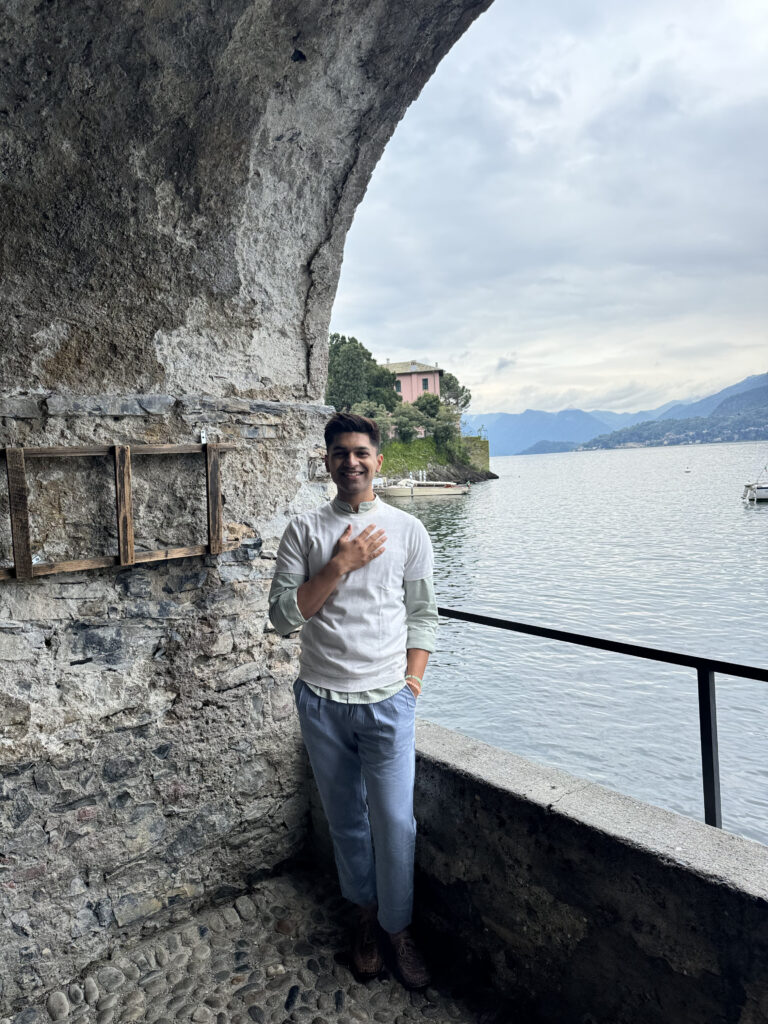
Villa Cipressi came first and was gorgeous. Villa Monastero was also great, though it felt slightly underwhelming compared to Cipressi. We wandered Varenna a little longer before catching the next ferry to Bellagio.
Bellagio
We reached in 15 minutes and explored on foot. Bellagio is the most commercial and largest of the upper Como towns. We passed Villa Melzi, the most beautiful villa here, but skipped the 15-20 euro entry, you can go in and report back.
For lunch, we stopped at Trattoria San Giacomo, good food, paired with Aperol Spritz (loved it) and Campari (hated it). One thing to know: restaurants across Italy add a cover charge of 2-4 euros per person. Our bill for two vegetarian items, two drinks, and the cover charge came to 45 euros for two people.
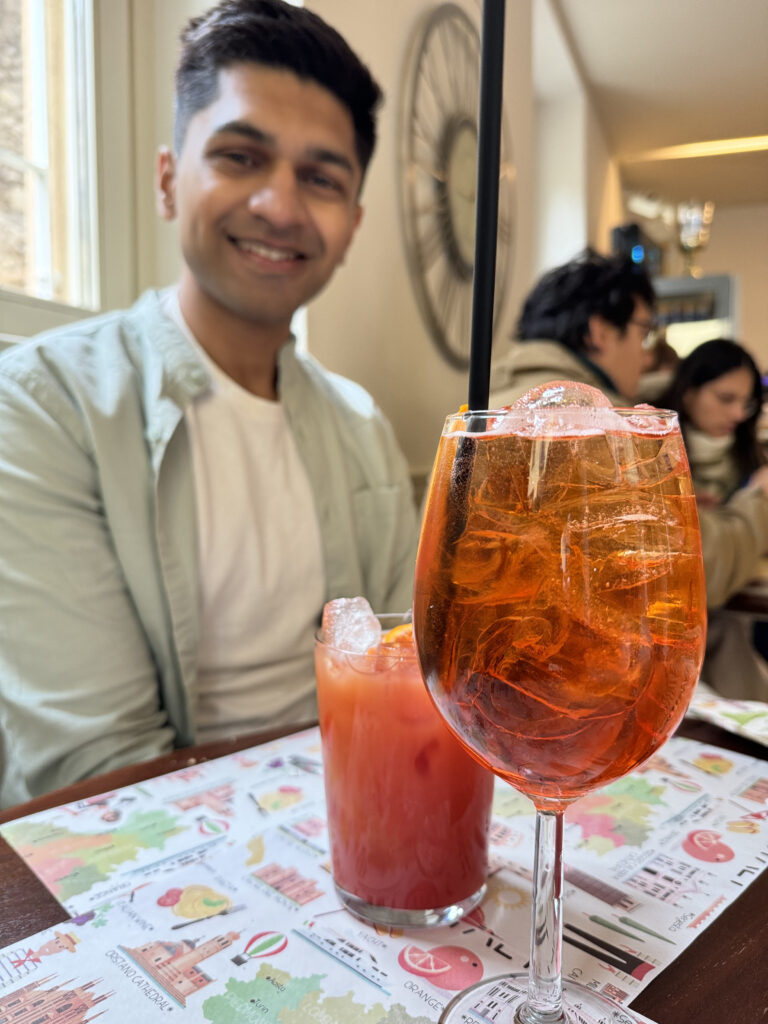
Next was hot chocolate, easily the worst we’ve ever had, followed by the best activity of the day: renting an e-bicycle. Unlike an e-bike, an e-bicycle has no accelerator, the motor just makes pedalling easier, so uphill rides feel effortless. We rented one for an hour at 15-20 euros per bike. Genuinely worth it, don’t skip this.
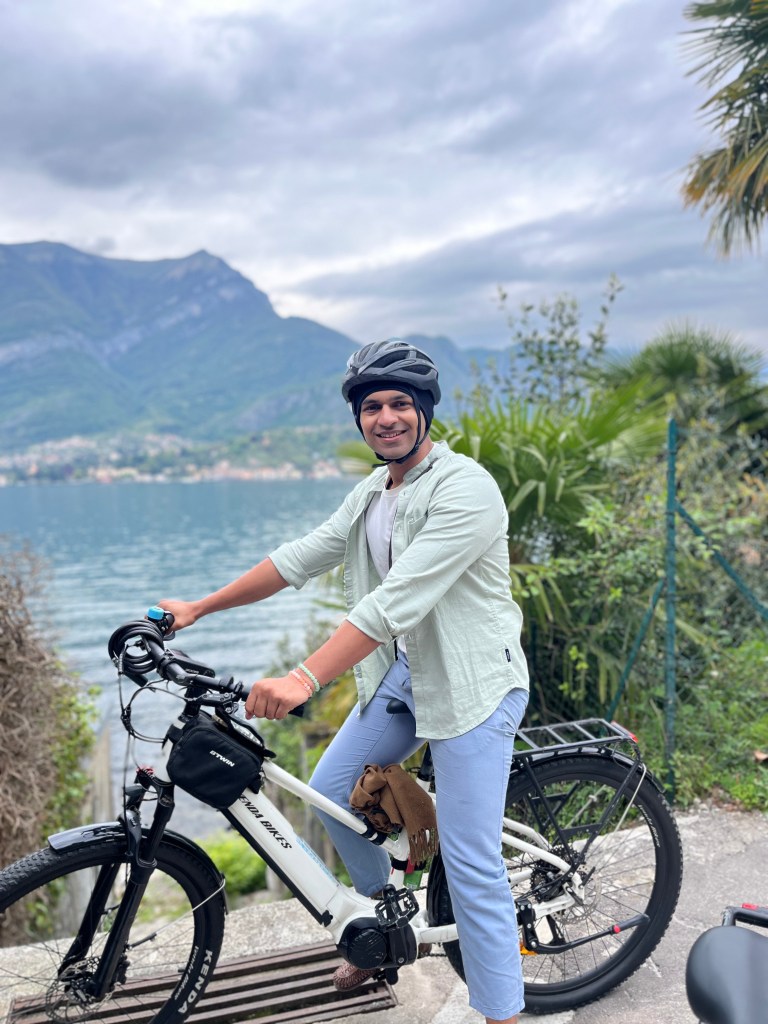
We returned the bicycles, caught the ferry back to Menaggio, rested briefly, then had dinner at Dal Tato, where the pasta was excellent, before heading to bed.
Day 2 ratings: Como ferry: +4 | Varenna: +2 | Villa Cipressi: +5 | Villa Monastero: +2 | Bellagio: +4 | Trattoria San Giacomo: +1 | E-bicycle experience: +5
27th April, Saturday – Milan
We started the day at the supermarket to buy a SIM card, bought it, but couldn’t get it activated. We also picked up some snacks for the trip to Milan, having chosen to drop the car off near Milan Central Station instead of MXP.
A tip for your own Italy itinerary: notice that our car sat parked the entire second day in Como. I’d recommend skipping the car altogether for exploring these towns, and pre-planning around train or bus instead. The lanes are too narrow, parking and moving the car between towns is expensive, and renting a car costs far more than public transport for this stretch.
Milan
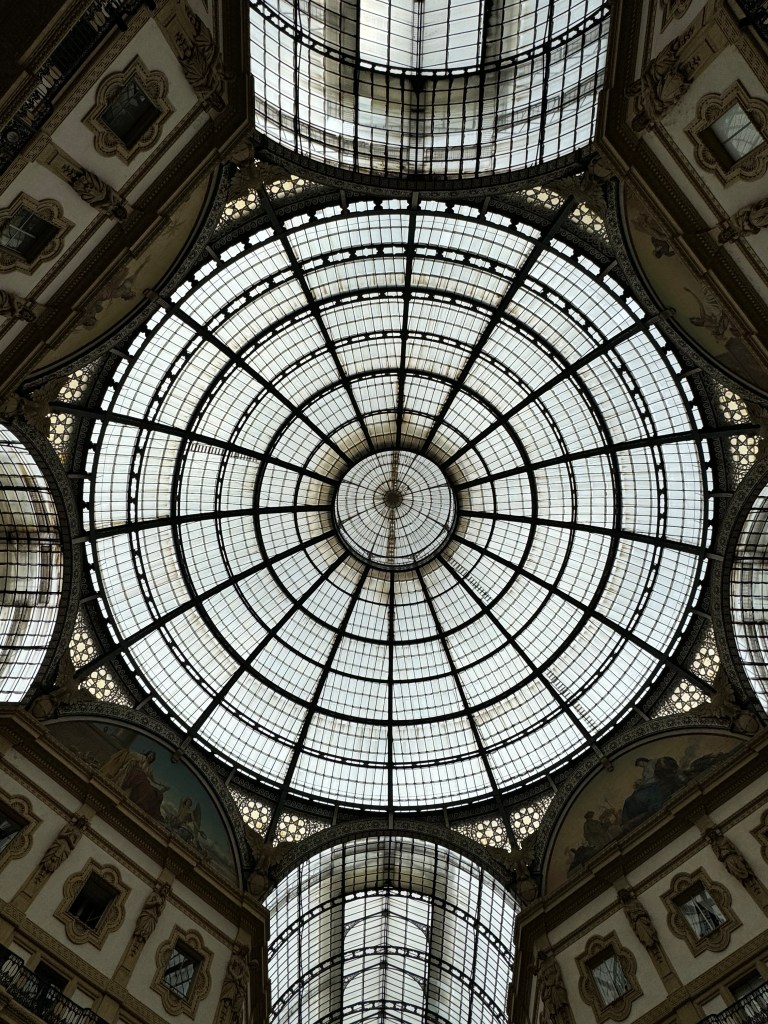
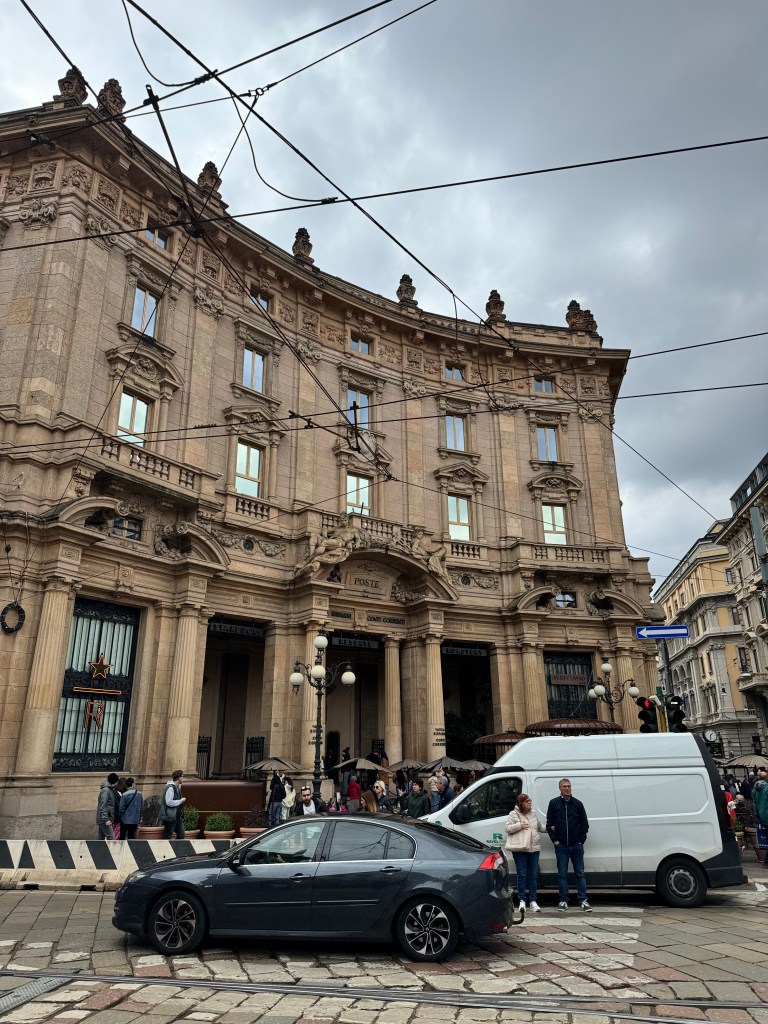
We parked near the Milan Cathedral and headed to Cathedral Square, where a queue of roughly 1,000 people greeted us. Since neither history nor religious sites are a big draw for us, we admired the Cathedral from the outside and moved on to Galleria Vittorio Emanuele II, Italy’s oldest active shopping gallery, dating back to 1877. It has striking architecture and today houses luxury labels like Armani, Prada, and Gucci.
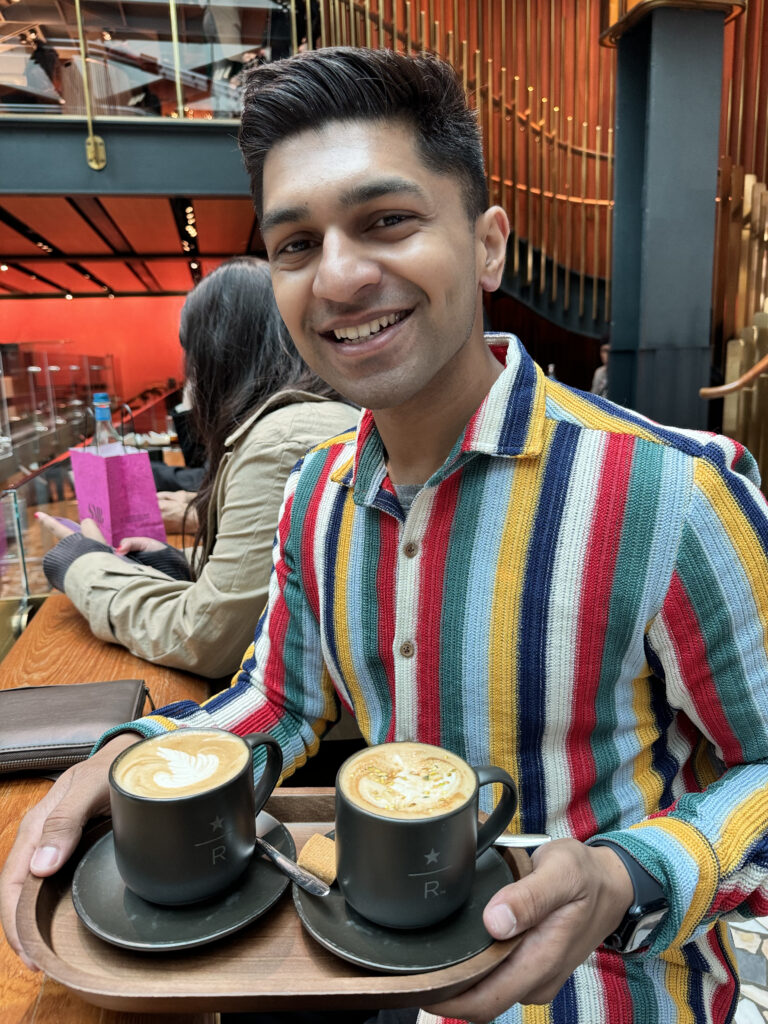
From the Galleria, we headed to the Starbucks Reserve Roastery, one of only 6 in the world and the only one in Europe. It’s a huge outlet serving Starbucks’ signature roasts. Nearby, you’ll also find fast fashion outlets like Uniqlo, H&M, and Zara. We shopped a little, then headed to Milan Central Station to pick up our third trip mate and catch our train.
We dropped our luggage with our friend at the station, then walked to Sicily by Car’s drop-off point nearby to return the car, a 15-minute walk back to the station once done. From here, we were headed to the five UNESCO-recognized fishing villages collectively known as Cinque Terre. We’d booked our stay at La Spezia, the town right after the five villages.
The train from Milan Centrale to La Spezia Centrale took about 3 hours, and we arrived at dusk. Our BNB was a 10-minute walk from the station.
A tip if this is part of your own Italy itinerary: at La Spezia Station, we bought 2-day passes each, a special train pass covering the route between the 5 villages and the two towns on either side, Levanto and La Spezia. It’s expensive, but worth getting, since there are frequent surprise ticket checks on both the trains and at the stations.
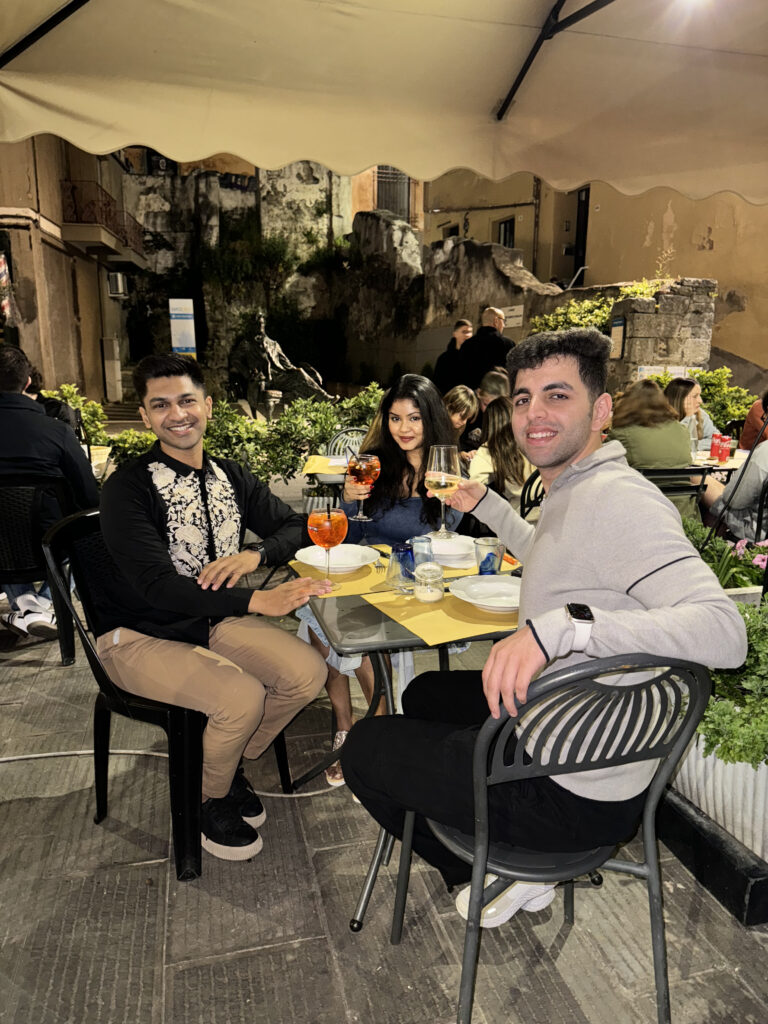
That evening, we explored La Spezia itself, home to roughly a hundred cafes, so there was no shortage of dinner options. We ate at Papa Nero, which was nice. Being a Saturday, we hoped to find a weekend party, but came up empty. Tired and it being late, we called it a night.
Day 3 ratings: Milan City: +2 | Milan Cathedral (from outside): +1 | Galleria Vittorio Emanuele II: +1 | La Spezia town: +2
A Quick Guide to Cinque Terre
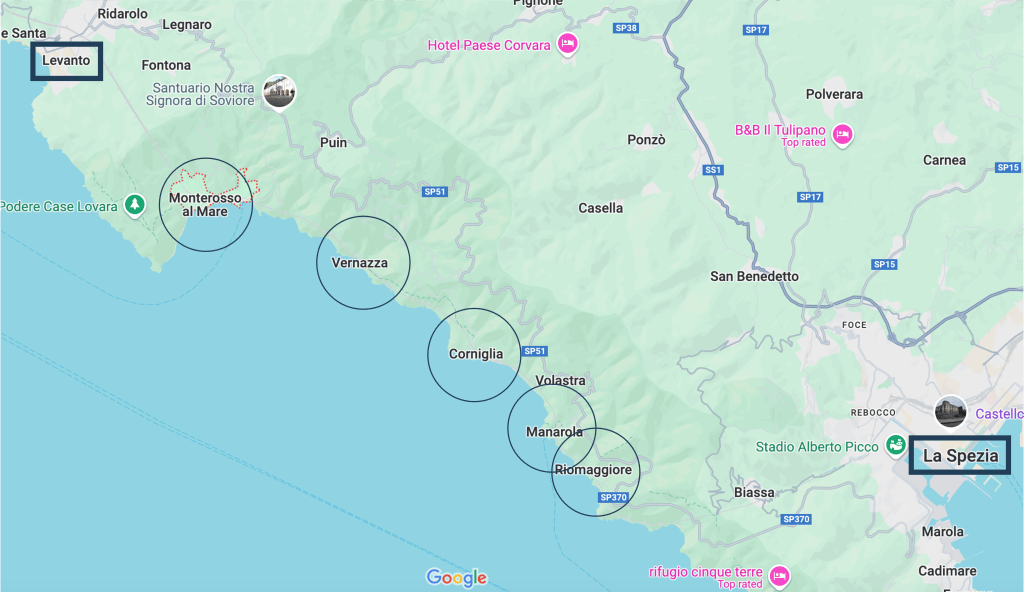
Before the day-by-day village breakdown, here’s what each of the five villages is actually like:
- Monterosso: The only village with a proper beach. The tourist area starts right outside the train station, with the main road running parallel to the ocean toward the beach. Rent a sunbed and order plenty of Limoncino and Aperol Spritz.
- Vernazza: Widely considered the prettiest, and quite small. Full of pretty corners for photos.
- Corniglia: The only village without beach access. Even the walk from the station to the town itself is a moderately challenging hike, we skipped it.
- Manarola: Has the highest concentration of restaurants and shops. The walk to the viewpoint (inside the town itself) is free and a must-do. Nessun Dorma, the most famous restaurant across all five villages, sits right at this viewpoint, bookable via app, though the wait is still long and it’s not great for vegetarians.
- Riomaggiore: A bit of everything, plenty of photogenic lanes, reasonably sized, and reportedly the only village with any real nightlife.
Where to base yourself: Levanto (west) and La Spezia (east) are the two adjacent towns offering better train connectivity and cheaper stays than the villages themselves. We stayed in La Spezia and it worked well, staying in one of the villages would have meant switching from the main rail line to the Cinque Terre line and buying the train pass separately.
A few practical notes:
- Most villages involve some hiking between the station and your hotel, worth planning for if you’re travelling with large suitcases.
- Touring the common areas of each village takes only 45 minutes to an hour.
- There’s a separate paid day-hiking pass for the trails connecting the villages. Unless you specifically want to hike, the train pass alone is enough, skip the hiking pass.
- Several operators offer kayaking and sailing tours in the area, we didn’t try these, but they’re worth knowing about.
- Look out for shops selling on-the-go alcoholic drinks in disposable glasses, handy for sipping while you explore.
28th April, Sunday – Riomaggiore and Manarola
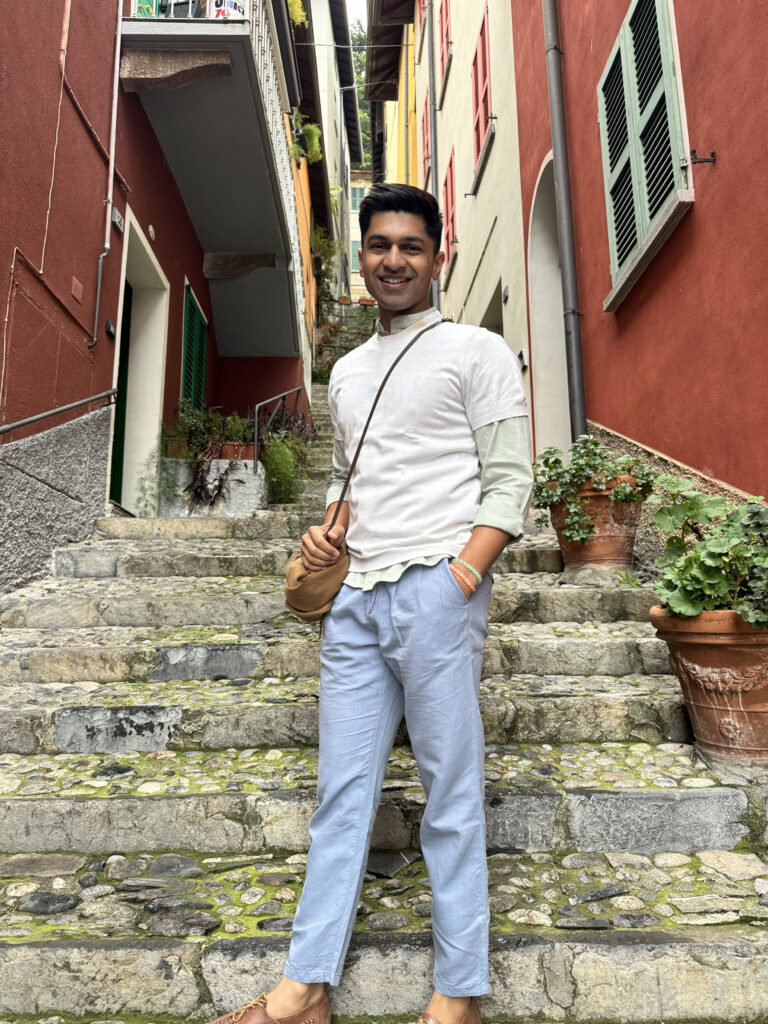
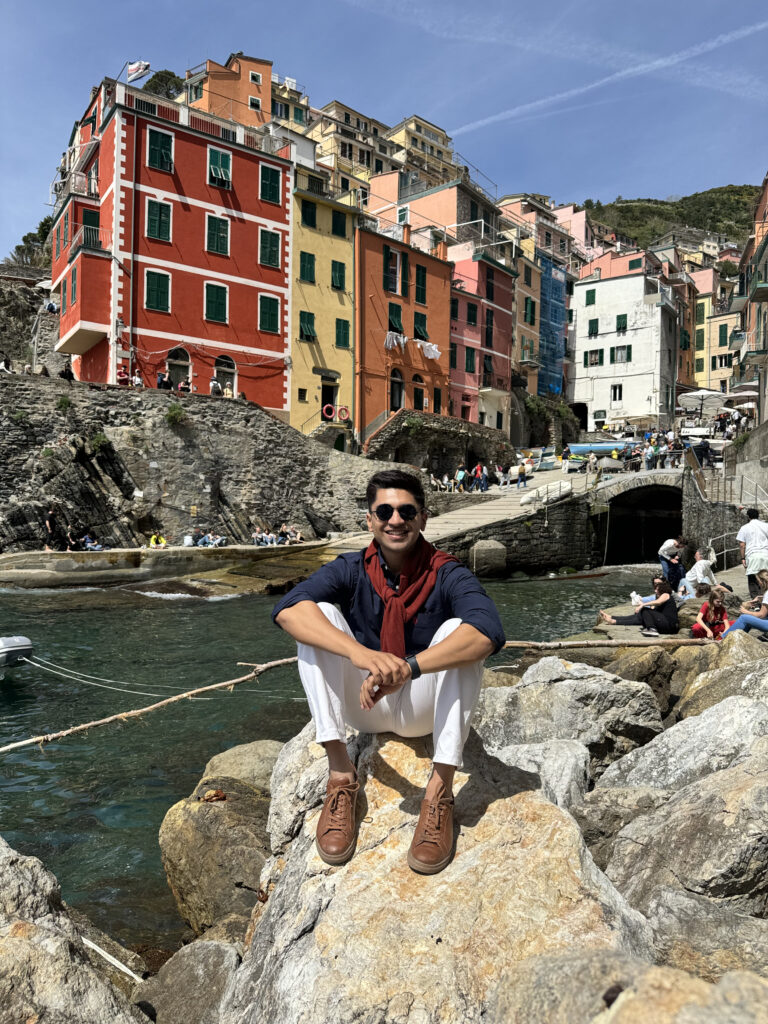
Riomaggiore is an uphill 15-minute walk from the station to the town itself, which turned out to be fairly large. We took plenty of photos and grabbed Limoncinos, avocado toast, and smoothie bowls for breakfast. Down at the town’s pier, a small area with large rocks to sit on, you get a great view back toward Riomaggiore’s postcard-colourful houses.
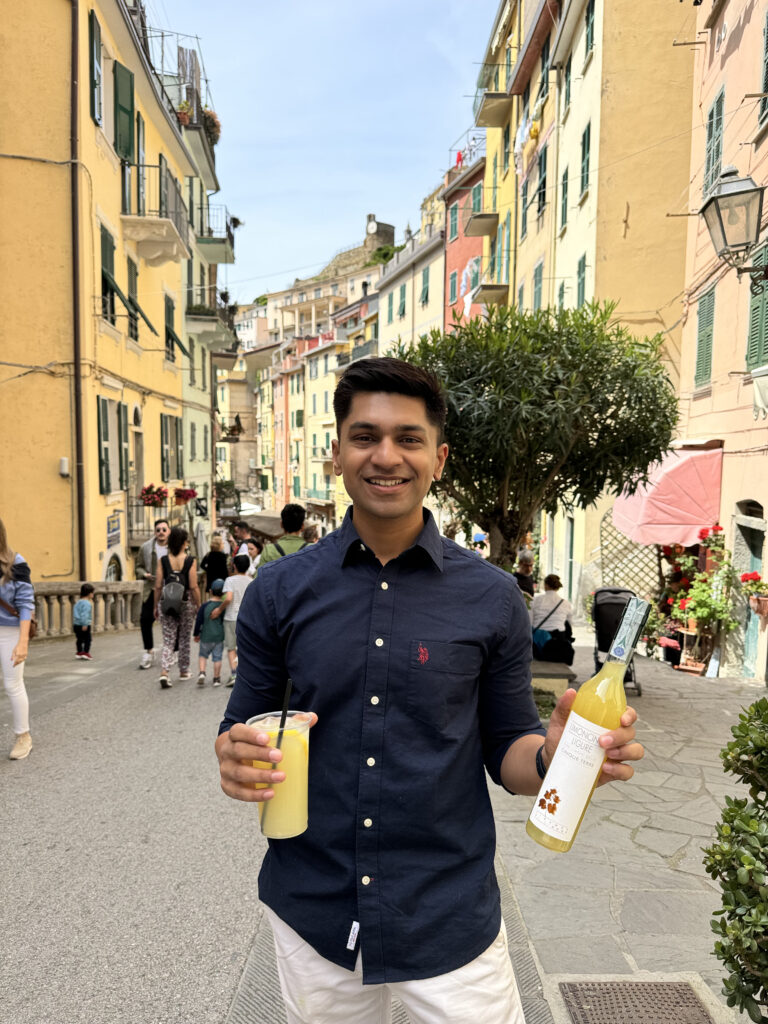
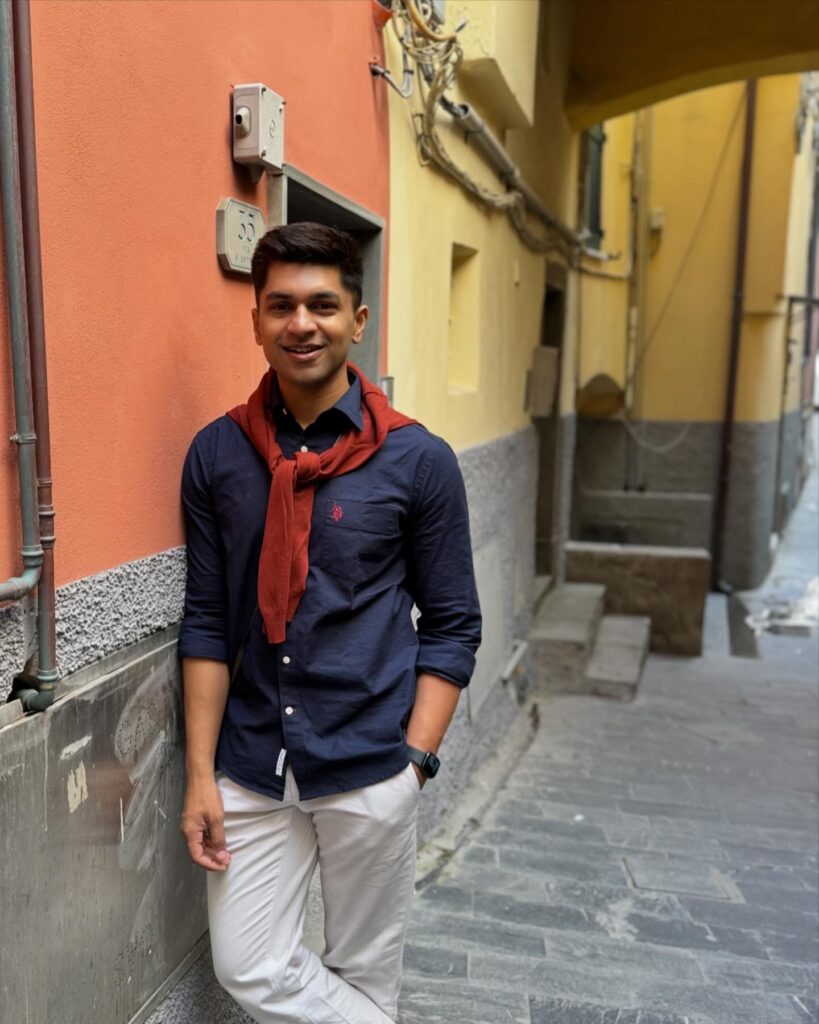
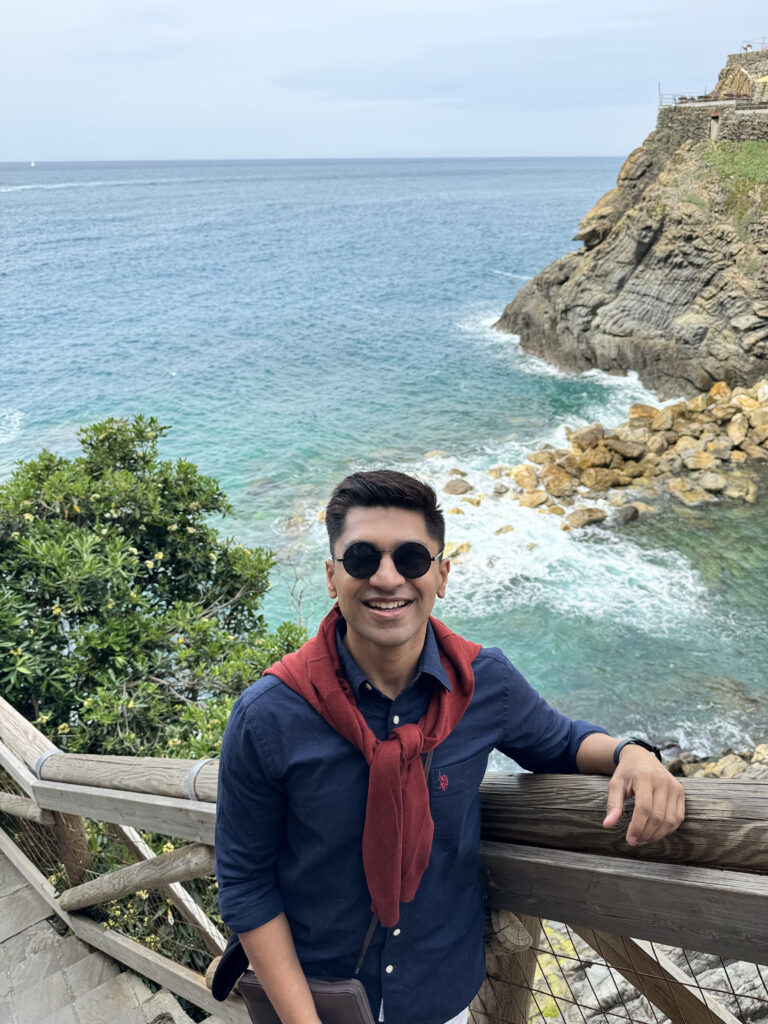
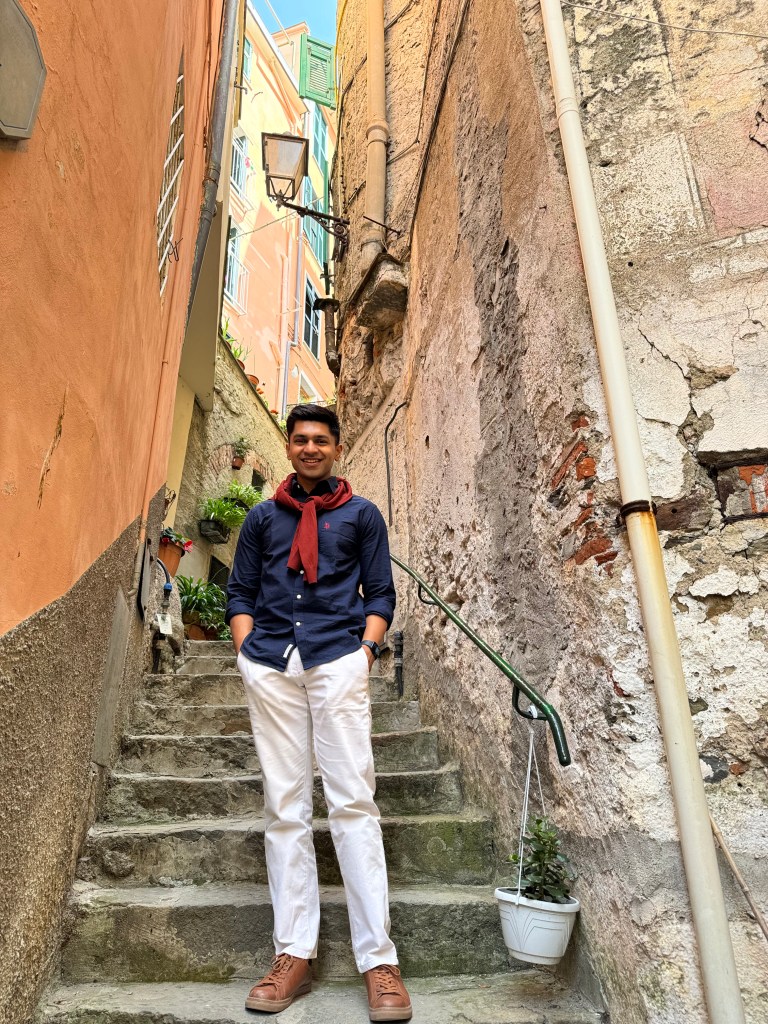
We headed down to the town’s pier, which is quite small with huge rocks on which one can sit and relax. One can look and Riomaggiore and see those postcard colourful houses.
From there, we moved on to Manarola for lunch. Focaccia is everywhere here, essentially a hard-bread open panini, but popular nonetheless. The pier has a large seating area too. April 2024 was unusually chilly across Europe, so the water was too cold for most of us to swim, though a few brave souls gave it a go anyway.
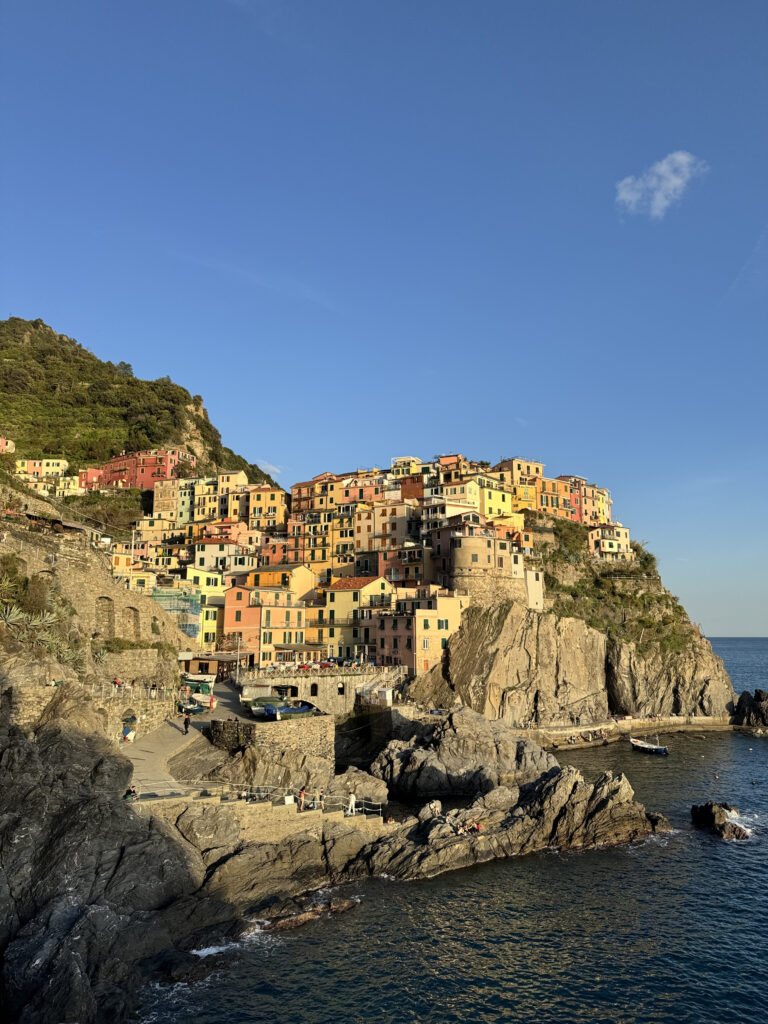
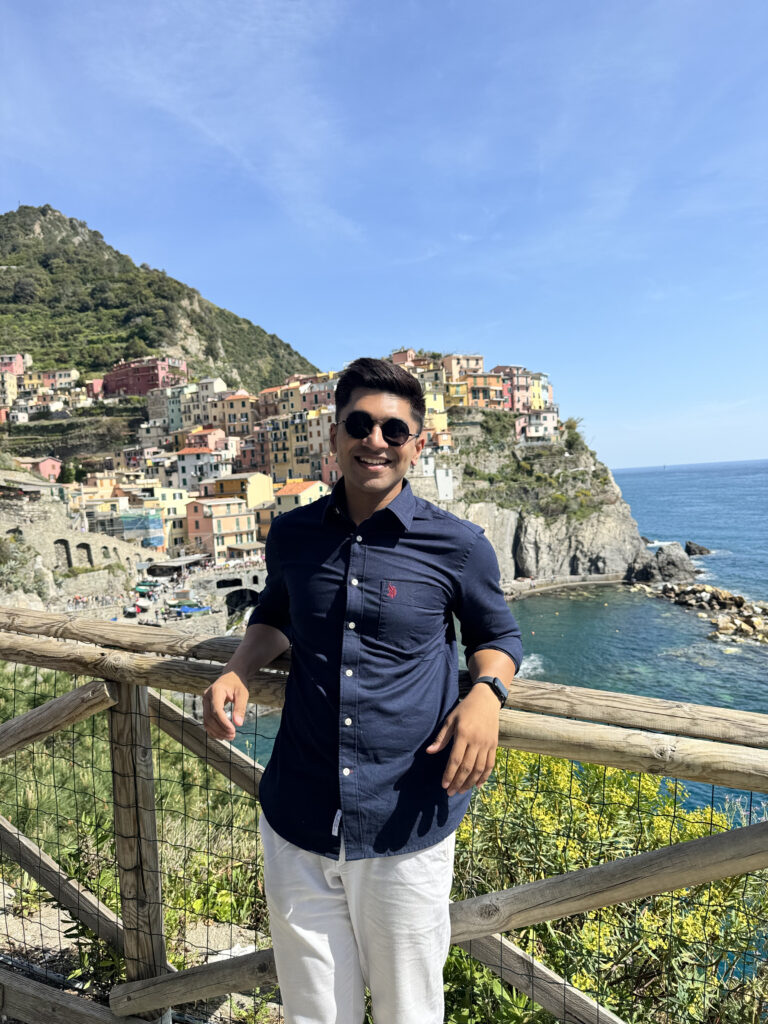
One important tip: always check the Cinque Terre train line schedule and note the last train, missing it makes getting back to your stay far more difficult. As it got dark, we headed back to La Spezia, rested, and went out for dinner.
Day 4 ratings: Riomaggiore: +2 | Manarola: +3.
29th April, Monday – Vernazza & Monterosso
We headed to Vernazza next, a pretty small town. Unlike Riomaggiore and Manarola, its pier is flat, with plenty of open space to sit and relax. We spent the day touring the town.
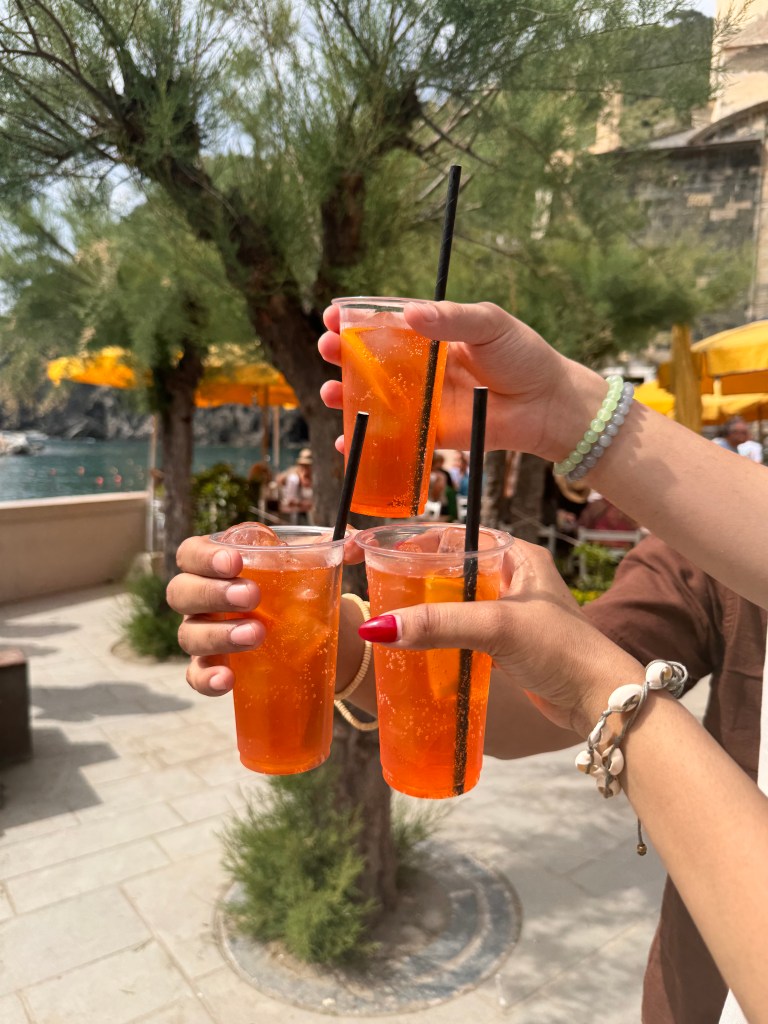
A hiking trail leading toward Monterosso offers the best view of Vernazza. Note that a separate hiking pass is required to walk between the villages, but the checkpoint for this comes about 5 minutes into the trail. We hadn’t bought a pass since we didn’t plan to hike, but when we asked the officer if we could walk a little further just for pictures, she kindly let us through. After 5 more minutes, you get the entire town in the backdrop for what are genuinely the best photos of Vernazza. We sipped Aperol Spritz along the way.
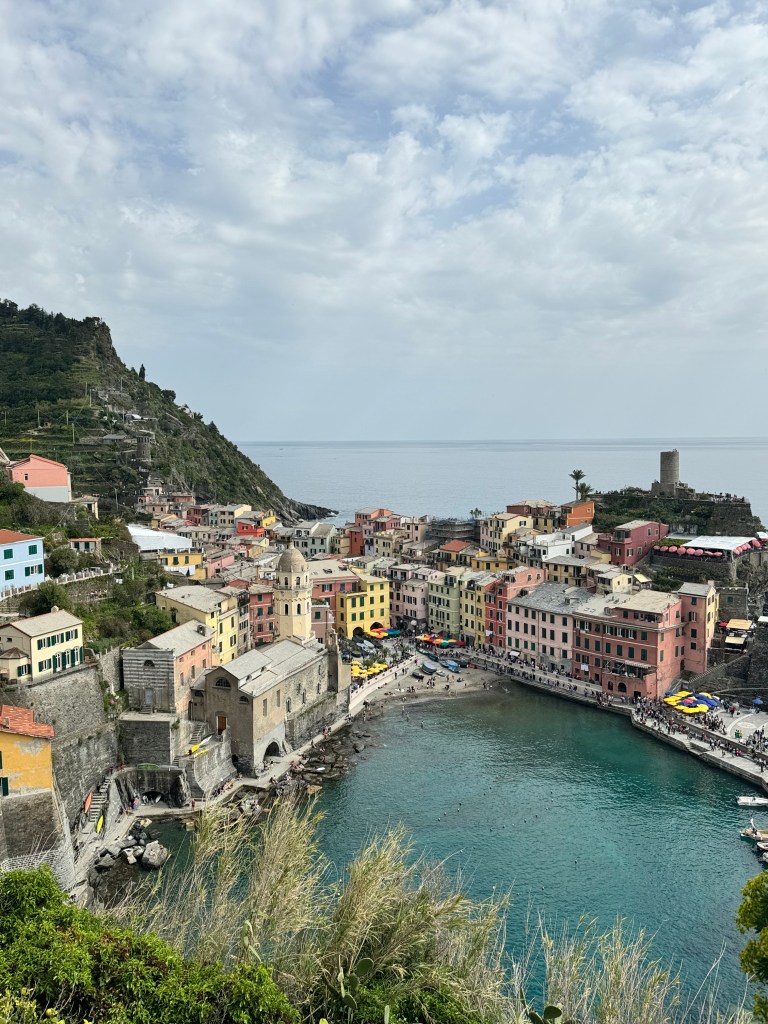
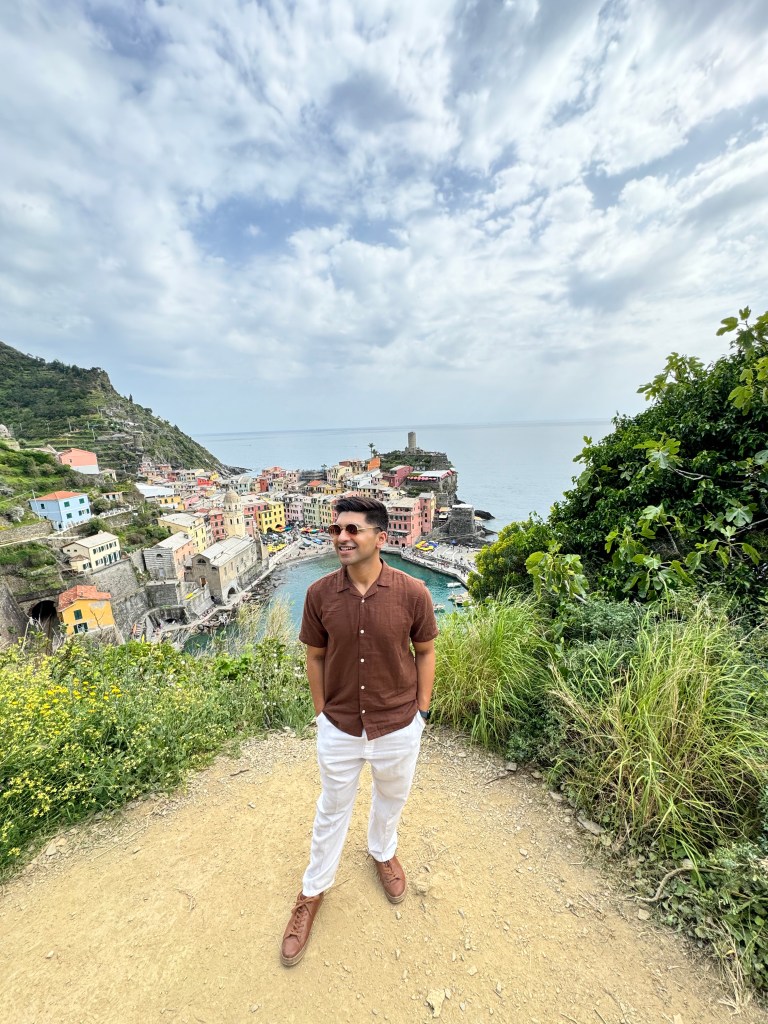
From Vernazza, we moved on to Monterosso, the biggest of the five villages and the most conventionally beautiful. The other three villages charm you with colourful, quaint houses, but Monterosso’s real draw is its ocean-facing walking lane leading down to a beach. We rented sunbeds, ordered Hugo, Limoncino, Aperol, and pizza, and relaxed with a light breeze through the afternoon.
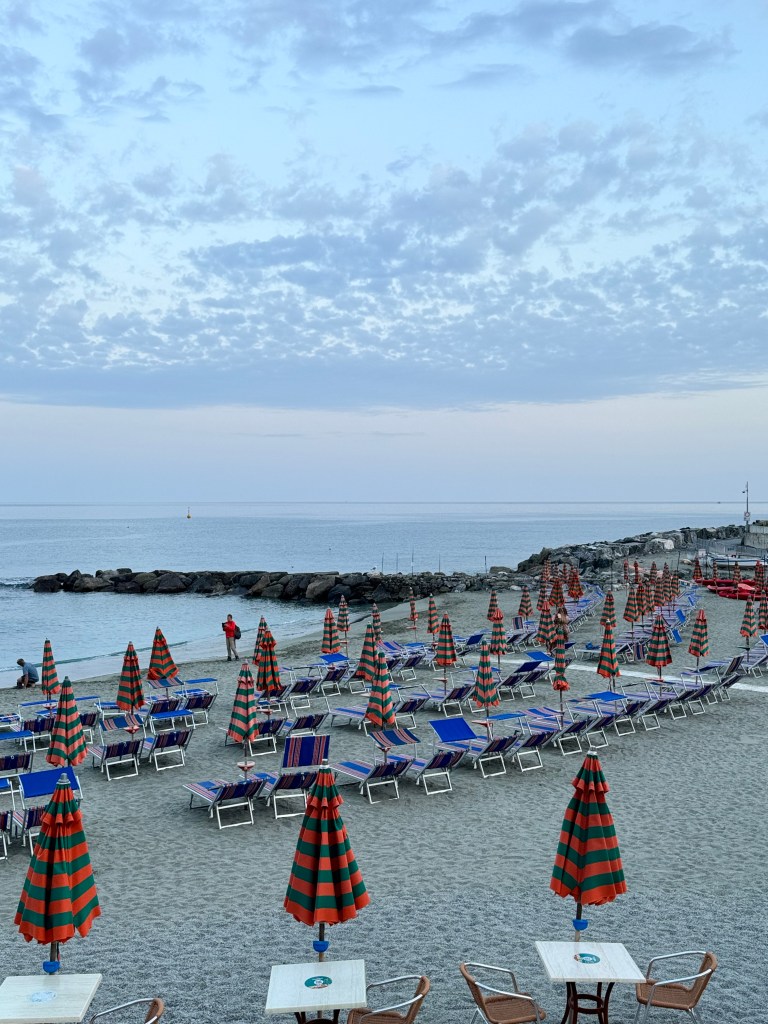
As it got dark again, we trained back to La Spezia for dinner. One thing worth mentioning: throughout the trip, we constantly picked up small snacks along the way, food really does make travel better.
Day 5 ratings: Vernazza: +3 | Monterosso: +3
30th April, Tuesday – Welcome to Tuscany
We had an early train booked from La Spezia to Florence Centrale, with breakfast in La Spezia beforehand. The journey took about 2 hours.
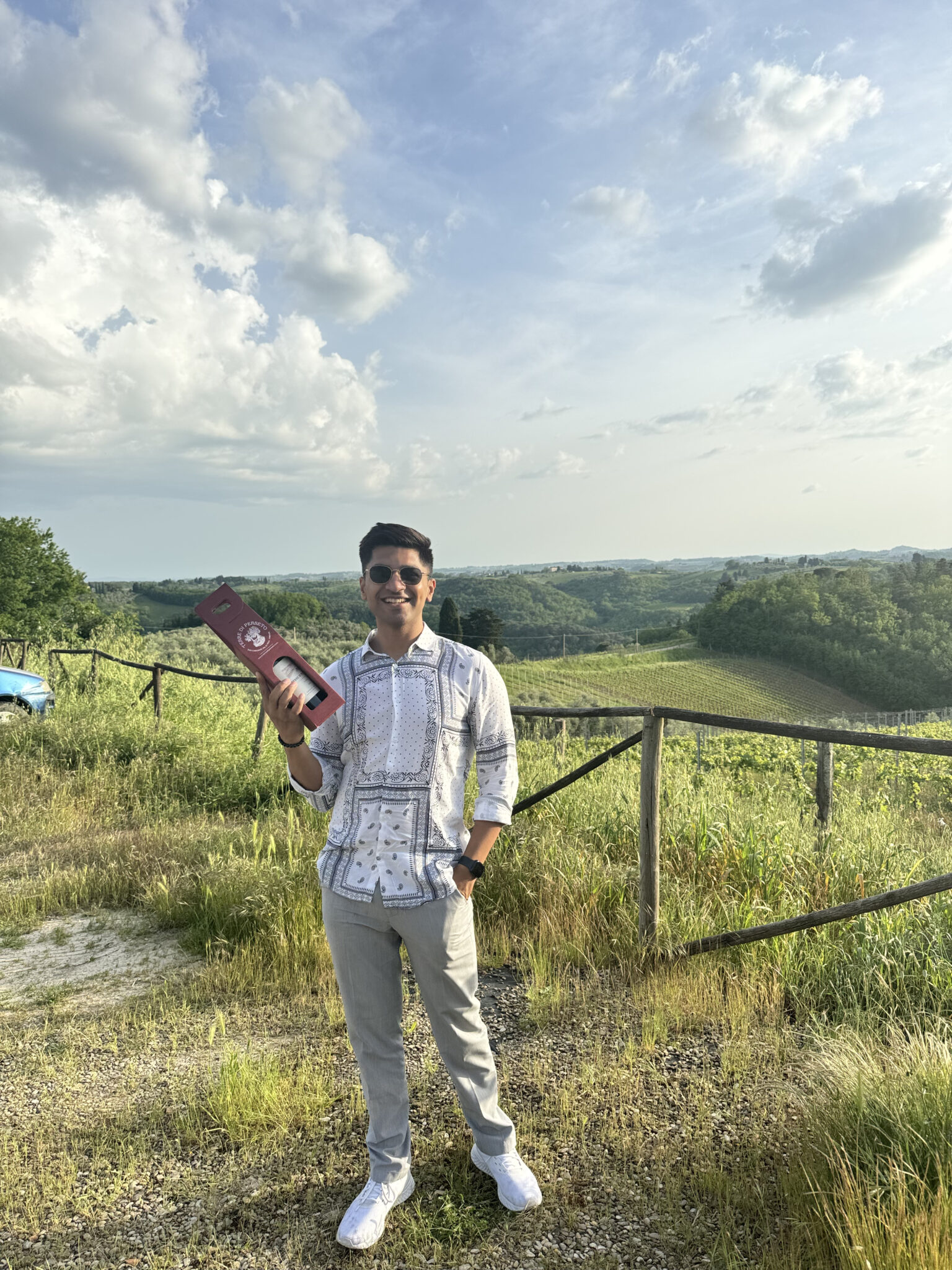
At Florence, we picked up our rental car. Though the office sat right outside the station, we had to walk 500 metres with our luggage to reach the actual pickup point. On the way to our stay, we stopped for a wine-tasting and vineyard tour in the Chianti Classico region, four glasses of wine paired with a cheese platter, followed by a tour of the vineyard and barrel warehouses.
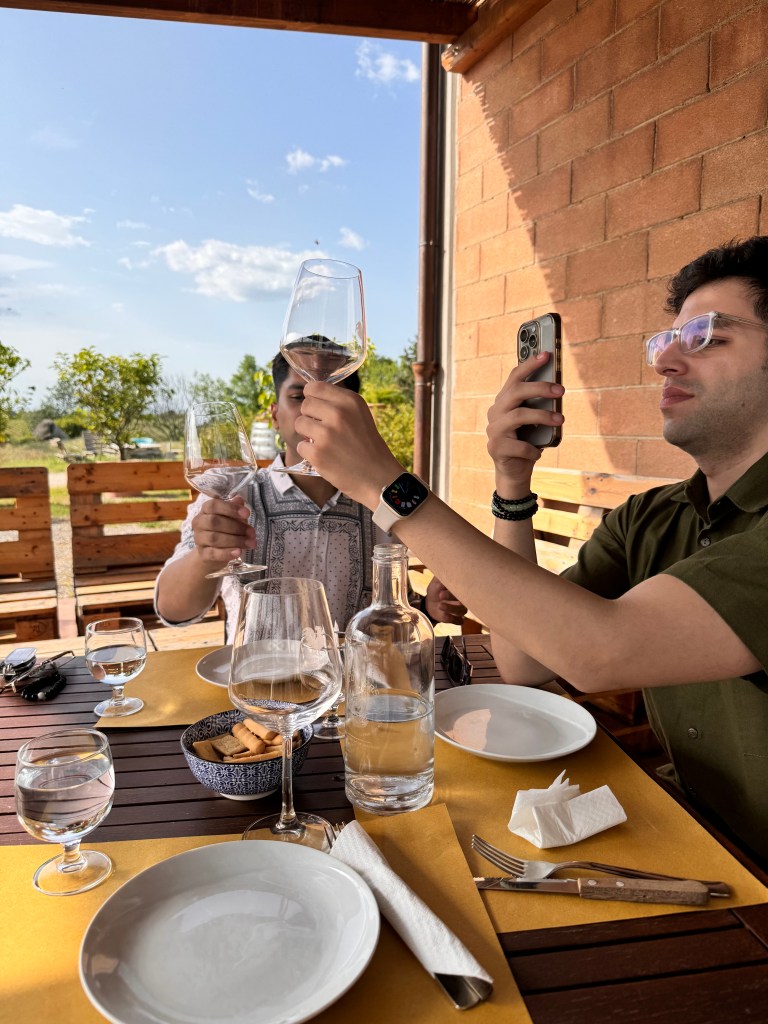
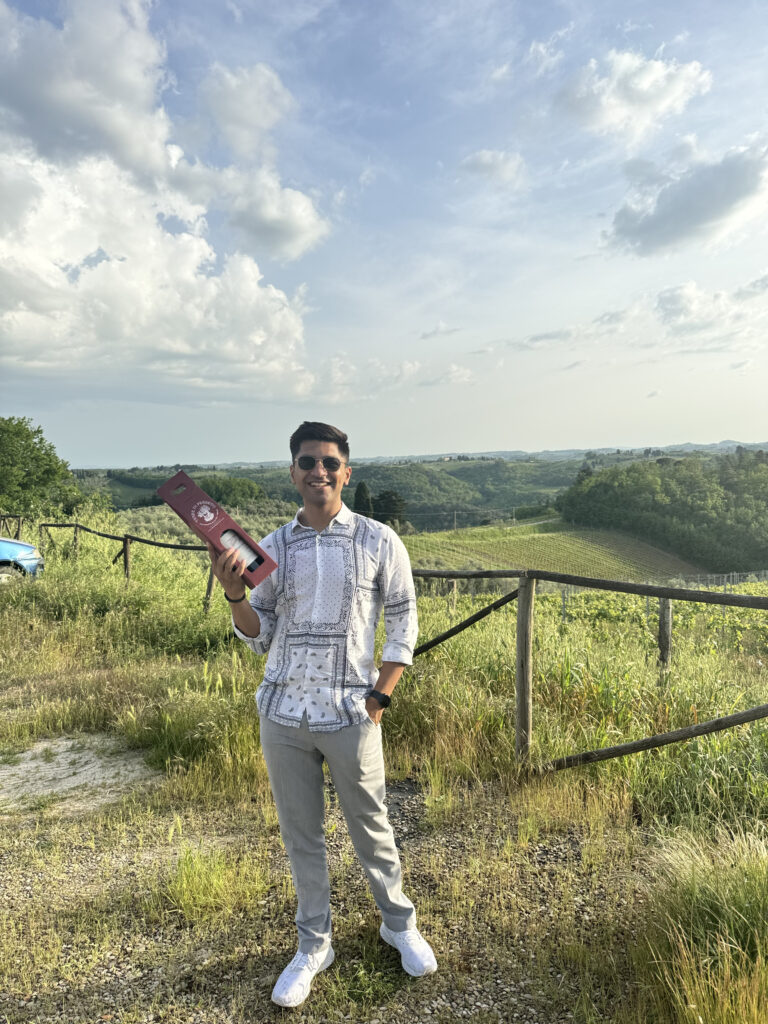
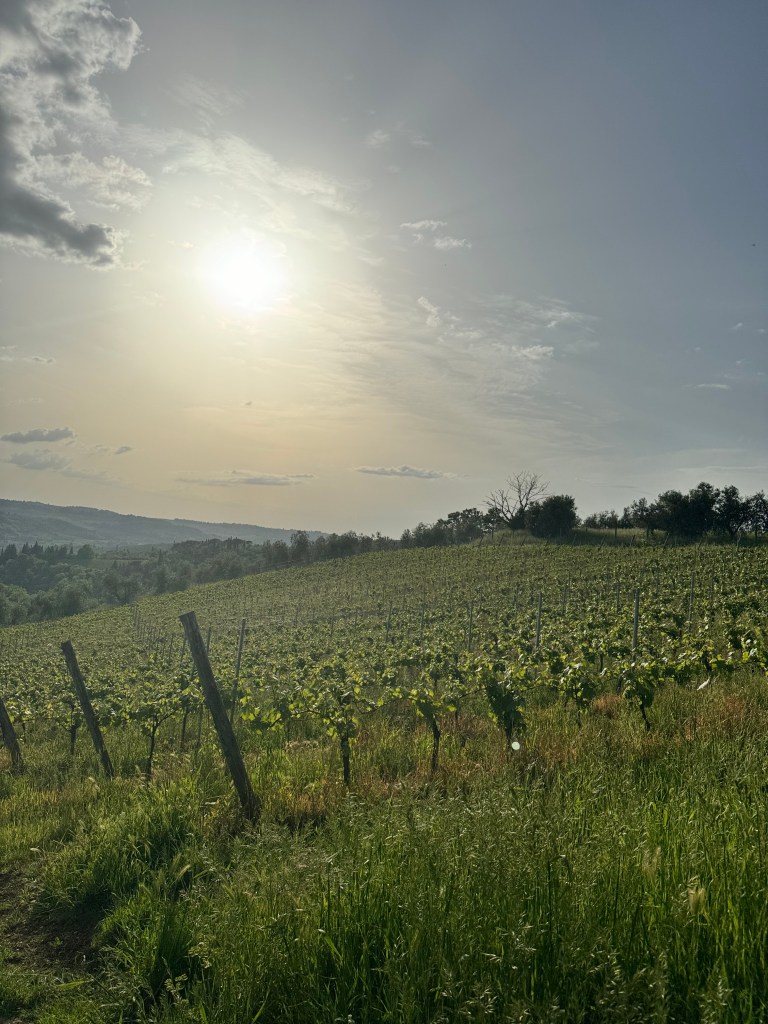
From there, we headed to our stay for the next two nights, Tenuta Decimo Villa Dini, tucked into the farmlands (worth searching up directly). It’s the kind of location you need a self-drive car to reach.
It was already dark by the time we headed out for dinner at Ristorante Pizzeria La Bona Osteria, 7 km from our stay, and easily the worst meal of the trip. We returned and called it a night.
Day 6 ratings: Wine Tasting Tour: +1 | Tenuta Decimo: +3 | La Bona Osteria: -5
1st May, Wednesday – Siena & San Gimignano
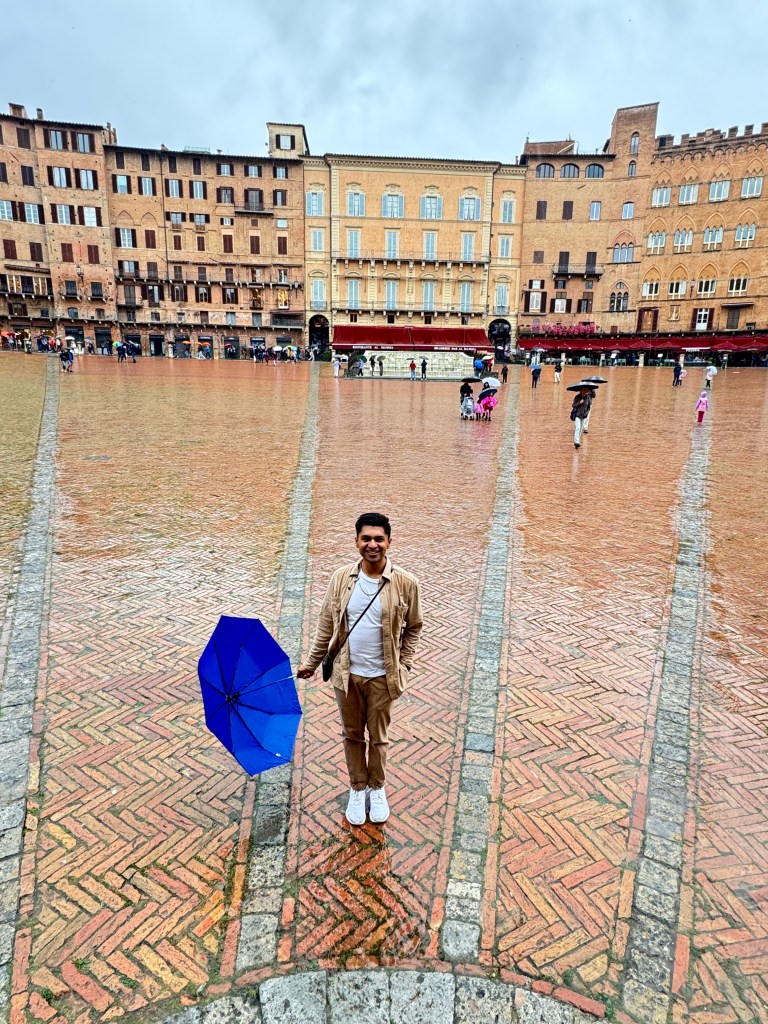
A countryside day, starting with Siena, one of the larger towns in Tuscany. Parking was a genuine struggle, but we eventually found a spot in one of the city’s car parks and headed for breakfast.
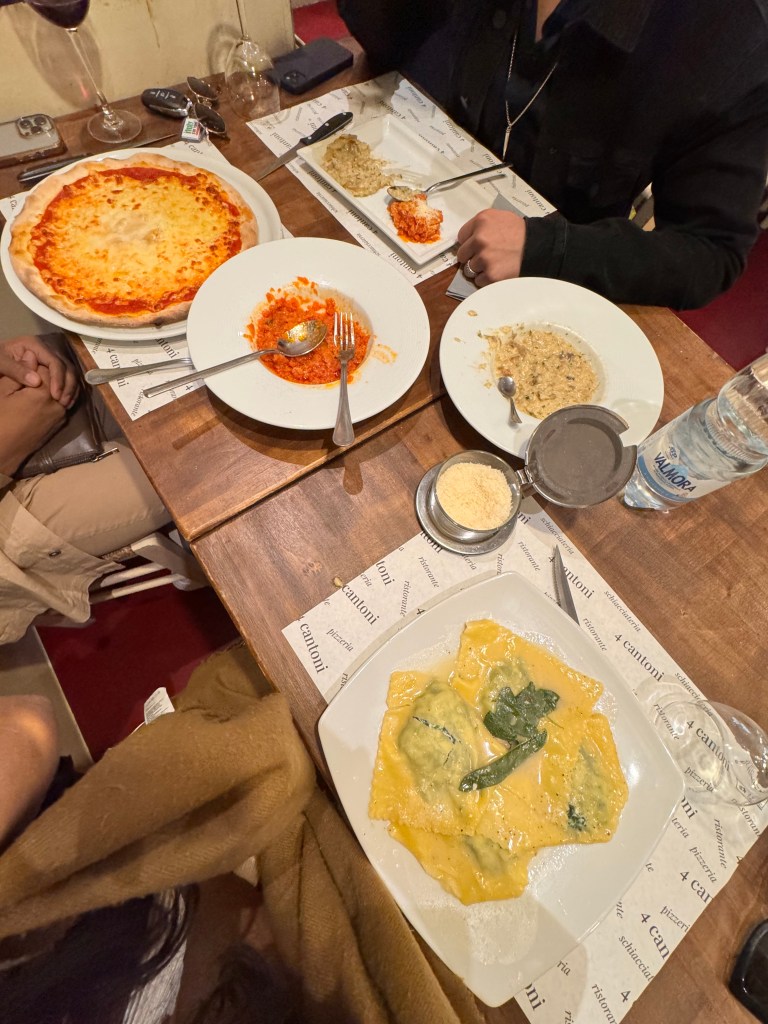
We had the best meal of the trip so far at Ristorante 4 Cantoni, the dry tomato soup, ravioli, and risotto were all excellent. From there, we explored the town itself, which is quite hilly, so expect plenty of stairs and inclines.
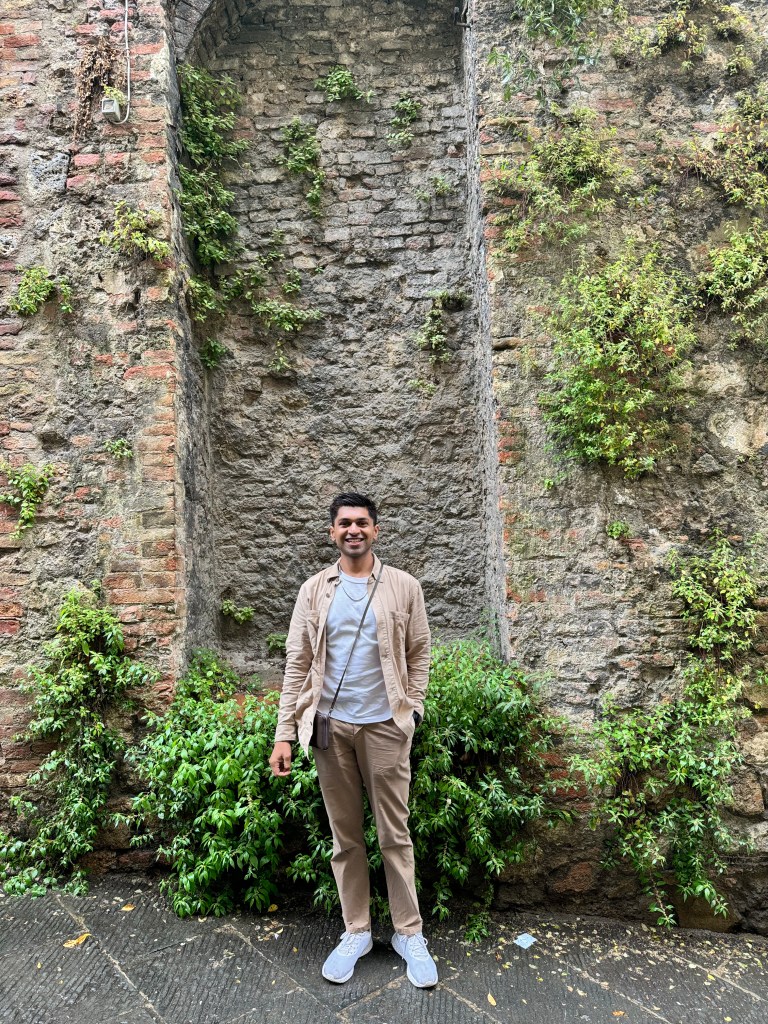
Siena Square is the clear highlight, worth sitting in one of the cafes around it for hot chocolate or coffee. The town also has shops selling wine, truffle oil, apparel, and olive oil.
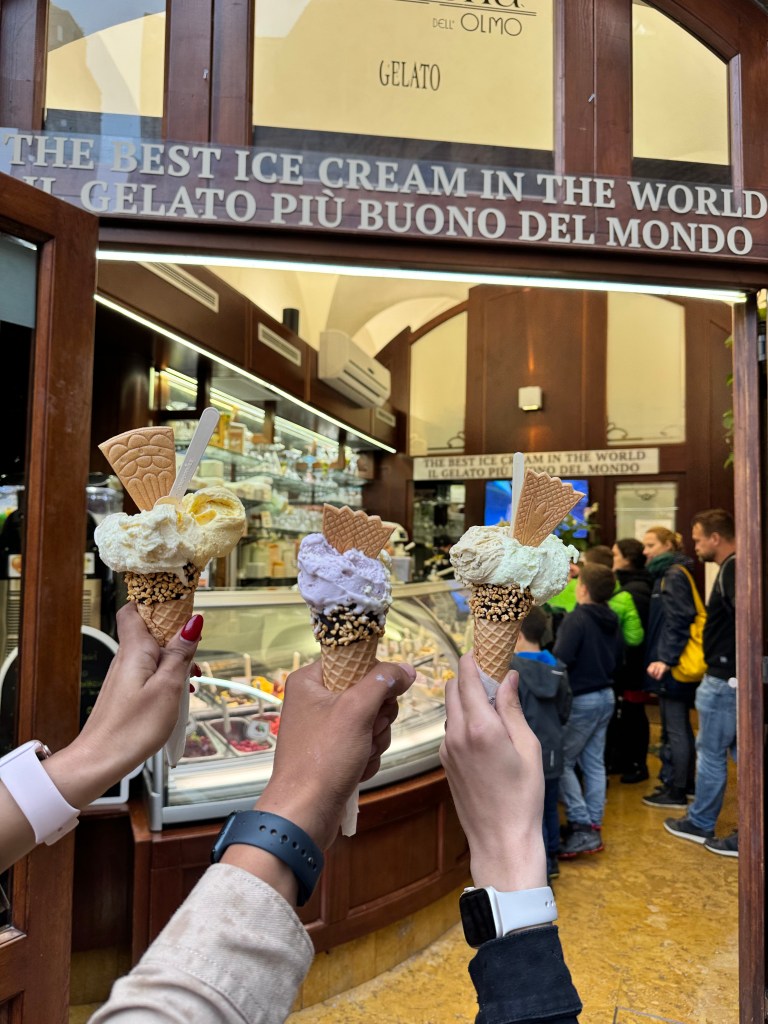
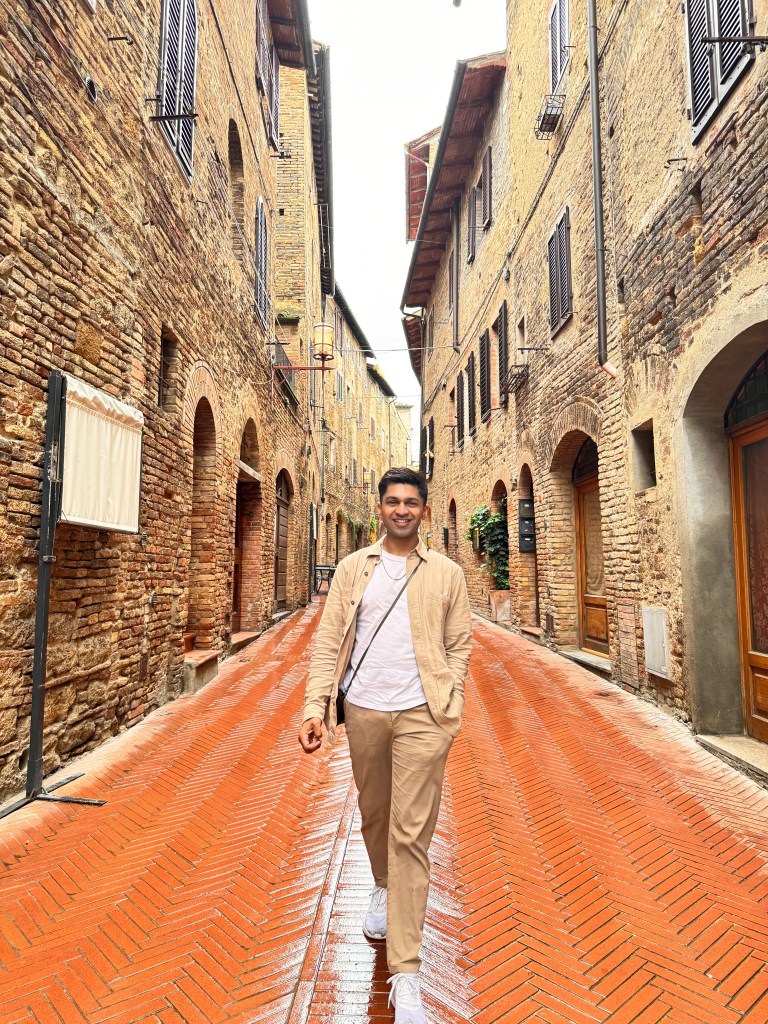
Next was San Gimignano, a sandstone-coloured town best explored on foot through its many lanes of food and shopping. The gelaterias here all claim to be the world’s best or most awarded, though I found them about as good as anywhere else in Italy.
We ended the day with dinner at La Locanda del Borgo, right next to our stay, also good, before crashing for the night.
Day 7 ratings: Siena town: +2 | Ristorante 4 Cantoni: +5 | Siena Square: +4 | San Gimignano: +2 | Gelaterias in San Gimignano: +3 | La Locanda del Borgo: +3
2nd May, Thursday – Reached Rome but missed my Train
We headed into Florence city, with a forward train to Rome booked for around 1 pm. Parking, like in most European cities, was a hassle.
Florence’s food reputation is well-earned, so we made a point of visiting one of its famous spots, Trattoria Za Za, where both the food and ambience were excellent. After breakfast, we went for affogato at Vivoli, the queue moved fast, and we were served in about 10 minutes. Good, but nothing extraordinary.
Then things fell apart.
With very little time left to catch our train, we split up: one person walked ahead to the car drop stand to complete formalities, while the other two of us went to collect the car. At the station, one person got off with all 6 bags while I planned to return the car and rush back on foot to meet everyone at the platform.
That’s when I discovered Florence’s one-way system meant a 500-metre walking distance was over 5 km by car, at least 20 minutes away with all the traffic lights and crossings involved. I called my friend at the car drop point and told them to rush to the station with the luggage and board the train without me, I’d catch the next one instead, keeping the ticket rebooking to just one person.
He ran for it, and then it started raining. He had to take shelter. Our third friend, standing with all 6 suitcases, could only fit under a ledge with 2 bags, leaving 4 out in the rain. None of us made the train.
Forty minutes later, the three of us regrouped at the station with all 6 suitcases and decided a bus was our cheapest option. We booked it, only to realize the boarding point was clear across the city. We sprinted for a tram, our bus was at 3:15 pm, and our tram got us to the right stop at 3:16 pm. Naturally, the bus was running late anyway, arriving 30 minutes after that.
We finally reached Rome, though some distance from our accommodation. We picked up a 3-day unlimited train pass and made our way to our stay, conveniently close to the Colosseum. Checking in turned into its own small ordeal, but once done, we headed to the old town for dinner near the Trevi Fountain, eating at Pizza in Trevi (good), before wandering the lanes and calling it a night.
Day 8 ratings: Florence City: +2 | Trattoria Za Za: +4 | Rome: +2 | Trevi Fountain: +4 | Pizza in Trevi: +2
3rd May, Friday- Roaming in Rome
My friends headed to Vatican City; having already seen it on my earlier trip, I skipped it. Instead, I used my train pass to explore the old town around Barberini station, lined with upscale stores, including a striking 4-storey Zara inside a landmark building. Breakfast was a solid poke bowl, followed by more wandering.
By lunch, we regrouped at a restaurant. Afterward, two of us went back to rest while one explored the Trastevere neighbourhood, returning quite tired.
That Friday night, we went to Muccassassina, widely considered Rome’s best weekly LGBT party, held only on Fridays, starting at 11 pm. Despite a long queue (pre-gaming helped), we got in. The venue spans three floors: Western pop on the ground floor, techno on the first, and a performance stage on the second. Great crowd, great night.
Day 9 ratings: Barberini neighbourhood: +3 | Poke bowls in general: +4 | Muccassassina: +5
4th May, Saturday- Nothing like Day Drinking
We woke up late after the previous night’s party. My friends had booked a Colosseum and Roman Forum tour, which I skipped, having done it on my earlier visit. I shopped in a different neighbourhood instead and met everyone later at the Roman Forum.
A useful tip: electric bikes from Lime, Bolt, Bird, and similar apps are easy to rent with just an Indian driver’s license, and the area’s regulated traffic makes them safe to ride. The learning curve is small, though rentals can get pricey.
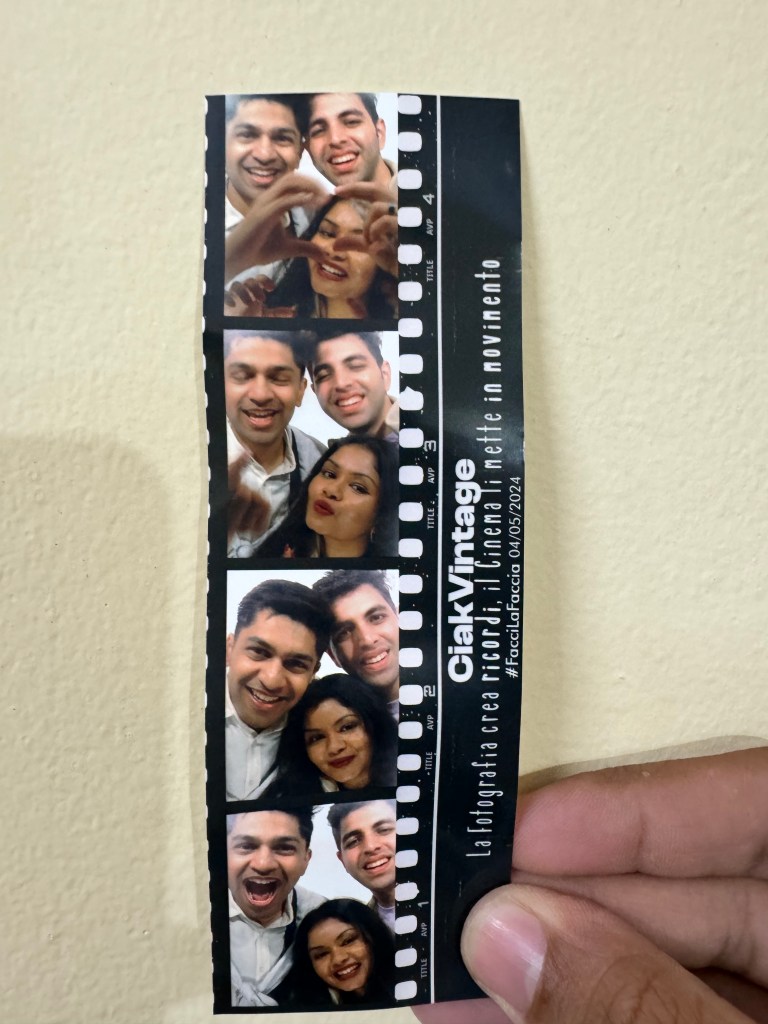
Later, we tried something distinctly Roman: day-drinking in a public park. We picked up a bottle each of Limoncino and Prosecco with three glasses, found a park, and got pleasantly tipsy in the afternoon sun. From there, we headed to Piccolo Buco, Rome’s most viral pizza spot, and queued for 90 minutes to get a table. The pizza was great, though not quite worth the wait.
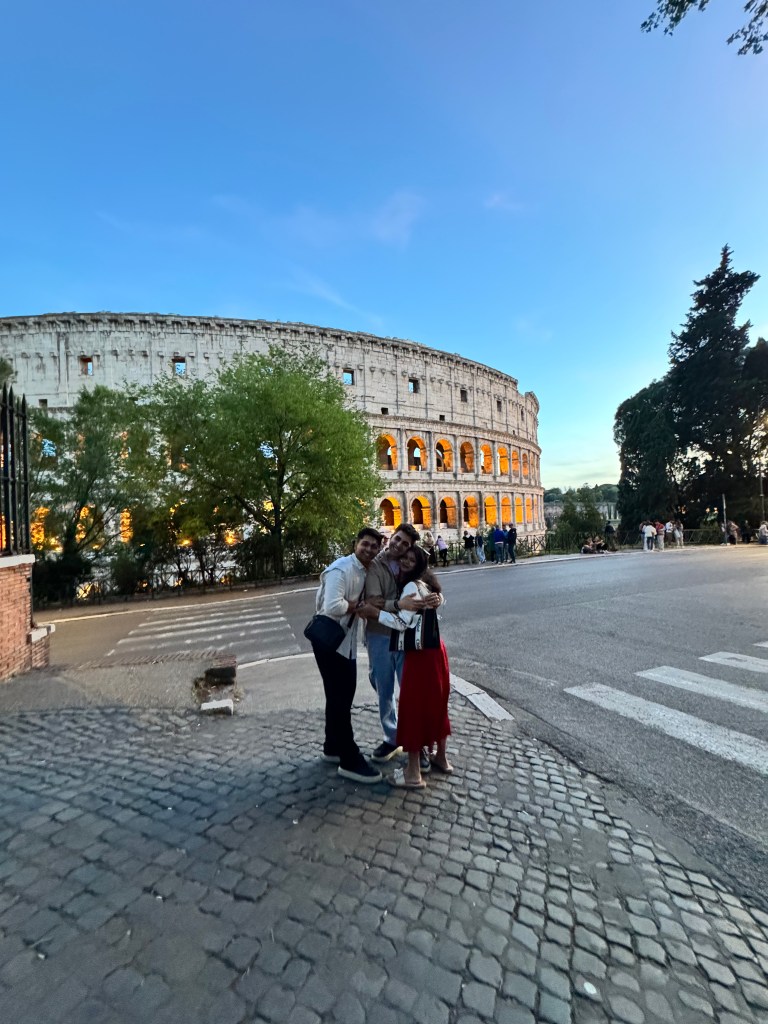

We packed that evening for our early flight home.
Day 10 ratings: Electric bikes: +2.5 | Day drinking in a public park: +4 | Piccolo Buco: +2
5th May, Sunday – Ciao Italy!
We had an early morning flight, got up reached the bus station, caught the airport bus, and flew back to India via Munich.
Highlights From the Previous Trip (October 2019)
In 2019, I visited Italy with my parents and covered a few places that didn’t make it into this year’s Italy itinerary.
Venice: The touristy part of Venice sits amid the sea with no main roads, only canals. It’s unique, but everything comes at a price. The gondola ride is iconic and needs pre-booking, though honestly not worth the hype. The shopping area is lovely, and taking a public boat instead of a bus is a genuinely different experience.
San Marino: With an unlimited EU Rail pass in hand, I woke up early, took a train to Bologna, then Rimini, and a bus straight to San Marino. It’s little more than a hill-country, about an hour to explore fully and reach the castle at the top. You can get a passport stamp from their government office for 5 euros. Underwhelming overall, worth it only if you want the country checked off your list.
Vatican City, Colosseum, and the Roman Forum: The Vatican has some of the best ceiling paintings I’ve ever seen, with the tour ending at the massive St Peter’s Basilica. The Colosseum looks impressive from outside, but its interior condition falls short of expectations. The Roman Forum, less said the better.
Pisa and a Tuscany wine tour: The Leaning Tower of Pisa, familiar from school textbooks, sits in a huge compound with three white marble monuments. You can climb the tower, but expect a long queue. The Tuscany wine tour, separately, had a beautiful table setup, elegant crockery, wine glasses, table runners, straight out of a period film, with vegetarian options available too.
2019 trip ratings: Venice: +3 | San Marino: -2 | Vatican City: +4 | Colosseum: -1 | Roman Forum: -3 | Pisa: +1 | Tuscany wine tour with food: +3
FAQ Section
Q: How many days do you need in Italy?
10 days is enough to cover a focused route like Lake Como, Cinque Terre, Tuscany, and Rome, without feeling rushed. If you want to add Venice, the Amalfi Coast, or Sicily, plan for 14+ days instead.
Q: How much does a 10-day Italy trip cost from India?
Budget around ₹2,20,000-2,25,000 per person for flights, stay, food, intercity travel, self-drive, and experiences like wine tasting and the Vatican, based on a trip for three people splitting costs.
Q: Can Indians self-drive in Italy without an International Driving Permit?
Yes. Since Indian driver’s licenses are printed in English (a Latin-script language), no IDP is required to self-drive across Italy or most of Europe.
Q: Which Italian city should I apply for a Schengen visa from?
You must apply from the VFS jurisdiction tied to your current residence, not your home state, and from the Schengen country where you’re spending the most nights, not necessarily your first stop.
Q: Is Cinque Terre worth visiting, and which village is best?
Yes. Vernazza is widely considered the prettiest, Monterosso has the only real beach, and Manarola has the most restaurants and the best viewpoint. Corniglia, the only village without beach access, is skippable.
Q: Is it better to self-drive or take trains around Cinque Terre and Lake Como?
Trains and ferries are strongly recommended over self-driving within these regions. The lanes are narrow, parking is expensive and limited, and a Cinque Terre train pass covers the villages easily.
End Note
Italy rewards a slower pace more than most European countries. The lakeside villas of Como, the pastel cliffs of Cinque Terre, and the vineyards of Chianti all ask you to linger rather than rush through a checklist. Ten days was enough to fall for it twice, and there’s still Venice, the Amalfi Coast, and Sicily left for a third.
If you’re planning your own Italy trip, start with the visa jurisdiction rules early, they trip up more Indian travellers than anything else on this list.