 By Tarang Bansal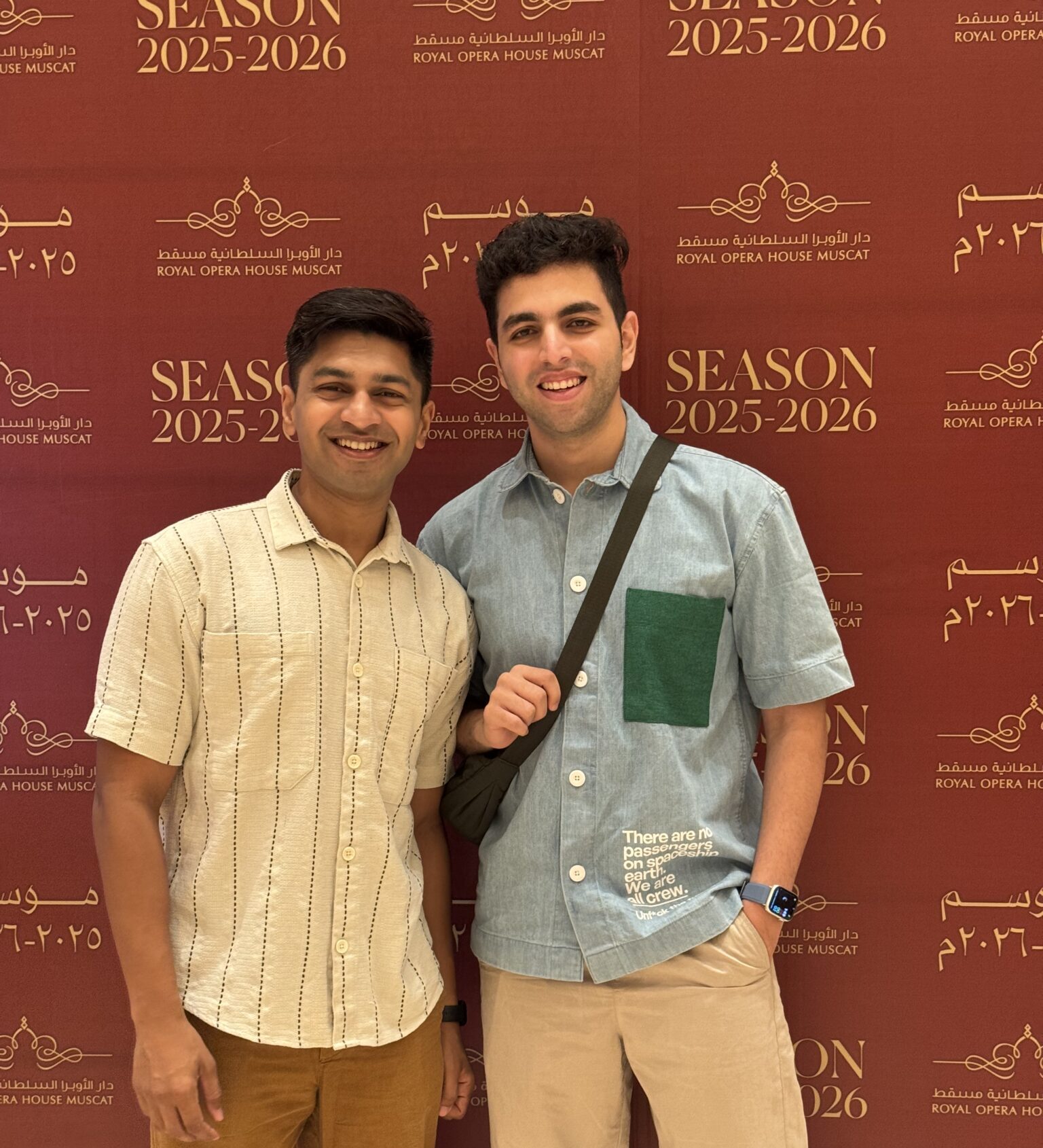

Oman was calm, organised, and quietly beautiful. Instead of glass skyscrapers, elegant low-rise buildings spread across the city, all respectfully shorter than the stunning Sultan Qaboos Grand Mosque that defines Muscat’s skyline.
The country is so sparsely populated that traffic congestion is rare. Roads are wide, clean, and impeccably maintained, and locals are warm, polite, and genuinely helpful. It’s incredibly safe, even late at night, you’ll see women walking alone on the beaches without a worry.
Oman isn’t really a walking country, though. Everyone drives, and distances can be long, especially in the heat. For most of the year, it’s extremely hot, and only in November, December, and January does the weather turn pleasant enough to truly explore. Come during those months, and you’re rewarded with some of the most beautiful, well-preserved natural landscapes in the region: turquoise wadis, wild beaches, rugged mountains, and endless desert that feels straight out of a movie.
We were two friends who put together this Oman itinerary for Indians while travelling through Muscat and around in early December 2025. Here’s how our 5-day trip looked:
| Date | Day | When Awake | Night At |
| 29th Nov | Sat | Bus to Muscat, Self Drive & 5 star Comfort | Muscat |
| 30th Nov | Sun | Muscat City – Opera & Muttrah | Muscat |
| 1st Dec | Mon | Day Trip to Wadi Shab | Muscat |
| 2nd Dec | Tue | Trip to Nizwa & Across the Ages Museum | Muscat |
| 3rd Dec | Wed | Sultan Qaboos Mosque & Fly Out |
Cost Breakup for 5D & 4N
| Amount (INR) | Comment | |
| Bus to Muscat from Dubai | 3,300 | 2400 DXB-MCT bus + 36 AED exit fees |
| Flight back to UAE | 7,500 | Salaam Air MCT-SHJ without check-in |
| Stay | 6,300 | 5-star was with points Took a very basic BNB |
| Food & Drinks | 11,000 | All 3 meals & snacks |
| Self-Drive Car | 9,000 | 7k for car + 2k for others |
| Entrances & Experiences | 3,500 | Opera, Museum, Muttrah Entrances & Wadi Shab Rentals |
| Visa, SIM, Insurance | 1,400 | Visa = free for US visa holders SIM = 1100 – Get Nomad Insurance ~340 |
| Total | 42,000 |
Oman Basics for First-Time Indian Travellers
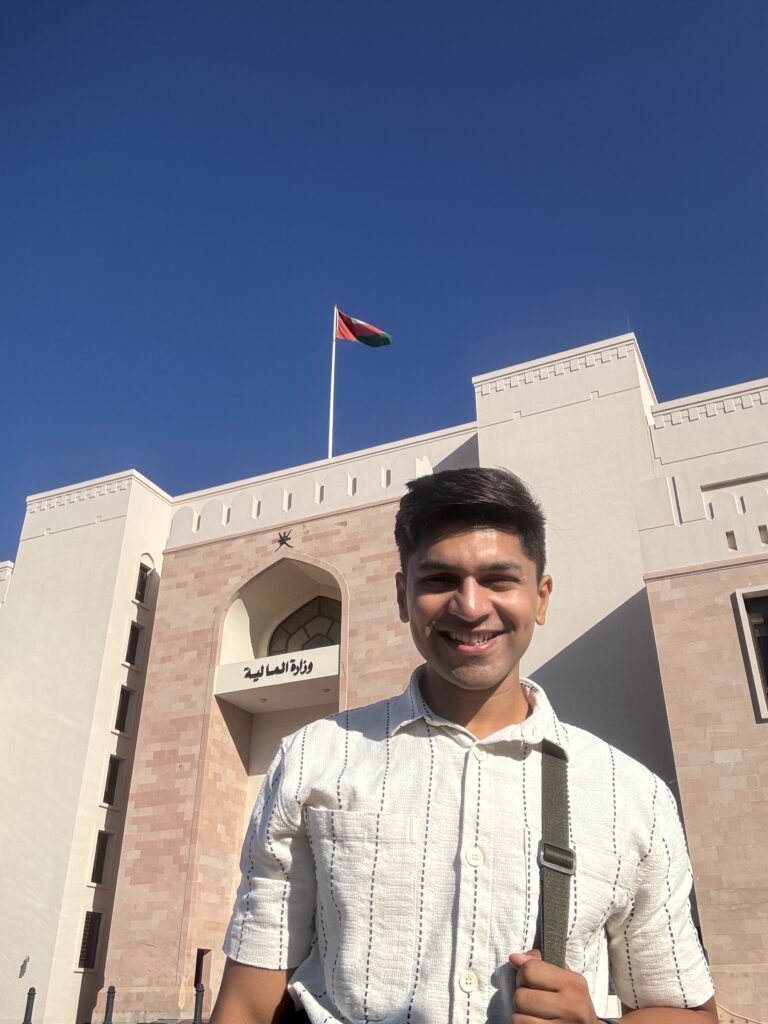
Oman is a stable absolute monarchy in Western Asia, officially the Sultanate of Oman, with Muscat as its capital. A large part of the country is desert and largely uninhabited, which is why cities feel spacious, quiet, and low-density rather than crowded.
Agriculture is limited and natural freshwater is scarce, but the country still offers striking natural diversity, from the wadis and beaches around Muscat to the lush, monsoon-kissed region of Salalah in the far south, a destination worthy of its own trip, though we didn’t cover it this time.
Currency and Language
The official currency is the Omani rial (OMR), one of the highest-valued currencies in the world at roughly ₹240 for 1 OMR, ranking just behind the Kuwaiti dinar and Bahraini dinar. That said, on a purchasing-power level, everyday costs are still lower than Dubai.
Arabic is the official language, but English is widely spoken and works perfectly fine in hotels, restaurants, and shops. The country is extremely card-friendly, you can tap your card almost everywhere, from small kiosks to big stores, and many places around Muscat also accept UAE dirhams alongside rials.
Culture and Safety
Culturally, Oman is a conservative Islamic monarchy, but enforcement on tourists is relatively relaxed. In government buildings, museums, and mosques, everyone is expected to cover shoulders and knees, regardless of gender. At wadis, beaches, and places like Wadi Shab or Sur, though, regular swimwear is fine, including for women.
The country feels very safe, including for solo women; it’s normal to see women walking alone on seafronts late at night. Crime rates are low, and people are generally polite and helpful.
The Skyline and Daily Life
Unlike the UAE, Oman consciously avoided the skyscraper race. The skyline is dominated by low-rise, sand-coloured buildings, all kept below the height of the main minaret of the Sultan Qaboos Grand Mosque, whose 90-91.5 metre minaret is still the tallest structure of its kind in the country.
You’ll see strong Omani cultural identity in daily life, men in traditional dishdasha robes and kumma caps, local women mostly with covered heads but moving freely, studying, working, and driving. Meat consumption is high, yet vegetarian dishes and a few dedicated veg-friendly restaurants can still be found in most urban areas.
Getting Around
Oman is made for driving: wide, perfectly surfaced highways, clear signage, almost no traffic, and dramatic scenery everywhere, from the rugged Hajar mountains to empty desert and long, clean seafronts. It’s not a walking country, and public transport is limited, so nearly everyone self-drives.
Getting There and Visa Rules
From India, Oman is extremely well connected, with Oman Air, SalamAir, and several Indian carriers flying from major cities, and Muscat serving as a hub further into Asia, Europe, and Africa. As of 2026, Indian travellers generally need to apply for an e-visa in advance, though there are visa-on-arrival or fee exemptions if you hold certain GCC residencies or valid visas for the US, UK, or Schengen area.
5D 4N Oman Itinerary for Indians
Day 1- 29th Nov, Sat: Bus Border Crossing, 5-Star Luxury & Welcome to Muscat
Oman and the UAE may be neighbours, but crossing between them by road feels like entering a completely different pace of life.
Catching the Dubai-Muscat Bus
On 29th November, we woke up painfully early in Dubai to catch the 7 am Al Khanjry Transport bus from their Deira office. Check-in starts an hour before, so we reached before 6 am to find a few passengers already waiting outside. The office doors opened at six sharp, and everyone queued up to check in their tickets.
At the time, Al Khanjry was the only operator running buses between Dubai and Muscat, with three departures daily in each direction, and no real online booking system, you had to physically go to their office to buy or pre-book tickets. Showing up on the day is possible too, but availability becomes a bit of a gamble.
The bus itself has very Indian semi-sleeper vibes: basic but comfortable enough, nothing fancy and nothing shabby. The ticket costs 100 AED one way, plus a 36 AED UAE exit fee charged per passenger when leaving by land. Al Khanjry collects this fee at check-in (cash only) and pays it in bulk on behalf of all passengers. Around 7-7:30 am, we rolled out of Dubai with our luggage stacked in the undercarriage, settling in for an 8-hour journey.
Crossing the Border
After about 3.5-4 hours, we reached the UAE-Oman border. Everyone gets off for UAE exit immigration first, then re-boards and continues a short distance to Oman immigration. Once passports are stamped, it’s on to customs: bags unloaded, run through scanners, and declared if needed. The whole process takes roughly an hour.
Somewhere after this stretch, the bus stops at a small roadside café for a 15-20 minute break. Vegetarian options were limited to a sandwich and maybe a basic burger, everything else was meat. They accepted both dirhams and rials, so paying was easy.
Arriving in Muscat
From the border, it’s another 3-4 hours to Muscat, with the bus dropping passengers at multiple points across the city. We needed to pick up our self-drive car from Muscat Airport and then head to our hotel, the JW Marriott, booked with Bonvoy points. So we got off at the stop closest to the airport and were immediately surrounded by local taxi drivers quoting fixed “airport drop” prices.
Oman doesn’t really have Uber, Grab, or Careem; the main app that works is Yango, an international taxi service. We downloaded it on the spot and booked a cab, which turned out much cheaper than the unofficial quotes. Within 2-3 minutes, our taxi arrived and took us to the airport.
Picking Up the Self-Drive Car
Car rentals are based at Arrivals. We’d pre-booked via Skyscanner with Dollar Car Rental, and their counter already had our reservation ready. I was asked for my Indian driving licence (in English) and a credit card (Visa or Mastercard) in my own name, against which they placed a hold of about ₹50,000 as a security deposit for any traffic fines or damage, not a charge, just a block.
Some sources online mention needing an International Driving Permit, but in our case, no one asked for it; the regular Indian licence was accepted. After signing a few papers and paying the airport car-park exit fee of around 5.25 OMR, we were handed the keys.
We’d booked the cheapest option and got a Nissan Sunny, automatic. A staff member walked us to the self-drive parking area, showed us the car, and we did the usual checks: a quick video of the exterior, fuel level (full-to-full policy), odometer reading, and boot space. Oman drives on the right-hand side, and honestly, it’s a dream: great roads, clear markings, disciplined traffic. Stick to your lane, follow Google Maps, and respect speed limits, and it’s very manageable even for a first-time Indian driver there.
Settling In
We drove straight to the JW Marriott for check-in. Since my friend is an Ambassador-level Bonvoy member, we had access to their evening meal spread starting around 4 pm, a welcome late lunch after a long bus and border day. The food was genuinely good.
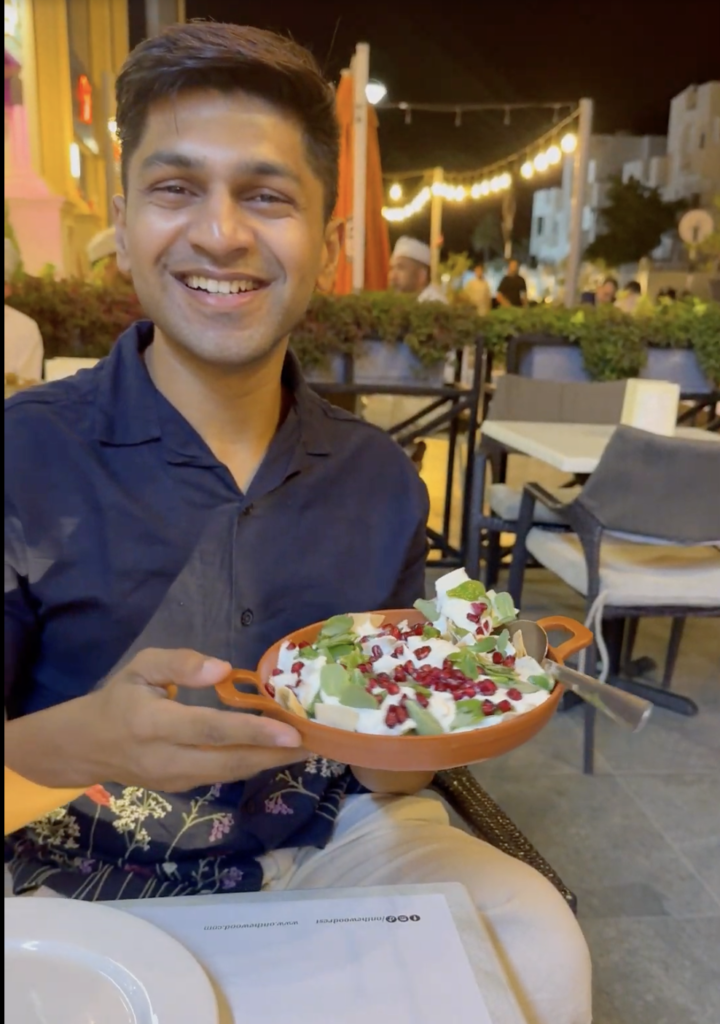
That evening, the plan was sunset at Al Qurum beach, but we arrived a little late. The area was still lovely regardless, wide promenades, beachfront cafés, a calm atmosphere. With the car giving us full freedom to roam, we settled on Melenzane, an Italian restaurant in Qurum. The food was excellent, easily a must-visit in Muscat if you enjoy Italian. A short beach stroll followed before heading back to the JW for the night.
Day 1 summary: bus, border, first self-drive pickup, a points-funded luxury stay, and a soft introduction to Muscat’s slow, peaceful rhythm.
Day 2- 30th Nov, Sun: Muscat City- Opera, Old Town & Souqs
Royal Opera House Muscat
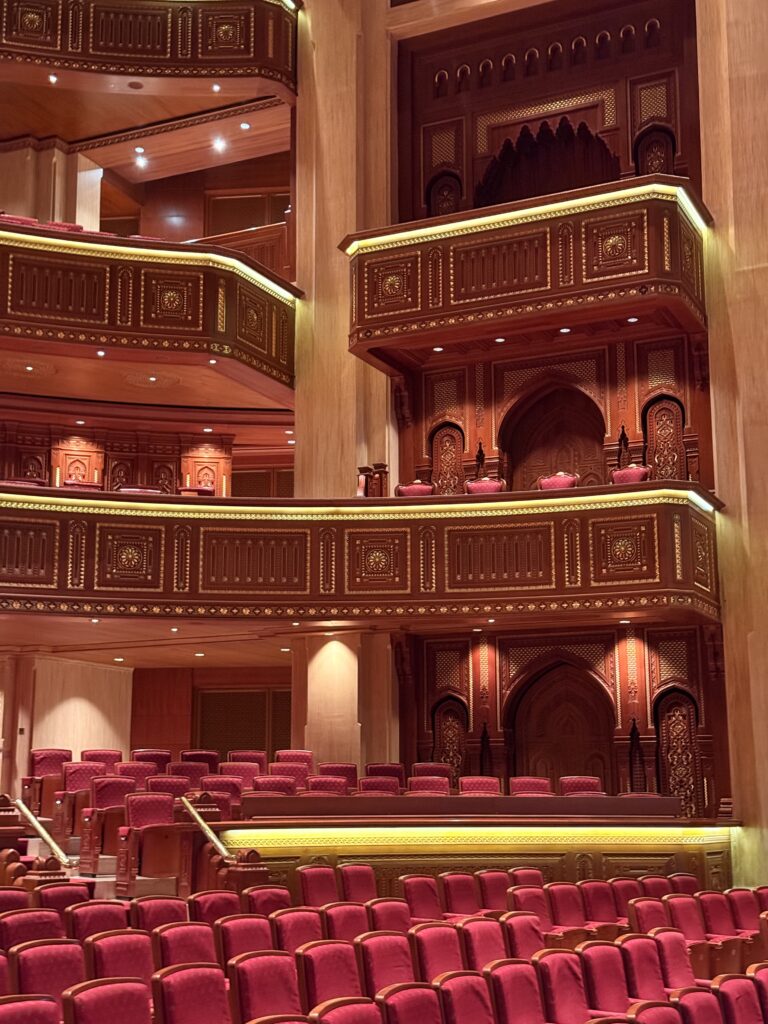
We let ourselves sleep in a little and started the morning slowly. Our first real stop was the Royal Opera House Muscat, and it set the tone for how polished and elegant Oman can be. For about 3.15 OMR per person, you get a short guided tour of roughly 15 minutes, with groups going in every 15 minutes. We bought tickets on the spot and waited just a couple of minutes.
A guide walked us through the main areas, the architecture, the royal family’s entrance, and a small but very fancy “room-lift” used to take VIPs up a level. Inside, the main auditorium is stunning: plush seating, multiple galleries, and a stage that can be resized based on the show. The Opera hosts world-class performances year-round, bookable online, though sadly the next show during our visit fell three days after we were leaving. Like most opera houses, there’s a strict dress code, formal shirts, trousers, proper shoes, so check the website in advance if you’re planning to catch a show.
National Museum Area and Bait Al Luban
After the Opera, we drove toward the National Museum area, a beautiful coastal drive with low-rise city blocks framed by rocky hills. We parked and walked around, but since we had another museum planned later in the trip, we skipped entry (about 5 OMR per adult) and focused on food instead.
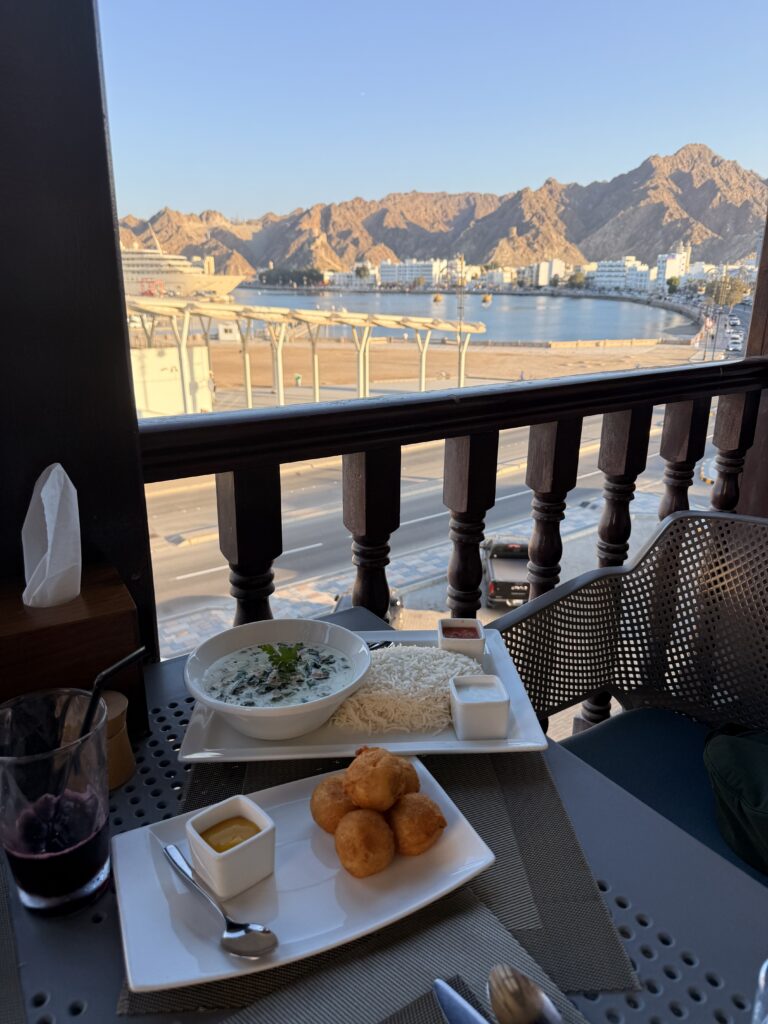
We headed to Bait Al Luban, a well-known Omani restaurant overlooking the Muttrah Corniche. The interiors felt distinctly local, and we were welcomed with a traditional Omani drink and, at the end, dates as a sort of dessert, similar to fennel or mishri back home. The menu is meat-heavy with a few vegetarian options. Nice experience, though not one I’d call a must-return spot on taste alone.
Muttrah Fort at Sunset
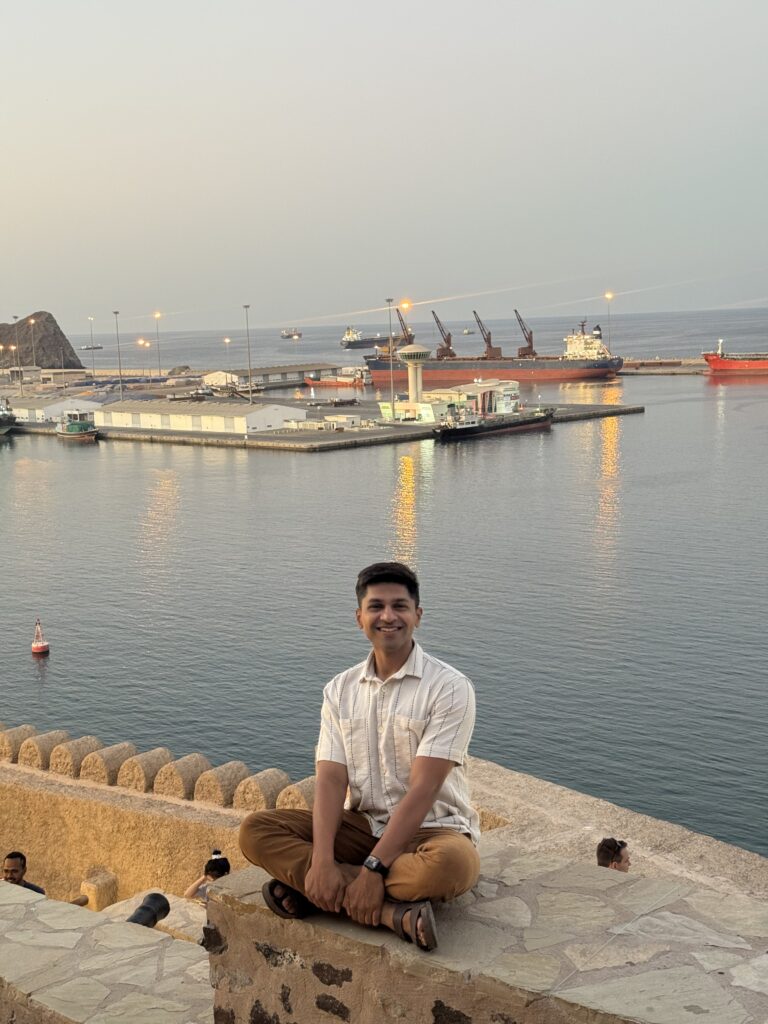
A short drive along the Corniche brought us to Muttrah Fort. The climb is short but steep in parts, a brief uphill path followed by stairs, maybe 5-10 minutes total. Entry was around 3.3 OMR per person. The fort itself is small, but absolutely worth it for sunset: fantastic views over the grey-white city, the harbour, and the surrounding hills, plus old cannons and terraces showing how the city was once defended. One of the best viewpoints in Muscat.
Muttrah Souq and Local Flavours
As it got dark, we descended into the Muttrah Souq. The air is thick with frankincense, and the lanes are packed with dates, perfumes, dry fruits, and Omani souvenirs. One thing that stood out: the number of Malayali Indians in Oman, Malayalam might genuinely be the second-most heard language after Arabic in Muscat. Many souq shopkeepers were Malayali, which made chatting and bargaining feel familiar and fun.
We then visited Diwaniah Halwa, which has outlets across Muscat. They follow a lovely tradition: around eight varieties of Omani halwa sit out for sampling all day, and anyone can walk in and taste before buying. We tried several and picked up some classic Omani halwa as gifts.
For dinner, we drove to Al Farah on the other side of town, having the car made these cross-city hops effortless. Pizzas and Lebanese dishes, decent but not exceptional. Then back to our stay in Al Qurum to call it a night.
Day 2 summary: Muscat’s polished modern side, its old harbour charm, and a first deep dive into Omani flavours and markets.
Day 3- 1st Dec, Mon: Wadi Shab- Aquamarine Pools & Cave Swim
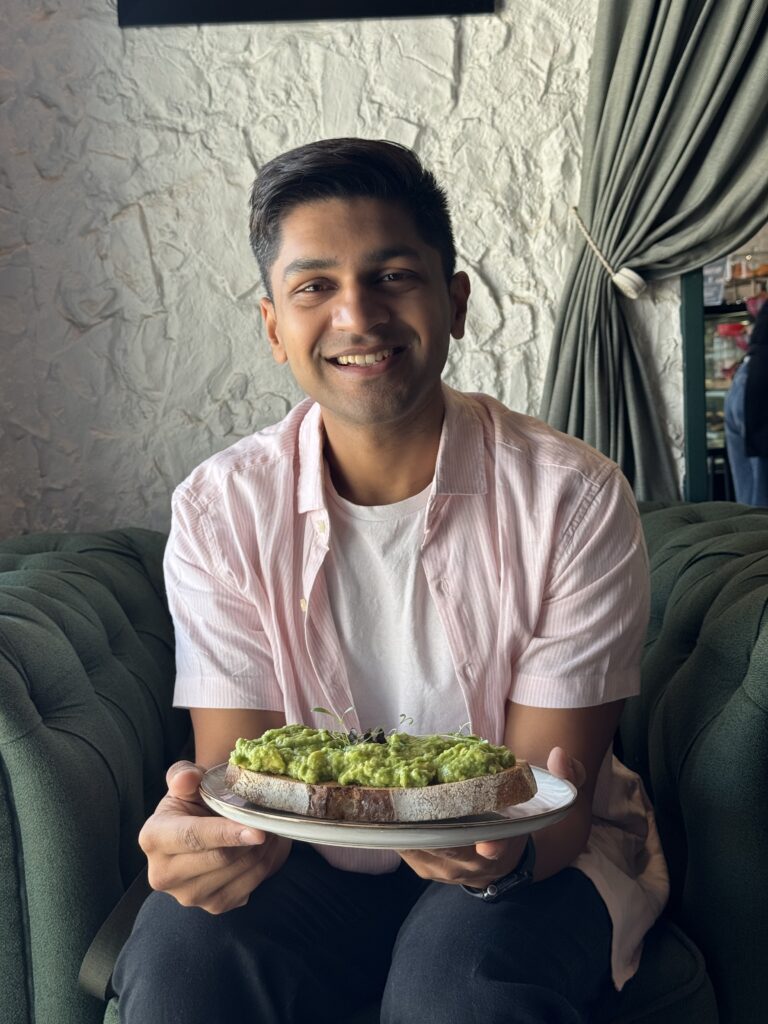
We dedicated Day 3 to Wadi Shab, about 150 km and roughly 1.5 hours from Muscat. After a slightly overpriced but decent breakfast of smoothies and avocado toast at Mackenzie, a modern Muscat café, we hit the road. The drive is stunning, mountains, sea, wide empty highways, but dotted with speed cameras every few hundred metres, most visible clearly on Google Maps. Oman is strict and expensive on speeding fines, so cruise control and discipline pay off.
Getting to the Trail
At Wadi Shab, a large parking lot buzzes with tourists. Entry is free; the only mandatory cost is the boat crossing at the start, a tiny 2-3 minute hop costing 1 OMR per person return, cash only. Vendors around the parking area rent everything you might need: life jackets in all sizes, water shoes, dry bags, and waterproof phone covers. Some accept cards, some don’t. The one time we actually needed cash in all of Oman was for the boatman, we paid our rental guy 2 extra rials by card, and he handed us the cash to give the boatman.
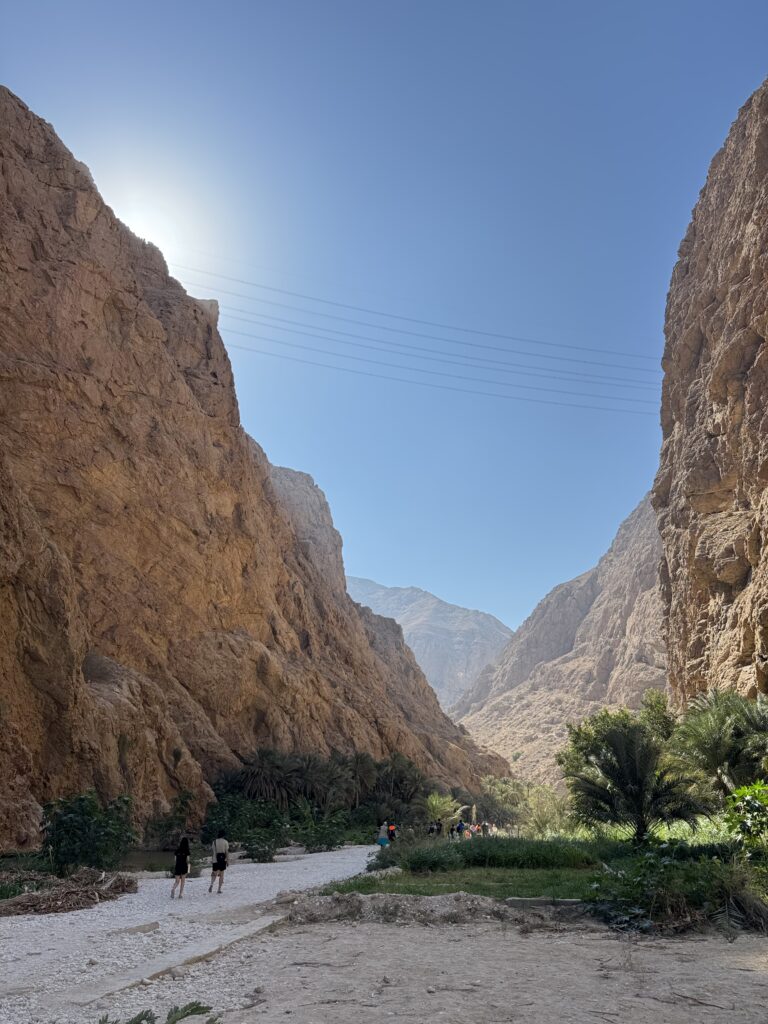
The Hike and Swim
Once across the water, the trail begins, mostly flat but rocky, walkable end-to-end in about 1-1.5 hours if you don’t stop. The path weaves between rocks, date palms, and sand, with multiple turquoise pools framed by red and white rock along the way, each one looking like a postcard. You can stop and swim in any of them. The water can get quite deep, so a life jacket is worth wearing even if you’re a confident swimmer, this is freshwater, far from shore, and the goal is to relax, not prove anything.
Roughly 75% of the route is walkable. For the last stretch, there’s no path, you swim from pool to pool to reach the final attraction: a hidden cave. Non-swimmers with life jackets can still manage this section since the water is calm and other visitors are usually around. Elderly travellers or those uncomfortable in deep water can treat the earlier pools as their turnaround point and still have a great day.
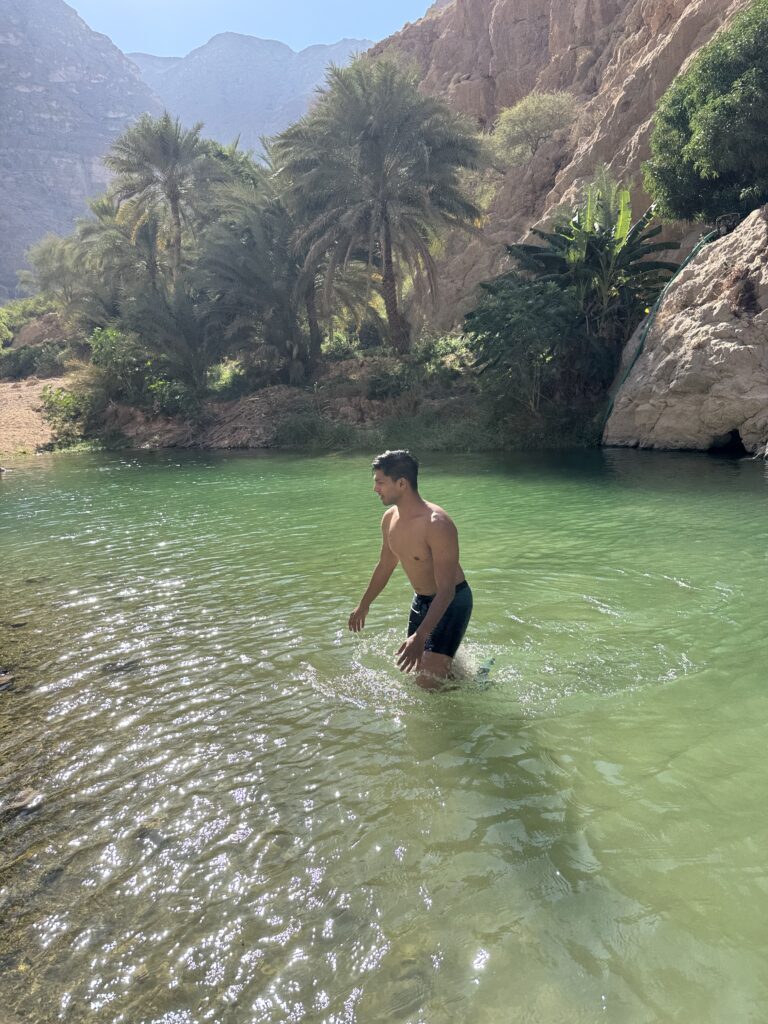
The Cave
Going all the way leads to a narrow rock opening in the cliff, the entrance to the cave pool. The gap is so small that at one point it’s barely as wide as your head, body in the water, only your face above the surface. A life jacket becomes essential here, there’s nothing to hold onto, and the space can get crowded. Inside, a beautiful enclosed pool with a small waterfall awaits, with the option to climb up beside it using carved footholds and ropes, then jump back down. This needs upper-body strength and comfort with heights, so it’s more for those into calisthenics or climbing than casual travellers.
One of the most magical moments comes on the way out: swimming back through the dark tunnel, light from outside flirts with the water, giving everything a surreal blue-grotto glow, as if lit from underneath.
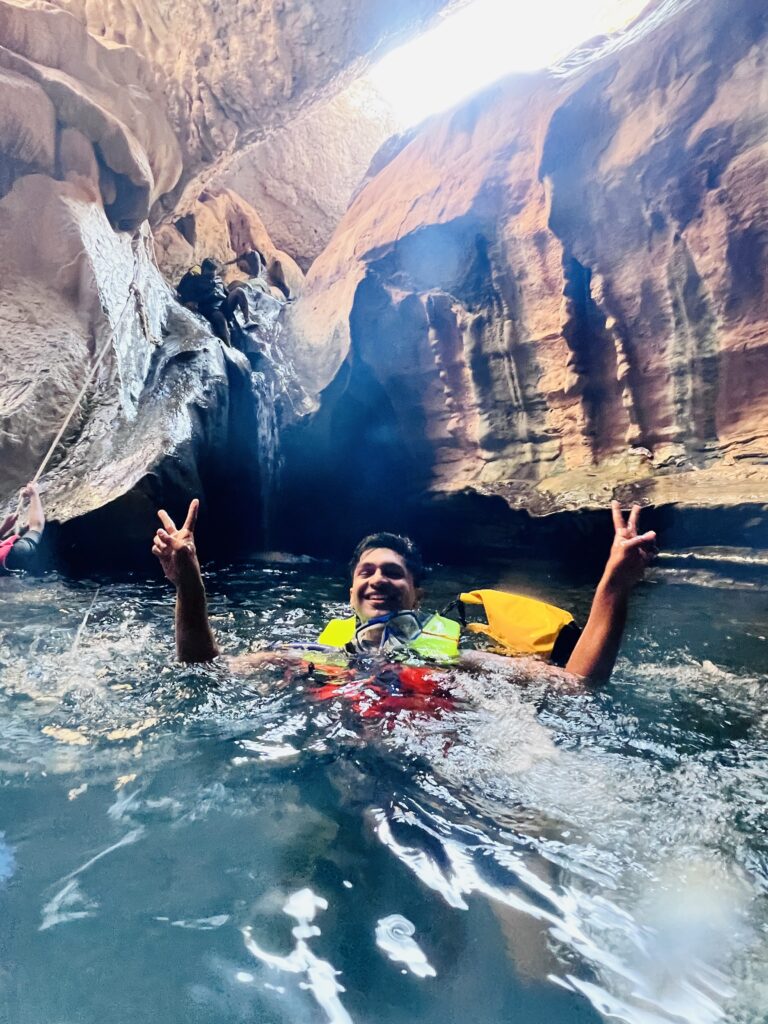
Heading Back
The last boats usually run till around 5-5:30 pm. We finished just in time, soaked and starving. There are basic prayer rooms and toilets, but no real changing rooms, so most people, us included, use towels and change discreetly near the car.
One important note: there are no proper restaurants right next to Wadi Shab. As vegetarians, we didn’t want to experiment while this hungry, so we drove straight back to Muscat to eat. If you’re going, carry snacks or plan your meals carefully.
Back in Muscat, we went to Annapoorna, a South Indian restaurant, for a late, hearty dinner, pav bhaji, dosa, uthappam, juices, exactly the comfort food this day called for. Tasty, vegetarian-friendly, and fairly pocket-friendly.
Day 4- 2nd Dec, Tue: Nizwa, Oman Across the Ages & A Fortified Old Town
Day 4 was another road-trip day, this time inland toward Nizwa, about 1 hour 40 minutes from Muscat on beautifully maintained highways cutting through rocky, desert landscapes. Just like the Wadi Shab road, speed cameras are frequent, so cruise control stays your best friend.
Breakfast at Dukanah Café
We started with a proper Omani breakfast at Dukanah Café in Muscat, a popular spot with a 15-20 minute wait when we arrived. The interiors mix traditional touches with earthen crockery, and it feels like a thoughtfully designed urban-cultural café. Worth the wait, easily the best breakfast of our trip.
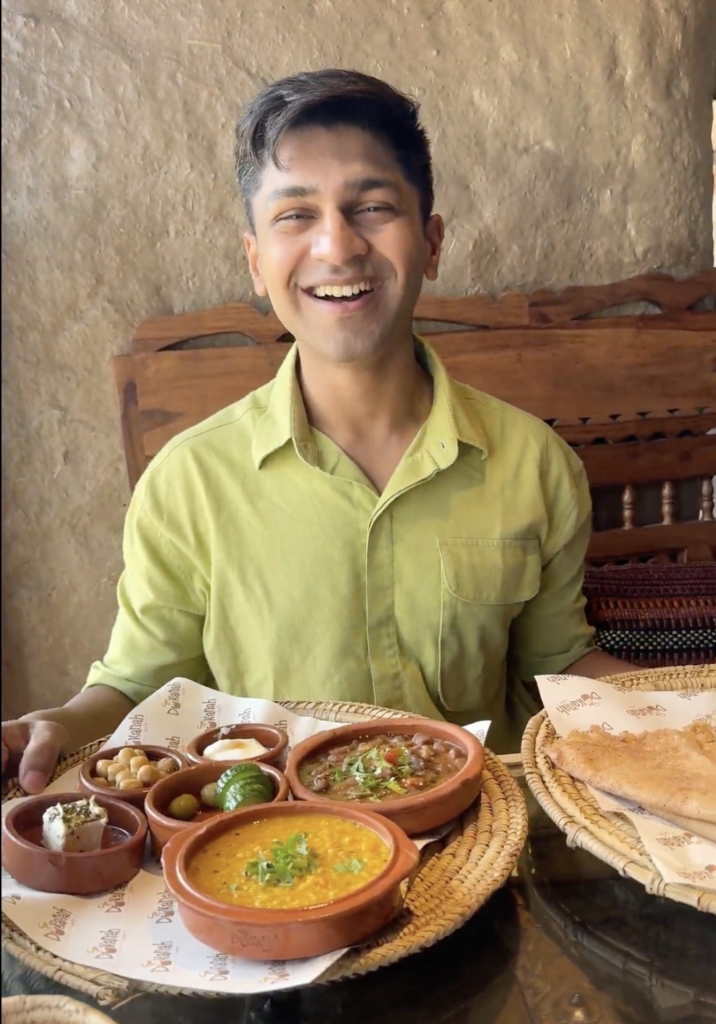
Oman Across the Ages Museum
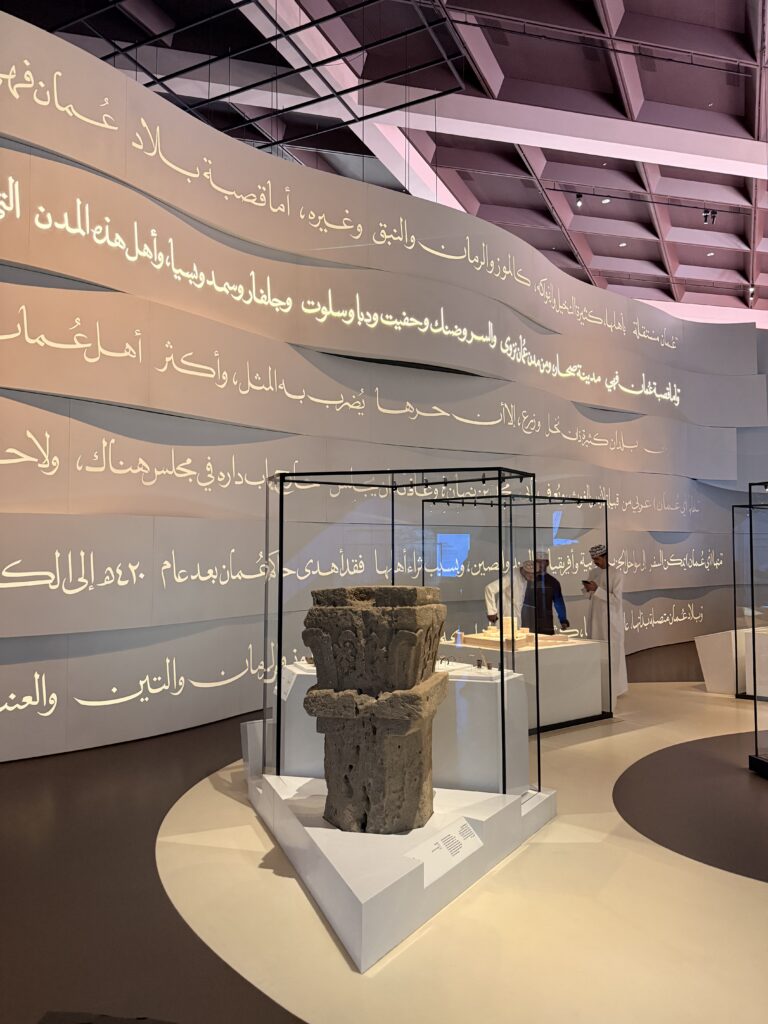
Our first big stop near Nizwa was the Oman Across the Ages Museum, about 15 minutes from Nizwa town and an absolute must-visit if you like history presented in a modern, creative way. The building itself is stunning from the outside, sleek and sculptural, worth photographing before you even go in. Parking, like most tourist sites in Oman, is free.
There’s a dress code I only realised at the gate. My shoulders were covered but I was in knee-length shorts, and security politely asked that knees be covered too. I adjusted my shorts lower and was let in. Lesson: for museums and official buildings in Oman, treat the dress code like a mosque, shoulders and knees covered, regardless of gender.
Entry is 5 OMR per adult. Inside, the narrative moves from prehistoric Oman through tribes and empires, the advent of Islam, the evolution of the monarchy, trade and seafaring, all the way to modern Oman’s future in technology and space. It’s not a read-the-boards museum, everything is interactive: transparent floor sections showing excavated layers, touch-triggered screens, floating books, immersive soundscapes. We spent just over an hour inside and could easily have stayed longer.
Exploring Nizwa Town
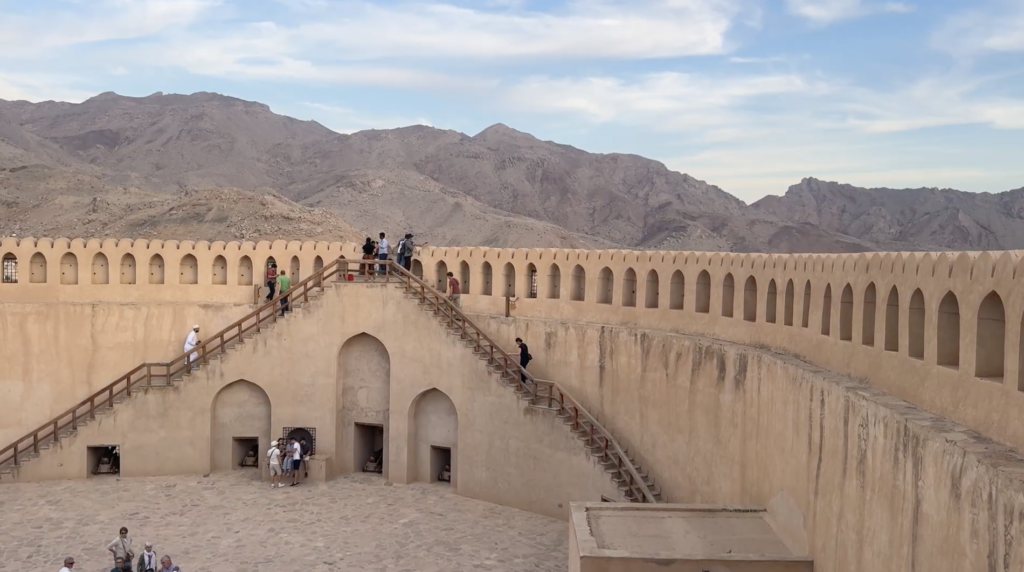
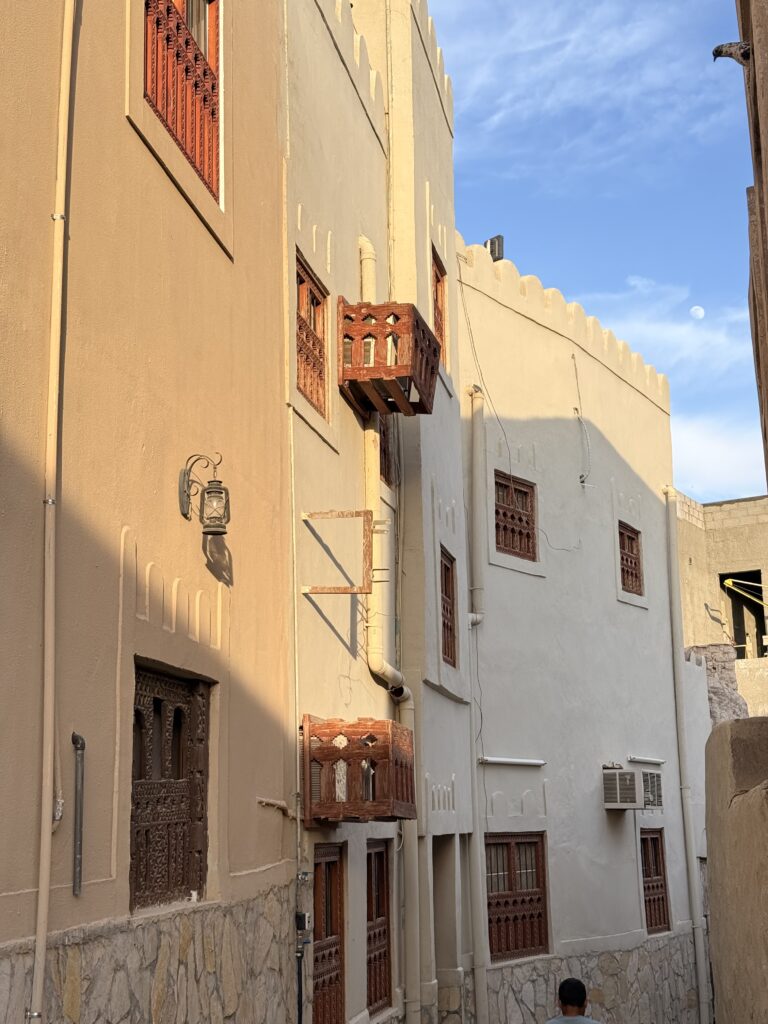
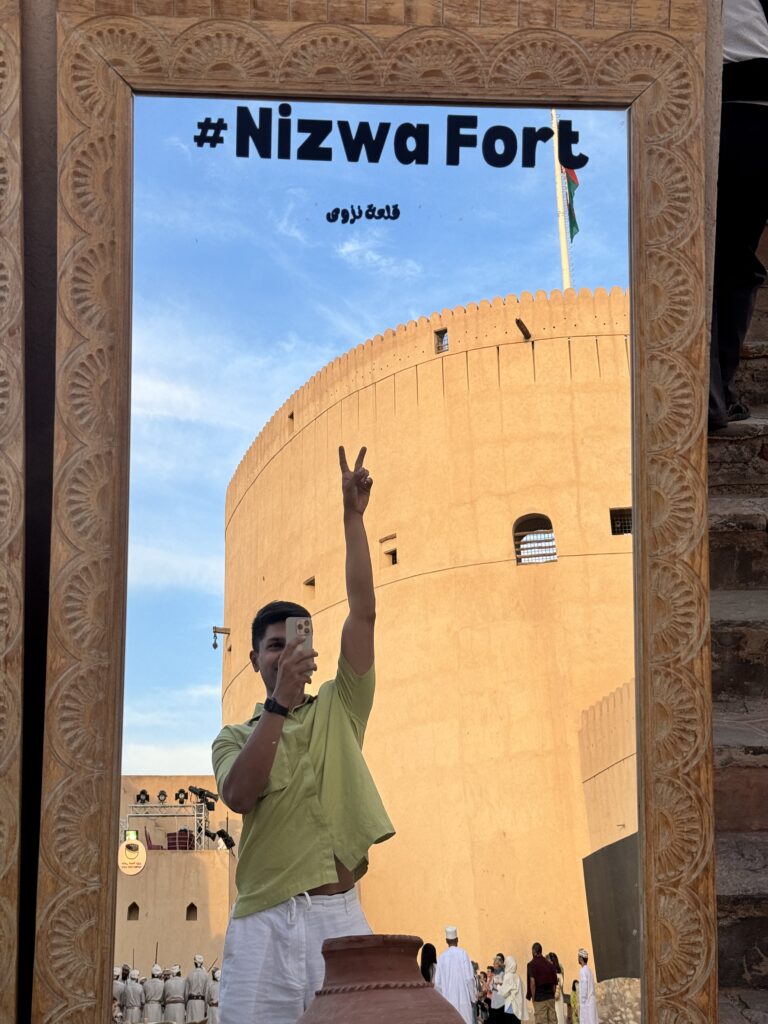
From there, we drove into Nizwa town, parked, and explored on foot. Nizwa feels very different from Muscat, more old-world, more compact, with traditional doors, low buildings, small shops, and cafés, anchored by Nizwa Fort.
Inside the fort, narrow staircases, trapdoors, and openings once used to pour hot oil on invaders tell the story of how the town defended itself. Multiple watchpoints overlook the town and palm groves, with small rooms once used by religious and military leaders. Not gigantic, but layered and atmospheric.
Nizwa carries the same generous food-sampling culture seen elsewhere in Oman, shops offering ten varieties of dates, honey, tea, and halwa to taste before buying. Inside the fort, a woman makes Omani paratha stuffed with chips, very local, very carb-heavy, very fun.
Back to Muscat for Dinner
As evening approached, Nizwa’s character shifted, dusty and golden before sunset, intimate and cosy after, with the fort lit up. Still, as vegetarians, we found Muscat’s food scene better suited to us, so we drove back, just under two hours on smooth, well-lit highways.
Dinner was at Pavo Real, a Latin American spot that sounded promising, tacos, nachos, enchiladas, but delivered the same tomato-based sauce with limited vegetarian creativity we’d experienced at similar restaurants before. Not terrible, just not memorable from a vegetarian standpoint.
Day 5- 3rd Dec, Wed: Sultan Qaboos Grand Mosque & Flying Out
Our last day was built around a perfect farewell before heading back to the UAE that evening.
Sultan Qaboos Grand Mosque
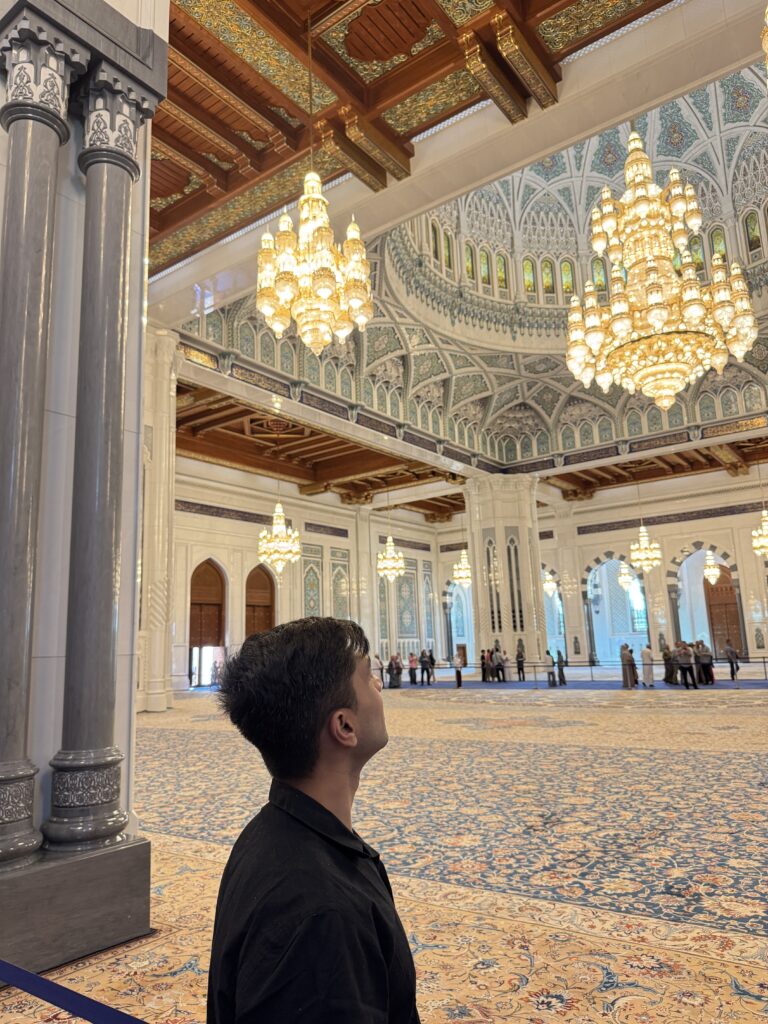
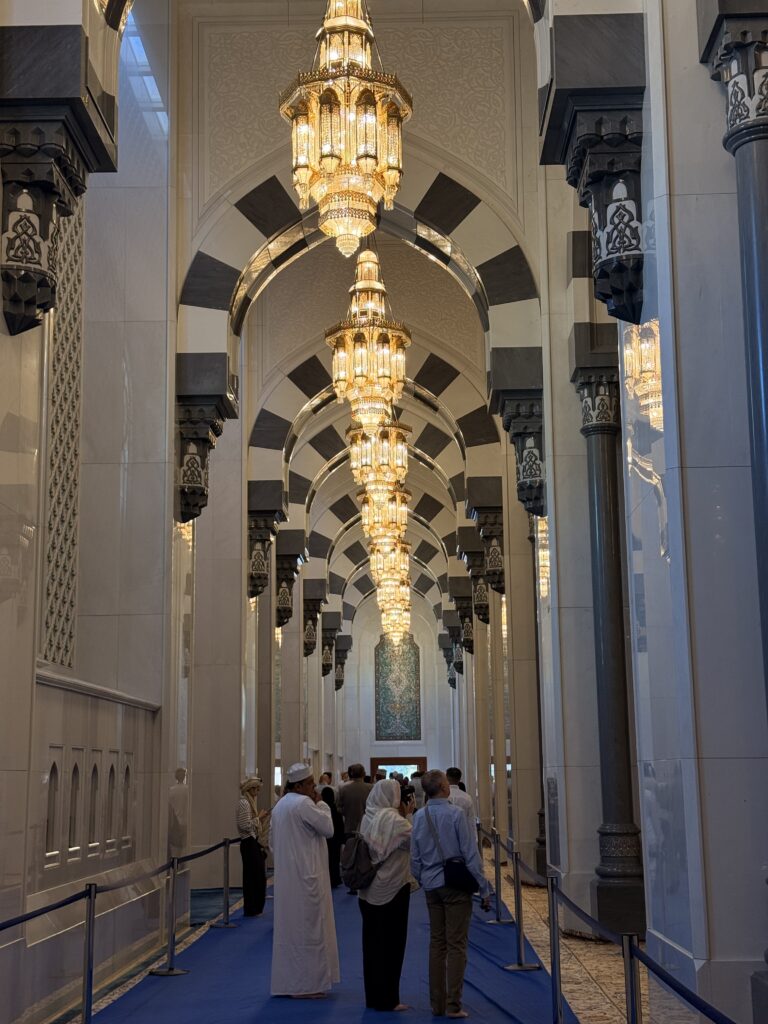
We started with the most iconic landmark in the country: the Sultan Qaboos Grand Mosque, the biggest and most beautiful mosque in Oman. Even from the highway, its white domes, minarets, and manicured lawns are visible. Once inside the complex, the symmetry and serenity are genuinely stunning.
Unlike many mosques open most of the day to tourists, this one allows non-Muslim visitors only between 8:30 am and 11:30 am, so plan accordingly. We went before breakfast, straight after checking out. No entry fee, ample free parking, and the standard modest dress code, shoulders and knees covered for everyone, heads covered with a scarf for women inside the main prayer hall.
We walked slowly through the courtyards, admiring the marble, stonework, arches, and colonnades, every angle photo-worthy. Inside the main prayer hall: enormous chandeliers, an intricately woven carpet, soaring ceilings, detailed glass and stone inlay. Grand and calming at once. We spent just over an hour exploring.
Returning the Car and the Best Lounge We’ve Seen
From the mosque, we headed to Muscat Airport to return the rental car. Our official return time was around 11 am, but the rental company was fine with us being 30-50 minutes late. We reached around 11:40, handed the car back after a quick check, and had no issues.

Both of us had international lounge access (a Diners Black card and a Visa card with lounge benefits, Priority Pass also works), and what followed was one of the biggest surprises of the trip: the Primeclass Lounge at Muscat Airport, easily the best airport lounge we’ve ever seen.
Live instrumental music through the day, three full buffet counters with plenty of vegetarian options, unlimited alcohol and soft drinks, huge sunlit seating areas, a dedicated kids’ area, private cabins, nine free sleeping rooms hotel-style, paid massage rooms, two conference rooms with a printer, massage chairs, clean showers, entry lockers, and even Xbox stations, billiards, and foosball. It felt less like a lounge and more like a mini airport hotel plus co-working space plus games room.
Eventually, it was time to board our SalamAir connecting flight back toward the UAE, closing out this Oman itinerary for Indians on a country of low skylines, wide empty roads, aqua wadis, and some of the kindest people we’ve met.
FAQ Section
Q: How many days do you need for an Oman itinerary?
5 days is enough for a solid Oman itinerary covering Muscat’s city sights, a day trip to Wadi Shab, and inland to Nizwa, without feeling rushed, especially with a self-drive car connecting each stop.
Q: Is self-driving in Oman easy for Indian travellers?
Yes. Oman drives on the right, roads are excellent, signage is clear, and an Indian driving licence is generally accepted without needing an International Driving Permit, though it’s worth confirming with your specific rental company.
Q: Do Indians need a visa for Oman?
Yes, most Indian travellers need to apply for an e-visa in advance, though visa-on-arrival or fee exemptions exist for holders of certain GCC residencies or valid US, UK, or Schengen visas.
Q: Is Wadi Shab difficult to hike, and do I need to know how to swim?
No swimming skills are required if you wear a life jacket. About 75% of the route is walkable, and non-swimmers can still reach the hidden cave pool with a life jacket on, though the final cave entrance is tight and best attempted by confident swimmers.
Q: Is Oman vegetarian-friendly?
Reasonably so. Vegetarian options exist at most restaurants, and cities like Muscat have dedicated vegetarian-friendly spots (including South Indian restaurants), though meat dominates most local menus.
Q: What’s the best time of year to visit Oman?
November, December, and January, when temperatures turn pleasant enough for outdoor activities like Wadi Shab and walking tours. The rest of the year is extremely hot.
End Note
Oman doesn’t try to impress you the way Dubai does, and that restraint is exactly the point. Low skylines, empty highways, and a pace of life that never once felt rushed made this one of the calmest trips either of us has taken in years.
Five days was enough to fall for Wadi Shab’s cave swim, Nizwa’s fortified old town, and a lounge that outdid the destination itself, but Salalah’s monsoon-kissed south is still sitting there for a return trip.
If you’re building your own Oman itinerary, keep the car, the roads alone make self-driving worth it, and budget one full day just for Wadi Shab. You won’t want to rush it.